Internal Revenue Manual § 3.12.32 - General Unpostables
3.12.32 General Unpostables
Manual Transmittal
September 04, 2025
Purpose
(1) This transmits revised IRM 3.12.32, Error Resolution - General Unpostables.
Material Changes
(1) Updates have been made throughout this IRM to reflect the changes in Filing Season Years.
(2) IRM 3.12.32.1.6(1) - Added additional terms to the List of acronyms and definitions.
(3) IRM 3.12.32.5.9(3) - Removed UPC 353, TC is 150 and MFT-CD is 67 from CATEGORY B1 CRITERIA (IMF/BMF/EPMF) table, to match the removal of "Reason Code" from the BMF Programming Requirements Package (PRP) per UWR 1008472.
(4) IRM 3.12.32.5.9.1(3) - Removed UPC 342 RC 9, TC is 290 from CATEGORY B3 CRITERIA (IMF/BMF/EPMF) table, per UWR 1008472.
(5) IRM 3.12.32.7 - Added information on erroneous referrals for the Form 4442, Inquiry Referral.
(6) IRM 3.12.32.13.2(1) - Added UPC 309 RC 1 to the URC D Auto-Closures per UWR 1008472.
(7) IRM 3.12.32.13.3(1) - Added UPC 313 RC 1 to URC 1 Auto-Closures per UWR 1008472.
(8) IRM 3.12.32.13.4 (1) - Updated the table URC 2 Auto-Closures to clarify transaction codes for unpostable conditions per UWR 1008472.
(9) IRM 3.12.32.13.6 - Updated the Table identifying the unpostable conditions that auto-closed using URC 8 (IRWorks Incident INC02468701 and INC02228175)
(10) Various editorial changes have been made throughout this IRM and IRM links, references and formatting has been corrected and revised as appropriate without changing any substantive content or its meaning.
Effect on Other Documents
This supersedes IRM 3.12.32 dated November 25, 2024 (effective January 1, 2025).
Audience
Taxpayer Services (TS) Employees, Tax Exempt and Government Entities (TE/GE) Employees, Large Business and International (LB&I) and Small Business/Self Employed (SB/SE) Employees.
Effective Date
(01-01-2026)
Scott Wallace,
Director, Submission Processing
Taxpayer Services Division
3.12.32.1 (01-01-2025)
Program Scope and Objectives
-
Purpose: This IRM provides information and guidelines on how the Generalized Unpostable Framework (GUF) system processes unpostable transactions received from various Master Files.
-
Audience: The primary audience for this IRM is all IRS employees who use the GUF system and reports to manage, reassign, research, suspend, close, and/or review Individual Master File (IMF), Business Master File (BMF), Employee Plan Master File (EPMF), Payer Master File (PMF) or Combined Annual Wage Reporting (CAWR) unpostable cases.
-
Policy Owner: Director, Submission Processing.
-
Program Owner: Post Processing Section (An organization within Submission Processing, Specialty Branch).
-
Primary Stakeholders: All business units that use the GUF system to resolve unpostable transactions including but not limited to:
-
Submission Processing
-
Criminal Investigation
-
Small Business-Self Employed
-
Independent Office of Appeals
-
Tax Exempt and Government Entities
-
Accounts Management
-
Return Integrity and Compliance Services
-
Large Business and International
-
3.12.32.1.1 (01-01-2022)
Background
-
Some transactions, payments and returns cannot post to the master file due to programming checks for specific conditions. These conditions generate "unpostables" that may require review and resolution determination on the Generalized Unpostable Framework (GUF) system. This IRM:
-
Explains how transactions are organized and categorized within the GUF system.
-
Explains the functionality of the command codes used to resolve unpostables.
-
Provides specific details on the reports that generate during GUF processing.
-
3.12.32.1.2 (01-01-2025)
Authority
-
Internal Revenue Code (IRC) 6213(b), provides the authority for resolution of mathematical and clerical errors identified during processing of tax returns. Title 26 of the United States Code (USC) has been amended by acts, public laws, rules and regulations, such as the following :
-
Taxpayer Bill of Rights I and II
-
IRS Restructuring and Reform Act of 1998
-
Revenue Reconciliation Act of 1998 (RRA)
-
Affordable Care Act (ACA)
-
Patient Protection and Affordable Care Act (PPACA) as amended by the Health Care and Education Reconciliation Act of 2010 (HCERA)
-
Federal Tax Liens - Lien Release and Related Topics IRC 7432
-
Tax Reform Act of 2017
-
Tax Cuts and Job Act 2018
Note:
The above list may not be all inclusive of the various updates to the IRC.
-
-
Policy Statements for Submission Processing can be found in IRM 1.2.1.4, Policy Statements for Submission Processing Activities.
3.12.32.1.3 (01-01-2021)
Roles and Responsibilities
-
The Director of Submission Processing monitors performance and policy related to this IRM.
-
The Campus Director monitors operational performance for the Submission Processing campus.
-
The Operations Manager monitors operational performance for their operation.
-
The Team Manager/Lead monitors and ensures employees have the tools to perform their duties.
-
The Tax Examiners working the Generalized Unpostable Framework (GUF) system follow the procedures and guidelines contained in this IRM.
3.12.32.1.4 (01-01-2023)
Program Management and Review
-
The information in this IRM applies to all GUF processing for all the following programs :
-
Individual Master File (IMF)
-
Business Master File (BMF)
-
Employee Plan Master Plan (EPMF)
-
Combined Annual Wage Reporting (CAWR)
-
Payer Master File (PMF)
-
-
The Generalized Unpostable Framework (GUF) program is managed through updates to programming based on feedback from employees working the program and legislation changes. Updates to the programming are requested through Unified Work Requests (UWRs) and tested in applications development. Once programming is implemented, the GUF system updates are monitored by program owners and employees utilizing the GUF system. Issues with the GUF system are elevated and tickets are input to correct programming when applicable.
-
The GUF system generates a variety of reports used for program management and review and can be found on the Control-D application. The reports detail the following:
-
Assigning and monitoring workloads - Weekly report generated for monitoring of workload and assignment.
-
Reassignment of workload - Daily reports generated to identify any changes of assignment by employee or area.
-
Case resolution - Weekly reports generated to display the type of closure for each GUF transaction.
-
Identifying trends in the types of transactions that unpost - Weekly reports display cumulative (CUM) data of generated unpostables or repeat unpostables generated at the campuses.
-
Maintaining an audit trail for closed cases - Weekly reports to display weekly and CUM closure actions of each unpostable transaction.
-
3.12.32.1.5 (01-01-2022)
Program Controls
-
Campuses coordinate with Headquarters at the beginning of each year to verify the programming of the Generalized Unpostable Framework (GUF) system is functional and validate the changes requested are implemented and programmed correctly. Sites review printed reports, test command codes and test resolutions of sample cases of each master file.
-
Campuses monitor reports weekly for anomalies in the GUF system programming and elevate issues as needed. Headquarter analysts work with the Information Technology (IT) analysts to determine if additional action is needed to correct issues elevated. If needed, a ticket or a work request will be submitted to IT to update programming for the GUF system.
3.12.32.1.6 (01-01-2026)
Terms, Definitions and Acronyms
-
The table lists commonly used acronyms, terms and their definitions.
Acronym/Term Definition AMS Accounts Management System CAWR Combined Annual Wage Reporting CC Command Code CCC Computer Condition Code DLN Document Locator Number EIN Employer Identification Number EPMF Employee Plans Master File EFPPS Electronic Federal Payment Posting System EFTPS Electronic Federal Tax Payment System GUF Generalized Unpostable Framework IDRS Integrated Data Retrieval System IDRS employee number A 10-digit Employee Security File identification number assigned to each IDRS user IRM Internal Revenue Manual IRPTR Information Returns Transcript File online IRS Internal Revenue Service IRRP Information Return Review Portal IRSN Internal Revenue Service Number ITIN Individual Taxpayer Identification Number LB&I Large Business and International MEF Modernized Electronic Filing MFT Master File Tax Account Code NAP National Account Profile NC Name Control OFP Organization, Function and Program PN Pending PMF Payer Master File P&A Planning & Analysis QR Quality Review RTR Remittance Transaction Research System SSN Social Security Number SB/SE Small Business Self Employed SCUPMF Service Center Unpostable Master File TAS Taxpayer Advocate Service TS Taxpayer Services TIN Taxpayer Identification Number TEGE Tax-Exempt Government Entities TC Transaction Code UPC Unpostable Code URC Unpostable Resolution Code
3.12.32.1.7 (01-01-2021)
Related Resources
-
Related resources include:
-
IRM 3.12.37, IMF General Instructions
-
IRM 3.12.38, BMF General Instructions
-
IRM 3.12.166, EPMF Unpostables
-
IRM 3.12.179, Individual Master File (IMF), Payer Master File (PMF) Unpostable Resolution
-
IRM 3.12.278, Exempt Organization Unpostable Resolution
-
IRM 3.12.279, BMF/CAWR/PMF Unpostable Resolution
-
IRM 3.13.122, Individual Master File (IMF) Entity Control Unpostables
-
IRM 3.13.222, BMF Entity Unpostables Correction Procedures
-
IRM 25.6.1, Statute of Limitations Processes and Procedures
-
IRM 2.3.37, Command Code UPTIN for the GUF System
-
IRM 2.3.48, Command Code UPDIS for the GUF System
-
IDRS Command Code Job Aid
-
3.12.32.2 (01-01-2025)
IRM Deviations
-
Service center directors, headquarter branch chiefs, and headquarter analysts do not have the authority to approve deviations from IRM procedures. Any request for an exception or deviation to an IRM procedure must be elevated through proper channels for executive approval. This ensures other functional areas are not adversely affected by the change, and it does not result in disparate treatment of taxpayers.
-
See specific guidelines in IRM 1.11.2, Internal Management Documents System, Internal Revenue Manual (IRM) Process. Submit IRM deviation requests in writing, following instructions in IRM 1.11.2.2.3 , When Procedures Deviate from the IRM. The Field Director must sign the request. Submit the request through the headquarters IRM Coordinator for executive level program owner review and approval. Deviations may begin after the request is approved.
3.12.32.3 (01-01-2023)
Cycles and Unpostable Processing Time Frames
-
The development and implementation of the Customer Account Data Engine (CADE) 2 system accelerated the following cycles and impact Unpostables:
-
Campus Cycle: Thursday - Wednesday
-
Master File Processing: Friday - Thursday
-
Unpostables: New available Tuesday; Closing Tuesday
Note:
Opening and Closing runs are delayed one day when Monday is a Federal Holiday.
-
-
New and repeat unpostables are available to work on Tuesday morning. The Generalized Unpostable Framework (GUF) system closing run occurs Tuesday evenings.
Note:
This applies to all Master Files.
-
Individual Master File (IMF) processes and posts specific transactions daily. Unpostables generate each day of the cycle. However, GUF cycles run weekly. Unpostables for all five days of the IMF cycle are marked for GUF to locate for opening runs beginning on Mondays.
-
Unpostable transactions may be resolved by subsequent transactions.
-
IMF does not re-analyze the account at the end of the cycle to determine if the unpostable condition is resolved.
-
GUF 07 reports are updated to contain multiple IMF data rows for each day of the production cycle.
-
Day five transactions include the last day of cycle unpostables as well as all weekly account unpostables.
Note:
Business Master File (BMF) processes weekly and creates one unpostable file for GUF for the Monday opening run.
-
-
Not all transactions or accounts post in IMF daily. Transactions or accounts marked as weekly resequence until Master File processes the end of the cycle on Thursday.
Note:
BMF processes weekly.
-
Corporate Files Online (CFOL) Command Codes contain indicators on the screen to identify whether the IMF account is a daily account or a weekly account.
-
IMF transactions posting time frames are outlined as follows in the If/Then table below:
If... Then... A. Daily transaction is directed to a daily account * Transactions are viewable using CFOL command codes the second day after campus input. * Transactions are viewable on Integrated Data Retrieval System (IDRS) command codes the third day after campus input. B. Weekly transaction directed to a daily account Transaction posts with the weekly processing run on Thursday which may change the account type to weekly. C. Daily and weekly transactions directed to a weekly account Transaction posts with the weekly processing run on Thursday. D. Transactions with posting delay codes contains a value other than 0 Transactions will continue to resequence and will be held until the weekly processing on Thursday for the number of cycles equal to the value. Note:
For items b and c, transactions are viewable using CFOL command codes on the Saturday following the Thursday processing run. Transactions are viewable on IDRS command codes Monday following the Thursday processing run.
Example:
A transaction input with a posting delay code of "1" (one) processes on Thursday, and resequences until the following weekly processing day (the following Thursday). Use of the posting delay code on a daily account with daily transactions may result in delaying the posting of the transactions that would resolve the account.
-
See the following chart for BMF transaction posting time frames:
If... And... Then... A. Using CFOL Command Code Thursday Master File processing run BMF transaction is viewable on Saturday B. Using IDRS Command Code Thursday Master File processing run BMF transaction is viewable on Monday ### Note: With the acceleration of IDRS weekly analysis occurring the weekend directly after Master File processing on Thursday, transactions post Monday instead of in showing as pending status. -
IMF cycle posting dates reflect a format of "YYYYCCDD." "YYYY" indicates the year. "CC" indicates the posting cycle. For IMF transactions, the following values for "DD" can be found below:
If... Then... A. Friday "DD" value is 01 B. Monday "DD" value is 02 C. Tuesday "DD" value is 03 D. Wednesday "DD" value is 04 E. Thursday "DD" value is 05 -
BMF cycle posting reflect "YYYYCC." The "YYYY" indicates the year, and "CC" indicates the posting cycle. BMF cycle posting dates in TXMOD reflect a format of "YYYYCCDD." The "DD" value is 08.
-
IMF accelerated refund processing prevents a refund transaction code (TC 846) from posting by placing a refund hold to an account containing the following conditions:
-
Priority Refund Transcript criteria (Refund, Refund-E, Refund-S, $1M, and $10M) contains a TC 971 action code (AC) 805 and a TC 570 with blocking series "55555." The systemic hold expires 4 business days after the TC 971 AC 805 cycle posting date.
-
Specific CP notice issuance criteria (processed on Thursday) contains a TC 971 AC 804 and a TC 570 with blocking series "55555." The systemic hold expires 7 calendar days after the TC 971 AC 804 cycle posting date.
-
-
Due to the accelerated refund processing, Bureau of the Fiscal Service (BFS) does not accept NOREF or HAL requests for IMF refunds. Impacted functions use specific guidelines to address accounts with systemic refund holds instead of using NOREF.
-
For functions without specific guidelines to place holds on inventory, refer to IRM 3.14.1.7.1.1, IMF Notice Review, Refund Intercepts.
-
The BMF and EPMF did not change to daily processing or accelerated refund schedule issuance. BMF/EPMF accounts continue to use NOREF and/or HAL per existing guidelines.
3.12.32.4 (01-01-2024)
Category Code Identification and Criteria
-
General Category Information - The Generalized Unpostable Framework (GUF) system assigns a "category code" to every unpostable record for all Master Files: Individual Master File (IMF), Business Master File (BMF), Employee Plans Master File (EPMF), Exempt Organization Master File (EOMF), Payer Master File (PMF) and Combined Annual Wage Reporting (CAWR).
-
Category codes consist of unique two-digit alpha-numeric codes that identify the assigned area to work the unpostable case and determine when a Form 4251, Return Charge-Out automatically generates.
-
The case is automatically sorted for an AUTO, MASS, or INDIVIDUAL type closure if the case requires routing of unpostable document to the preparer, or another function.
-
When the case is an expedite and/or requires special handling, the sequence is sorted in order according to the recipient.
-
The following table lists the unpostable category codes, category names, primary processing areas and applicable Master File(s):
Category Code Category Name Primary Processing Area Master File A1 Criminal Investigation Criminal Investigation IMF, BMF, EPMF A6 Appeals Appeals IMF, BMF, EPMF B1 Entity Control Unpostables IMF, BMF, EPMF B3 Entity Control - Exempt Organization (EO) Unpostables BMF B4 Entity Control - EPMF Unpostables EPMF B5 Entity Control - 1120-S, 1065, or 1041 Unpostables BMF B6 Exempt Organization E-Post filings Unpostables EOMF C1 Statute Reject Batch Statutes IMF, BMF C2 Statute Close Batch Statutes IMF, BMF C3 Potential Statutes Unpostables IMF, BMF C5 Credit Interest Returns Unpostables IMF, BMF D3 Accounts Management - Close Batch Unpostables IMF, BMF ### Note: Category D3 should be worked as individual closures. E1 Examination Changes Examination IMF, BMF, EPMF E2 Examination Statutes Examination IMF, BMF, EPMF E3 Examination Close Batch Examination IMF, BMF, EPMF F1 Name Control Files Unpostables IMF, BMF, EPMF, PMF F3 Files Unpostables Unpostables IMF, BMF, EPMF, PMF G1 Electronic Federal Tax Payment System Transactions Unpostables BMF, IMF H1 Large Business and International Large Business International BMF I1 Identity Theft (IDT) Unpostables IMF I2 IDT - Return Integrity and Compliance Services (RICS) RICS (AMTAP on reports) IMF, BMF I4 IDT - Lock (No Filing Requirement) Unpostables IMF L1 Foreign Operations Unpostables IMF, BMF L3 All other transactions, no document Unpostables IMF, BMF, EPMF L5 All other transactions with documents Unpostables IMF, BMF, EPMF L7 Credit Transfers and Bad Checks Unpostables IMF, BMF P1 PMF - Generated Adjustments Unpostables PMF R1 Reject Batch Transactions Unpostables IMF, BMF, EPMF T1 IDT - Taxpayer Protection Program Return Integrity Compliance Services (AMTAP on reports) IMF V1 Batch Close, with documents Unpostables IMF, BMF, EPMF, PMF V3 Batch Close, no document Unpostables IMF, BMF, EPMF V5 Generated Transactions Unpostables IMF, BMF, EPMF V6 Information Return Document Matching - Generated Transactions Unpostables IMF, BMF V7 Centralized Authorization File Unpostables EPMF V8 CAWR Unpostables CAWR W1 Records with Transcripts Unpostables BMF W3 Documents and Transcripts Unpostables BMF W5 Retention Register Microfilm Unpostables IMF, BMF Y1 With-Remittance (ISRP/RPS) Batch Unpostables IMF, BMF Y2 With-Remittance (ISRP/RPS) Prior Unpostables IMF, BMF Z1 Bankruptcy Unpostables IMF, BMF
3.12.32.4.1 (01-01-2024)
Policy for Establishing a Category Code
-
The Generalized Unpostable Framework (GUF) system assigns each unpostable transaction a category code based on the first category condition it satisfies after analyzing the following:
-
MF-UP-TYPE-CODE
-
UNPOSTABLE-CD
-
DOC-CD
-
TRANS-CD
-
BLOCK-NUM
-
GEN-TRANS-SOURCE-DOC-IND
-
INPUT-SYSTEM-SOURCE-CODE
-
MFT-CD
-
RPS-RETURNS-IND
-
MF-UP-REASON-CD
-
FILE-LOC-CD
-
-
The transaction’s category code cannot be changed once established. Unpostables do not have a subsequent category check, even if the unpostable case is reassigned to another area.
-
This category code sort sequence, which is different than the preceding alpha-numeric list in IRM 3.12.32.4, Category Code Identification and Criteria, determines which unpostable transactions belong in each category. The following table lists all the category codes in category sort sequence (priority) order:
Category Code Category Sort A1 Criminal Investigation A6 Appeals I1 Identity Theft (IDT) I2 IDT - Return Integrity and Compliance Services (RICS) I4 IDT - Lock (No Filing Requirement) T1 IDT - RICS Taxpayer Protection Program (TPP) Z2 Bankruptcy Freeze Z1 Bankruptcy C2 Statute Close Batch E2 Examination Statute C1 Statute Reject Batch C3 Potential Statutes G1 Electronic Federal Tax Payment System (EFTPS) Transactions P1 Payer Master File (PMF) Generated Transactions V6 Information Return Document Matching (IRDM) Generated Transactions V7 Centralized Authorization File (CAF) V8 Combined Annual Wage Reconciliation (CAWR) B4 Employee Plans Master File (EPMF) Unpostables B1 Entity Control B3 Exempt Organization B5 Entity Control - Master File Tax (MFT) 02, MFT 05 and MFT 06 unpostables - Form 1120S / Form 1065 / Form 1041 E1 Examination Changes E3 Examination Close Batch L7 Credit Transfers and Bad Checks D3 Adjustment Close Batch V5 Generated Transactions Y2 Remittance Processing With Remittance (ISRP/RPS) - Prior Year or Repeats Y1 Remittance Processing With Remittance (ISRP/RPS) Batch R1 Batch Reject Transactions C5 Credit Interest Return Transactions L1 Foreign Operations Transactions F1 Name Control - Files Research F3 Files Unpostables W5 Retention Register Microfilm V1 Batch Close with Documents V3 Batch Close No Document W3 Batch with Documents and Transcripts W1 Batch Transactions with Transcripts B6 Exempt Organization E-file L5 All Other Transactions with Documents H1 Large Business and International (LB&I) L3 All Other Transactions No Document
3.12.32.5 (01-01-2021)
Unpostable Category Code(s) - Specific Category Sort Details
-
The following subsections provide specific details for each processing area.
-
The specific details include the following:
-
Processing area
-
Closure Type
-
Category Criteria
-
Aging Criteria
-
3.12.32.5.1 (01-01-2022)
Criminal Investigation (CI) - A1
-
PROCESSING AREA: All unpostable records in the Criminal Investigation (CI) Category A1 are assigned to and closed by CI or Internal Security, Inspection-PSC using specific instructions provided by CI.
-
CLOSURE TYPE: Criminal Investigation A1 category is generally an individual closure.
-
CATEGORY A1 CRITERIA (IMF/BMF/EPMF):
-
Unpostable Code (UPC) is 183
-
UPC 309 Reason Code (RC) 2
-
UPC is 333
-
Transaction Code (TC) is 596, 910-912 or 914-919
-
or TC 016 and the Document Locator Number (DLN) block number is 700 through 799
Note:
The Area Office (AO) and various TC 91X information are part of CC UPCAS display.
-
-
Category A1 cases may involve statute, bankruptcy, or With-Remittance (ISRP/RPS) return issues, in addition to the CI issue. The CI function will resolve the following issues (as necessary) as part of the A1 case:
-
STATUTE - If IMF or BMF TC 150, 29X, 30X, or Doc-Code 17, 18, 24 or 48 with TC 170 or 200, and the assessment statute considerations.
-
BANKRUPTCY- If an IMF or BMF account/module and TC 520 with Closing Code 085 or 088 posted.
-
CREDIT INTEREST- An IMF or BMF refund return, involving a credit interest issue.
-
With-Remittance (ISRP/RPS) RETURN - If an IMF or BMF With-Remittance (ISRP/RPS) TC 150 and/or 610, then also involves With-Remittance (ISRP/RPS) processing considerations.
-
-
AGING CRITERIA: Category A1 unpostables age 10 cycles after the original unpostable cycle.
3.12.32.5.2 (01-01-2023)
Appeals - A6
-
PROCESSING AREA: All unpostable records in Appeals Category A6 are assigned to and closed by the Appeals Function using specific instructions provided by Appeals.
-
Form 4251, Return Charge-Out does not generate for Category A6.
-
CLOSURE TYPE: Appeals A6 category is generally an individual closure.
-
CATEGORY A6 CRITERIA (IMF/BMF/EPMF): Transactions with DOC-CD 47 and Blocking Series 70X, 78X and 79X.
-
AGING CRITERIA: Category A6 unpostables age 10 cycles after the original unpostable cycle.
3.12.32.5.3 (01-01-2024)
Identity Theft (IDT) - I1, I2, I4 and T1
-
PROCESSING AREA:
-
All unpostable records in Category I1 are assigned to and closed by the Submission Processing (SP) Unpostable function using IRM 3.12.179, Individual Master File (IMF), Payer Master File (PMF) Unpostable Resolution and IRM 3.28.4, Identity Theft Returns for Submission Processing.
-
All unpostable records in Identity Theft Category I2 are assigned to and closed by Return Integrity and Compliance Services (RICS), Return Integrity and Verification Operations (RIVO).
Note:
GUF reports label RICS as Accounts Management Taxpayer Assurance Program (AMTAP). Programming restrictions prevent the name on the reports to be updated to RICS/ RIVO.
-
All unpostable records in Identity Theft Category I4 are assigned to SP and closed by GUF Auto Closure programming.
-
-
CLOSURE TYPE:
-
Identity Theft I1 category is generally an individual closure.
-
Identity Theft I2 category is systemically closed by GUF.
-
Identity Theft I4 category is systemically closed by GUF.
-
-
CATEGORY I1 CRITERIA (IMF): UPC 147 RC 0; TC 150.
-
CATEGORY I2 CRITERIA (IMF):
-
UPC 194 RC 3 with TC 971 AC 5XX
-
UPC 368 RC 1 with TC 971 AC 712/713
-
-
CATEGORY I4 CRITERIA (IMF): UPC 147 RC 4; TC 150.
-
AGING CRITERIA: Category I1, I2, and I4 unpostables age 10 cycles after the original unpostable cycle.
-
Criteria for unpostables in the IDT Category T1 is found in subsection, IRM 3.12.32.5.3.1, Identity Theft Taxpayer Protection Program (TPP) - T1.
3.12.32.5.3.1 (01-01-2021)
Identity Theft Taxpayer Protection Program (TPP) - T1
-
PROCESSING AREA: All unpostable records in RICS Category T1 are assigned to and closed by RICS/RIVO using specific instructions provided by Return Integrity and Verification.
-
CLOSURE TYPE: Category T1 unpostables are closed based on the unpostable code:
-
UPC 126 RC 0 is generally an individual closure.
-
UPC 126 RC 1 is systemically closed by GUF.
-
-
CATEGORY T1 CRITERIA (IMF):
-
UPC 126 RC 0
-
UPC 126 RC 1
-
-
AGING CRITERIA: Category T1 unpostables age 10 cycles after the original unpostable cycle.
3.12.32.5.4 (01-01-2021)
Bankruptcy - Z1 and Z2
-
PROCESSING AREA: All unpostable records in Category Z1 are directly assigned to and worked by SP unpostables using IRM 3.12.179, Individual Master File (IMF), Payer Master File (PMF) Unpostable Resolution and IRM 3.12.279, BMF/CAWR/PMF Unpostable Resolution.
Exception:
Category Z1 cases can be worked by the Area Office per local agreement/procedures.
-
CLOSURE TYPE:
-
Category Z2 is systemically closed by GUF.
-
Category Z1 are generally an individual closure.
-
-
CATEGORY Z2 CRITERIA (IMF): UPC 171 RC 4 and TC 520.
-
CATEGORY Z1 CRITERIA (IMF/BMF):
-
UPC 171 and not RC 3 and TC 150, 290, 300 or 370
-
UPC 322 and not RC 3
-
-
AGING CRITERIA: Category Z2 and Z1 unpostables age 3 cycles after the original unpostable cycle.
Note:
This category does not calculate into the aged percentage.
3.12.32.5.5 (01-01-2022)
Statute - C1, C2 and C3
-
PROCESSING AREA: All unpostable records in Category C2 and C1 are directly assigned to and closed by the Statute function using specific instructions provided by the Statute Protection function.
-
CLOSURE TYPE: Category C2 and C1 unpostables are generally individual closures.
-
CATEGORY C2 CRITERIA (IMF/BMF): UPC 150 or UPC 350 and DOC-CD 54.
-
CATEGORY C1 CRITERIA (IMF/BMF): UPC 150 or UPC 350.
-
AGING CRITERIA: Category C1 and C2 unpostables age 3 cycles after the original unpostable cycle.
-
Criteria for unpostables in Statute Category C3 is found in subsection IRM 3.12.32.5.5.1, Potential Statutes - C3.
3.12.32.5.5.1 (01-01-2021)
Potential Statutes - C3
-
PROCESSING AREA: All unpostable records in category C3 are directly assigned to SP unpostables and resolved using IRM 3.12.179, Individual Master File (IMF), Payer Master File (PMF) Unpostable Resolution. After screening, statute cases will be immediately routed to the Statute protection function after case reassignment on Service Center Unpostable Master File (SCUPMF).
-
CLOSURE TYPE: Category C3 unpostables are generally an individual closure.
-
CATEGORY C3 CRITERIA (IMF/ BMF):"Potential" statute cases will be identified by a Master File Unpostable Type Code of S.
-
AGING CRITERIA: Category C3 unpostables age 5 cycles from the original unpostable cycle.
3.12.32.5.6 (01-01-2024)
Examination - E1, E2 and E3
-
PROCESSING AREA: All unpostable records in category E2 are directly assigned to and closed by the Examination Function and must be worked on an expedite basis.
-
CLOSURE TYPE: Category E2 unpostables are generally an individual closure.
-
CATEGORY E2 CRITERIA (IMF/BMF):
-
UPC 150 or UPC 350 and DOC-CD 47
-
Master File Code "S" is present with TC 300 and DOC-CD 47
-
UPC 191 RC 0 and Master File Code is "S"
-
-
AGING CRITERIA: Category E2 unpostables age 5 cycles after the original unpostable cycle.
-
Criteria for unpostables in Examination Category E1 and E3 are found in the following subsections:
-
IRM 3.12.32.5.6.1, Examination Changes - E1
-
IRM 3.12.32.5.6.2, Examination Close Batch - E3
-
3.12.32.5.6.1 (01-01-2024)
Examination Changes - E1
-
PROCESSING AREA: All unpostable records in category E1 are directly assigned to and closed by the Examination Function using instructions located in IRM 4.4.35, Audit Information Management System (AIMS) - Validity and Consistency - Unpostable Resolution.
-
CLOSURE TYPE: Category E1 is generally an individual closure.
-
The following table lists the category criteria for E1.
CATEGORY E1 CONDITION CRITERIA (IMF/BMF/EPMF) 1. TC is 30X and UPC is not 193 RC 0 or 494 RC 0 or TC is 428 or 81X 2. TC is 421, DOC-CD is 47 3. UPC 144 or UPC 380 4. UPC 160 RC 5 5. UPC 168 RC 0, TC is 300, DOC-CD is 47 6. (UPC 192 or 29X and MFT-CD is 55) and (DOC-CD is not 24, 34, 45, 48, 51, 52, 58 or 87) and (MFT-CD is 55 and not UPC 290 RC 9, and DOC-CD is not equal to 19) 7. UPC 191 RC 0 8. UPC 313 RC 1 TC is 300 and DOC-CD is 47 9. UPC 314 RC 1/3 10. (UPC 342 RC 4 and ((DOC-CD is 47, 51 or 54) and (TC is 340 or 341)) OR (DOC-CD is 47 or 54 and TC is 770) 11. UPC 342 RC 4, MFT-CD is 52, DOC-CD is 47, 51 or 54 and TC is 290 or 30X 12. UPC 361, MFT-CD is 13 and DOC-CD is not equal to 24, 34, 45, 48, 51, 52, 58 or 87 13. UPC 492 RC 3 -
AGING CRITERIA: Category E1 unpostables age 10 cycles after the original unpostable cycle.
3.12.32.5.6.2 (01-01-2024)
Examination Close Batch - E3
-
PROCESSING AREA: All unpostable records in Category E3 are directly assigned to Examination.
-
CLOSURE TYPE: Category E3 is systemically closed by GUF.
-
CATEGORY E3 CRITERIA (IMF/BMF/EPMF): TC is 42X, 494, 495, 560, 564, 576, 577, 595 or 936 or UPC 494 RC 0 and TC is 30X.
-
AGING CRITERIA: Category E3 unpostables age 3 cycles from the original unpostable cycle.
3.12.32.5.7 (01-01-2024)
Electronic Federal Tax Payment System (EFTPS) - G1
-
PROCESSING AREA: All records in Category G1 are directly assigned to and closed by the Unpostable function using IRM 3.12.279, BMF/CAWR/PMF Unpostable Resolution, IRM 3.12.179, Individual Master File (IMF), Payer Master File (PMF) Unpostable Resolution, IRM 3.13.122, Individual Master File (IMF) Entity Control Unpostables and IRM 3.13.222, BMF Entity Unpostable Correction Procedures.
-
CLOSURE TYPE: Category G1 is generally an individual closure.
-
CATEGORY G1 CRITERIA (IMF/BMF): Master File System ID Code is IMF or BMF and the Input System Source Code (ISSC) is "P" , and DOC-CD is 19, and the transaction code is 61X, 62X, 64X, 65X 66X, 67X, 68X, 69X, and the EFTPS-NUM is significant.
-
AGING CRITERIA: Category G1 unpostables age 5 cycles from original unpostable cycle.
3.12.32.5.8 (01-01-2024)
Generated Adjustments/Transactions - P1, V5 and V6
-
PROCESSING AREA: All PMF generated adjustment unpostable records in Category P1 are directly assigned to and closed by the SP Unpostable function using instructions in IRM 3.12.179, Individual Master File (IMF), Payer Master File (PMF) Unpostable Resolution or IRM 3.12.279, BMF/CAWR/PMF Unpostable Resolution.
-
CLOSURE TYPE: Category P1 is generally an individual closure.
-
CATEGORY P1 CRITERIA (PMF): TC is 290 MFT-CD is 13 or 55 and block number of DLN is 590-599.
-
AGING CRITERIA: Category P1 unpostables age 10 cycles from the original unpostable cycle.
-
Criteria for generated transaction unpostables in Category V6 and V5 are found in the following subsections:
-
IRM 3.12.32.5.8.1, Information Return Document Matching (IRDM) Generated Transactions - V6
-
IRM 3.12.32.5.8.2, Generated Transactions - V5
-
3.12.32.5.8.1 (01-01-2024)
Information Return Document Matching (IRDM) Generated Transactions - V6
-
PROCESSING AREA: All unpostable records in Category V6 are directly assigned to and closed by the SP Unpostable function using instructions in IRM 3.12.179, Individual Master File (IMF), Payer Master File (PMF) Unpostable Resolution or IRM 3.12.279, BMF/CAWR/PMF Unpostable Resolution.
-
CATEGORY V6 CRITERIA (IMF/ BMF/ CAWR):
- ((UPC 345 RC 4 or 5, TC is 925, DOC-CD is 77) and (MFT-CD is 02 and TAX-CLASS is 3) or (MFT-CD is 05 or 06 and TAX-CLASS is 2))
-
CLOSURE TYPE: Category V6 is systemically closed by GUF.
-
AGING CRITERIA: Category V6 unpostables age 3 cycles from original unposted cycle.
3.12.32.5.8.2 (01-01-2021)
Generated Transactions - V5
-
PROCESSING AREA: Unpostable records in Category V5 are directly assigned to and worked by the SP Unpostable function using IRM 3.12.179 Individual Master File (IMF), Payment Master File (PMF) Unpostable Resolution or IRM 3.12.279, BMF/CAWR/PMF Unpostable Resolution.
-
CLOSURE TYPE: Category V5 is generally an individual closure.
-
CATEGORY V5 CRITERIA (IMF/BMF/EPMF/CAWR):
-
Generated transaction source document indicators with "0" or "1" and TC is not 980 or 982.
Note:
Generated transaction indicator "0" identifies a generated transaction with no source document generated. Indicator "1" identifies a generated transaction with a generated transaction document (in Files).
-
The third digit of the TC contains "6" or "7" and TC is not 016, 157, or 986.
-
TC is 019, 120, 132, 140, 141, 142, or 922.
Note:
Immediately elevate generated records appearing to be a program problem (other than transaction codes listed) to the Campus Planning and Analysis Staff and/or Computer System Analysis (CSA) for referral to headquarters if necessary.
-
TC 599 with DAR-CLOSING-CODE 99.
-
-
AGING CRITERIA: Category V5 unpostables age 3 cycles from original unposted cycle.
3.12.32.5.9 (01-01-2026)
Entity Control - B1, B3, B4, B5 and B6
-
PROCESSING AREA: All unpostable records in Category B1 are directly assigned to Entity Control and worked using specific instructions in IRM 3.13.122, Individual Master File (IMF) Entity Control Unpostables or IRM 3.13.222, BMF Entity Unpostable Correction Procedures.
-
CLOSURE TYPE: Category B1 is generally an individual closure.
-
The following table lists the Category Criteria for B1 unpostables:
CATEGORY B1 CRITERIA (IMF/BMF/EPMF) 1. TC 023, 024, 058, 059, 06X 2\. UPC 182, 341, 810 or 811 and the TC is not 120, 132, 140, 141, 142, 147, 30X, 42X, 470-475, 480-483, 488, 489, 582 583, 590-599, 920, 922, 930 or 96X 3. TC is 96X with MFT-CD is 00 and Tax Period 000000 and not UPC 345 RC 1 4. UPC 177, 307, 308, 343, 352, 355, 372, 429, 813, 842, or 880, or UPC 384 RC 1 5. TC is 590 and DOC-CD is 90 6. MFT-CD is 33 and not UPC 329 RC 1 or 2 7. (UPC 301 and RC 1, 2, 3 or 4) and (DOC-CD is 05, 06, 08, 09, 29 or 59) and (TC is not 96X or 98X) 8. UPC 302 and DOC-CD is 80 and Block Number of Document Locator Number (DLN) is not 990-999 9. UPC 302 RC 2 and Block Number of DLN is not 990-999 10. UPC 303, DOC-CD is 35, 36, or 39 and MFT-CD is 01 or 10 11. UPC 313 RC 1 and TC is 077 12. UPC 323 RC 2, 3 or 5 13. UPC 326 RC 4 14\. UPC 329 RC 2 and MFT-CD is 02, 05 or 06 15. UPC 331 RC 7, TC is 150, MFT-CD is 12 and DOC-CD is 25 16. UPC 331 RC 6 17. UPC 338, TC is 150 and DOC-CD is 07 18. UPC 338 RC 5 19. UPC 339 RC 1 and TC is 061, 066, 074, 076, 078, 090, 091, 096, 100, 101, 102 or 103 20. UPC 339 RC 2 and TC is 063, 064, 070, 084, 086, 093 and 094 21. UPC 366, and not MFT-CD 47 or 49 22. UPC 432 RC 1 23. UPC 498 RC 1 or 2 24. UPC 801 TC is 121-123 or 125 -
AGING CRITERIA: Category B1 unpostables age 10 cycles from original unpostable cycle.
-
The criteria for unpostables in Entity Category B3, B4, B5, and B6 are detailed in the following subsections:
-
IRM 3.12.32.5.9.1, Exempt Organization - B3
-
IRM 3.12.32.5.9.2, Employee Plan Master File (EPMF) - B4
-
IRM 3.12.32.5.9.3, Entity Control, Form 1120-S, Form 1065 or Form 1041 - B5
-
IRM 3.12.32.5.9.4, Exempt Organization E-Post Filings - B6
-
3.12.32.5.9.1 (01-01-2026)
Exempt Organization - B3
-
PROCESSING AREA: All unpostable records in Category B3 are directly assigned to Exempt Organization and worked using specific instructions in IRM 3.12.278, Exempt Organization Unpostable Resolution.
-
CLOSURE TYPE: Category B3 is generally an individual closure.
-
The following table lists the Category Criteria for B3:
CATEGORY B3 CRITERIA (IMF/BMF/EPMF) 1. 971-CD of DAR-DOC-SECT-DATA is 341-345 or 349-353 and TC is 971 ### Note: GUF FSP refers Action Code (AC) as DAR-DOC-SECT-DATA 2. MFT-CD is 46 and DOC-CD is 61, 62, 72, 74, 75 or 88 3. MFT-CD is 47 or 49 4. MFT-CD is 74 and DOC-CD is 31, 32 or 37 5. MFT-CD is 76 and DOC-CD is 35 6. UPC 342 (except RC 4), UPC 351, UPC 355-359, UPC 363, UPC 365, UPC 366, UPC 369-373, UPC 379 or UPC 382 7. UPC 302 RC 1, MFT-CD is 53 and DOC-CD is 73 8. UPC 303 RC 3, MFT-CD is 53 and DOC-CD is 73 9. UPC 307 RC 1, MFT-CD is 53 and DOC-CD is 73 10. UPC 308 RC 3, TC is 150, MFT-CD is 49 and DOC-CD is 62 11. UPC 308 RC 4, 5, 8 or 9 and MFT-CD is 33, 34, 36, 37, 44, 46, 60 or 70 12. UPC 313 RC 1, TC is 023, 024, 071, 072, 073 or 075 13. UPC 323 RC 2, TC is 023 or 024 14. UPC 323 RC 3, TC is 07X 15. UPC 329 RC 1 or 2, MFT-CD is 33, 34, 36, 37, 44, 50, 60, 67 16. UPC 332 RC 9 17. UPC 359 RC 7, MFT-CD is 67 and TC is 971 18. (UPC 383 RC 1 and MFT-CD is not 67) OR (UPC 383 RC 2 or 3, MFT-CD is 67, TC is 150, DOC-CD is 90 and Tax Class is 4) OR (UPC 383 RC 3, TRANS-CD is 150, DOC-CD is 93 and TAX-CLASS is 4) OR (UPC 383 RC 4, MFT-CD is 67 and TC is 620) OR (UPC 383 RC 5) 19. UPC 490 RC 1, MFT-CD is 34 and DOC-CD is 93 20. UPC 498 RC 6 and TC is 011 -
AGING CRITERIA: Category "B3" unpostables age 10 cycles from original unpostable cycle.
3.12.32.5.9.2 (01-01-2021)
Employee Plan Master File (EPMF) - B4
-
PROCESSING AREA: All unpostable records in Category B4 are directly assigned to SP Unpostables and closed using specific instructions in IRM 3.12.166, EPMF Unpostables.
-
CLOSURE TYPE: Category B4 is generally an individual closure.
-
CATEGORY B4 CRITERIA (EPMF):
-
UPC 801, 802, 803, 806, 808, 810, 811, 812, 813, 815, 823, 824, 832, 836, 838, 839, 840, 842, 843, 844, 845, 847, 848, 849, 851, 852, 853, 854, 869, 877 and MFT-CD is 74
-
UPC 801 RC 2
-
UPC 498 RC 2 MFT-CD is 74
-
DOC-CD is 35 or 52, MFT-CD is 76 and TC is 019, 150 or 460
-
-
AGING CRITERIA: Category B4 unpostables age 10 cycles from the original unpostable cycle.
3.12.32.5.9.3 (01-01-2024)
Entity Control, Form 1120-S, Form 1065 or Form 1041 - B5
-
PROCESSING AREA: All unpostable records in Category B5 are directly assigned to Entity Control and closed using specific instructions in IRM 3.13.222, BMF Entity Unpostable Correction Procedures. Unpostable records in this category are specific to MFT 02, Form 1120-S, U.S. Income Tax Return for an S Corporation, and MFT 06, Form 1065, U.S. Return of Partnership Income, and MFT 05, Form 1041, U.S. Income Tax Return for Estates and Trusts.
-
CLOSURE TYPE: Category B5 is generally an individual closure.
-
CATEGORY B5 CRITERIA (BMF):
-
UPC 307 RC 5, and (MFT-CD is 02, DOC-CD is 16) or (MFT-CD is 06, DOC-CD is 65, 67 or 68)
-
UPC 307 RC 6, MFT-CD is 02 and DOC-CD is 23
-
UPC 310
-
UPC 329 RC 1, MFT-CD is 02 or 05 or 06
-
UPC 332 RC 2 or RC 3
-
-
AGING CRITERIA: Category B5 unpostables age 15 cycles from the original unpostable cycle.
3.12.32.5.9.4 (01-01-2021)
Exempt Organization E-Post Filings - B6
-
PROCESSING AREA: All unpostable records in Category B6 are directly assigned to Exempt Organization (EO) and closed using specific instructions in IRM 3.12.278, Exempt Organization Unpostable Resolution.
-
CLOSURE TYPE: Category B6 is generally an individual closure.
-
CATEGORY B6 CRITERIA: Meets "B3" category criteria and contains a DLN with FLC 92 or 93.
-
AGING CRITERIA: Category B6 unpostables age 10 cycles from the original unpostable cycle.
3.12.32.5.10 (01-01-2021)
Combined Annual Wage Reporting (CAWR) - V8
-
PROCESSING AREA: All unpostable records in Category V8 are directly assigned to SP Unpostables and closed using specific instructions in IRM 3.12.279, BMF/CAWR/PMF Unpostable Resolution.
-
CLOSURE TYPE: Category V8 is generally an individual closure.
-
CATEGORY V8 CRITERIA:
-
TC 980 or 982
-
UPC 301 RC 1 and TC 98X
-
UPC 303 RC 1 and TC 98X
-
UPC 312 RC 2 and TC 98X
-
-
AGING CRITERIA: Category V8 unpostables age 15 cycles from the original unpostable cycle.
3.12.32.5.11 (01-01-2024)
Credit Transfers and Bad Checks - L7
-
PROCESSING AREA: All unpostable records in category L7 are directly assigned to and closed by the SP Unpostable function using IRM 3.12.179, Individual Master File (IMF), Payer Master File (PMF) Unpostable Resolution or IRM 3.12.279, BMF/CAWR/PMF Unpostable Resolution.
-
CLOSURE TYPE: Category L7 is generally an individual closure.
-
CATEGORY L7 CRITERIA (IMF/BMF):
-
UPC 138 RC 4 and TC is 848 and DOC-CD is 48
-
UPC 159 RC 0
-
UPC 171 RC 3
-
(UPC 196 RC 1) or (DOC-CD is 24, 34, 45, 48, 58 or 87)
-
UPC 309 RC 1
-
-
AGING CRITERIA: Category L7 unpostables age 10 cycles from the original unpostable cycle.
3.12.32.5.12 (01-01-2023)
Credit Interest Return Transactions - C5
-
PROCESSING AREA: All unpostable records in Category C5 are directly assigned to and closed by the SP Unpostable function using IRM 3.12.179, Individual Master File (IMF), Payer Master File (PMF) Unpostable Resolution or IRM 3.12.279, BMF/CAWR/PMF Unpostable Resolution.
-
CLOSURE TYPE: Category C5 is generally an individual closure.
-
CATEGORY C5 CRITERIA (IMF/BMF): A return (TC 150 with MFT-CD 02, 05, 30, 33 and 34) and the Interest Reduction Overpayment Computer is ≡ ≡ ≡ ≡ ≡ ≡ ≡ ≡ ≡ ≡ ≡ ≡ ≡ ≡ ≡ ≡ ≡ ≡ and the interest penalty date plus 25 is prior to the current date.
-
Form 4251, Return Charge-Out, is generated for every unpostable record in this category. Unpostables "8" is in the recipient field for C5 Form 4251, Return Charge-Out. Files will route these documents to unpostables for processing and these requests will require expedite processing.
-
AGING CRITERIA: Category C5 unpostables age 5 cycles from the original unpostable cycle.
3.12.32.5.13 (01-01-2022)
Batch Closure Records - D3, R1, V1 and V3
-
PROCESSING AREA: All Adjustment closure batch records in category D3 are directly assigned to and closed by the Unpostable function using IRM 3.12.179, Individual Master File (IMF), Payer Master File (PMF) Unpostable Resolution or IRM 3.12.279, BMF/CAWR/PMF Unpostable Resolution.
-
CLOSURE TYPE: Category D3 is generally an individual closure.
-
CATEGORY D3 CRITERIA (IMF/BMF/PMF):
-
TC is 470, 471 or 472
-
UPC 141 RC 0
-
UPC 171 RC 3 not TC 670
-
UPC 317 RC 4
-
UPC 322 RC 3
-
-
AGING CRITERIA: Category D3 unpostables age 3 cycles from the original unpostable cycle.
-
Criteria for unpostables in Batch Closure Category R1, V1, and V3 are found in the following subsections:
-
IRM 3.12.32.5.13.1, Reject Batch Transactions - R1
-
IRM 3.12.32.5.13.2, Batch Void with Document - V1
-
IRM 3.12.32.5.13.3, Batch Void No Document - V3
-
3.12.32.5.13.1 (01-01-2023)
Reject Batch Transactions - R1
-
PROCESSING AREA: All unpostable records in Category R1 are directly assigned to SP Unpostables using specific instructions in IRM 3.12.179, Individual Master File (IMF), Payer Master File (PMF) Unpostable Resolution.
-
CLOSURE TYPE: Category R1 is generally an individual closure.
-
CATEGORY R1 CRITERIA (IMF/BMF/EPMF):
-
UPC 164 RC 1
-
UPC 164 RC 5 and TC 150
-
-
AGING CRITERIA: Category R1 unpostables age 3 cycles from original unpostable cycle.
3.12.32.5.13.2 (01-01-2024)
Batch Void with Document - V1
-
PROCESSING AREA: All unpostable records in category V1 are directly assigned to SP Unpostables using specific instructions in IRM 3.12.179, Individual Master File (IMF), Payer Master File (PMF) Unpostable Resolution and IRM 3.12.279, BMF/CAWR/PMF Unpostables.
-
CLOSURE TYPE: All records in Category V1 will be systemically closed by GUF if Integrated Data Retrieval System (IDRS) employee number is present.
-
The following table lists the Category Criteria for V1 unpostables:
CATEGORY V1 CRITERIA (IMF/BMF/EPMF) 1. TC is 011, 012, 020, 022, 488, 489, 984 or 986 2. TC is 96X and MFT-CD is 00 and tax period 000000 3. DOC-CD is 80 and Block Number of DLN is 990-999 4. UPC 130 RC 1, TC is 011, 013, 040 or 041 and DOC-CD is 63 5. UPC 145, 345, 349, 357, 358, 370, 371, 850, 852, or 854, and TC is not 150 and primary transaction pre-journalized (PJ) amount is zero 6. UPC 185 or 346 and TC is 930 7. UPC 302 and DOC-CD is 81 8. UPC 306 and TC is 29X 9. UPC 313, TC is 052 and DOC-CD is 63 10. UPC 373, 379, 382 or 805 11. UPC 806 and TC is 151 12. UPC 853, TC is not 150, 154, 155, or 460 -
AGING CRITERIA: Category V1 unpostables age 3 cycles from original unpostable cycle.
3.12.32.5.13.3 (01-01-2021)
Batch Void No Document - V3
-
PROCESSING AREA: All records in category V3 are directly assigned to SP Unpostables using specific instructions in IRM 3.12.179, Individual Master File (IMF), Payer Master File (PMF) Unpostable Resolution and IRM 3.12.279, BMF/CAWR/PMF Unpostables.
-
CLOSURE TYPE: All Category V3 unpostables will be auto-closed by GUF if IDRS employee number is present.
-
CATEGORY V3 CRITERIA (IMF/BMF/EPMF):
-
UPC 151, 197, 301, 347, 701 or 801 and DOC-CD is 14, 49, 63, 64, 77- 81, and TC is not 150 or 460
-
UPC 390 RC 1
-
(UPC 302, 802, 815) or (UPC 430, and TC is 016)
-
UPC 163, 172, 195, 199, 312, 331, 356, 365 or 369 and TC is not 150 and the PJ amount is zero
-
TC is 131, 473-475, 480-483, 521, 550, 582, 583 or 920
-
TC is 59X and DAR-CLOSING-CODE of TC 59X is not 014
-
UPC 840, 844 or 845
-
-
AGING CRITERIA: Category V3 unpostables age 3 cycles from original unpostable cycle.
3.12.32.5.14 (01-01-2022)
Files and Name Control Files Research - F1 and F3
-
PROCESSING AREA: All unpostable records in category F1 are directly assigned to and closed by the SP Unpostable function using IRM 3.12.179, Individual Master File (IMF), Payer Master File (PMF) Unpostable Resolution and IRM 3.12.279, BMF/CAWR/PMF Unpostable Resolution for name control files research.
-
CLOSURE TYPE: Category F1 is generally an individual closure.
-
CATEGORY F1 CRITERIA (IMF/BMF/PMF/EPMF):
-
UPC 152 and UPC 153
-
UPC 156 or UPC 176 and TC is not 460, and DOC-CD is not 14, 49, 63, 64, 77- 81
-
UPC 303 and DOC-CD is not 80 and Block Number of DLN is not 990-999
-
UPC 503
-
UPC 803
-
-
AGING CRITERIA:
-
IMF/BMF/EPMF Category F1 unpostables age 5 cycles from the original unpostable cycle.
-
PMF Category F1 unpostables age 15 cycles from the original unpostable cycle.
-
-
Criteria for Files unpostable Category F3 is found in IRM 3.12.32.5.14.1, Files Unpostables - F3.
3.12.32.5.14.1 (01-01-2021)
Files Unpostables - F3
-
PROCESSING AREA: All unpostable records in category F3 are directly assigned to and closed by the SP Unpostable function using IRM 3.12.179, Individual Master File (IMF), Payer Master File (PMF) Unpostable Resolution and IRM 3.12.279, BMF/CAWR/PMF Unpostable Resolution.
-
CLOSURE TYPE: Category F3 is generally an individual closure.
-
CATEGORY F3 CRITERIA (IMF/BMF/PMF/EPMF):
-
UPC 151, 166, 301 or 801 and TC is not 460 and DOC-CD is not 14, 49, 63, 64, 77-81
-
UPC 164 RC 2
-
UPC 395 RC 5
-
UPC 501
-
-
AGING CRITERIA:
-
IMF/BMF/EPMF Category F3 unpostables age 5 cycles from the original unpostable cycle.
-
PMF Category F3 unpostables age 15 cycles from the original unpostable cycle.
-
3.12.32.5.15 (01-01-2021)
Retention Register Micro - W5
-
PROCESSING AREA: All unpostable records in category W5 are directly assigned to and closed by the SP Unpostable function using IRM 3.12.179, Individual Master File (IMF), Payer Master File (PMF) Unpostable Resolution or IRM 3.12.279, BMF/CAWR/PMF Unpostable Resolution.
-
CLOSURE TYPE: Category W5 is generally an individual closure.
-
CATEGORY W5 CRITERIA (IMF/BMF): UPC 197 or UPC 347, not TC 460 and the DOC-CD is not 14, 49, 63, 64, 77- 81.
-
AGING CRITERIA: Category W5 unpostables age 10 cycles from the original unpostable cycle.
3.12.32.5.16 (01-01-2024)
All Other Transactions - L3 and L5
-
PROCESSING AREA: All other transactions with documents records in category L5 are directly assigned and worked by SP Unpostables using IRM 3.12.179, Individual Master File (IMF), Payer Master File (PMF) Unpostable Resolution or IRM 3.12.279, BMF/CAWR/PMF Unpostable Resolution.
-
CLOSURE TYPE: Category L5 is generally an individual closure.
-
The following table contains category L5 criteria:
CATEGORY L5 CRITERIA (IMF/BMF/EPMF) 1. TC is 150, 154, 155, 430, 460, or 620 or DOC-CD is 18, 51, 52, 54 or 97 2. DOC-CD is 17 but TC is not 670 3. UPC 172, 354, 362, 364, 366, 808 or 877 4. UPC 148 RC 9, TC is 150, MFT-CD is 30, and Tax Class is 2 5. UPC 157 RC 2 6. UPC 165 RC 3, TC is 290, MFT-CD is 55, DOC-CD is 54 and Tax Class is 2 7. UPC 169 MFT-CD is 55 8. UPC 193 RC 1, TC is 290 9. UPC 195 RC 1 or RC 2 10. UPC 198 RC 2, TC is 610 11. UPC 290 RC 3 12. UPC 299 RC 9 13. UPC 304 RC 0, MFT -CD is 17, DOC-CD is 40 and not TC is 150 14. UPC 304 RC 6, MFT-CD is 14, DOC-CD is 49 and not TC 150 15. UPC 304 RC 9, MFT-CD is 43, TC is 640, DOC-CD is 17 or 19 and Tax Class is 4 16. UPC 304 RC 9, MFT-CD is 79 and Tax Class is 4 17. UPC 311 RC 6, TC is 971 18. UPC 315 RC 8, TC is 290, MFT-CD is 13, DOC-CD is 54 and Tax Class is 3 or (UPC 315 RC 9) 19. UPC 327 RC 2, (TC is 29X and DOC-CD is 54) or (TC is 370 and DOC-CD 51 or 52) 20. UPC 328 RC 4, TC is 290 21. UPC 328 RC 6 22. UPC 329 RC 5, TC is 610, 640 or 670 23. UPC 329 RC 6, TC is 150, MFT-CD is 01 or 14 24. UPC 491 RC 4 25. UPC 498 RC 4, TC is 150 -
AGING CRITERIA: Category L5 unpostables age 10 cycles from original unpostable cycle.
-
Criteria for all other transactions without documents, Category L3 records are found in IRM 3.12.32.5.16.1, All Other Transactions, No Document - L3.
3.12.32.5.16.1 (01-01-2023)
All Other Transactions, No Document - L3
-
PROCESSING AREA: All records in Category L3 are directly assigned and closed by the SP Unpostable function using IRM 3.12.179, Individual Master File (IMF), Payer Master File (PMF) Unpostable Resolution or IRM 3.12.279, BMF/CAWR/PMF Unpostable Resolution.
-
CLOSURE TYPE: Category L3 cases are generally individual closures.
-
CATEGORY L3 CRITERIA (IMF/BMF/EPMF): All other unpostable records not included in any other category where a document is not needed.
-
No Form 4251, Return Charge-Out, or transcript is generated.
-
AGING CRITERIA: Category L3 unpostables age 10 cycles from the original unpostable cycle.
3.12.32.5.17 (01-01-2024)
Remittance Processing - Y1 and Y2
-
PROCESSING AREA: Remittance (Integrated Submission and Remittance Processing (ISRP) and Lock Box) records from the prior years and/or repeat records in Category Y2 are directly assigned to and closed by the SP unpostable function using IRM 3.12.179, Individual Master File (IMF), Payer Master File (PMF) Unpostable Resolution and IRM 3.12.279, BMF/CAWR/PMF Unpostable Resolution.
-
CLOSURE TYPE: Category Y2 cases are generally individual closures
-
The following table lists the Category Criteria for Y2 unpostables:
CATEGORY Y2 CRITERIA (IMF/BMF) 1. TC is 150 and Remittance Processing System (RPS) Return Indicator is on and DLN year is not equal to the current year and Master File system ID code is IMF or BMF 2. TC is 150 and Remittance Processing System (RPS) Return Indicator is on and Unpostable Classification Code is 2 (corrected) or 3 (reclassified) and Master File system ID code is IMF or BMF 3. TC is 610 but UPC is NOT 198 RC 2 4. TC 610 but DOC-CD is NOT 24, 34, 45, 48, 58 or 87 and DLN year is NOT equal to the current year 5. TC 610 but DOC-CD is NOT 24, 34, 45, 48, 58 or 87 and Unpostable Classification Code is corrected or reclassified 6. TC 610, DOC-CD is NOT 24, 34, 45, 48, 58 or 87 and not UPC 198 RC 2 and not UPC 329 RC 5 and DLN year is not equal to current year 7. UPC 140 or 399 and DLN year is not equal to current year 8. UPC 140 or 399 and Unpostable Classification Code is 2 (corrected) or 3 (reclassified) -
AGING CRITERIA: Category Y2 unpostables age 5 cycles from the original unpostable cycle.
-
Criteria for remittance processing batch records in Category Y1 is found in IRM 3.12.32.5.17.1, Remittance Batch - Y1.
3.12.32.5.17.1 (01-01-2024)
Remittance Batch - Y1
-
PROCESSING AREA: Category Y1 unpostable cases are directly assigned to and closed by the SP Unpostable function using IRM 3.12.179, Individual Master File (IMF), Payer Master File (PMF) Unpostable Resolution and IRM 3.12.279, BMF/CAWR/PMF Unpostable Resolution.
-
CLOSURE TYPE:
-
Category Y1 is generally an individual closure.
-
Category Y1 unpostables UPC 140 and UPC 399 are systemically closed to correct the name control or tax period by GUF when the With-Remittance (ISRP/RPS) TC 150 finds a matching TIN and remittance TC 610.
-
-
CATEGORY Y1 CRITERIA (IMF/BMF):
-
TC is 150 with a Remittance Processing System (RPS) indicator remaining on and Master File system ID code being IMF or BMF
-
TC is 610 and not UPC 198 RC 2 or UPC 329 RC 5
-
TC 610 and DOC-CD is not 24, 34, 45, 48, 58, or 87
-
UPC 140
-
UPC 399
-
-
AGING CRITERIA:
-
Category Y1 TC 150 unpostables age 5 cycles from the original unpostable cycle.
-
Category Y1 TC 610 unpostables age 10 cycles from the original unpostable cycle.
-
3.12.32.5.18 (01-01-2022)
Documents and Transcripts - W1 and W3
-
PROCESSING AREA: All unpostable records in category W3 are directly assigned to and closed by the SP Unpostable function using IRM 3.12.279, BMF/CAWR/PMF Unpostable Resolutions.
-
TYPE CLOSURE: Category W3 unpostable cases are individual closures.
-
CATEGORY W3 CRITERIA (BMF): UPC 305 and TC 150 or UPC 489.
-
AGING CRITERIA: Category W3 unpostables age 10 cycles from the original unpostable cycle.
-
Criteria for batch transactions with transcripts, Category W1 is found IRM 3.12.32.5.18.1, Records with Transcripts - W1.
3.12.32.5.18.1 (01-01-2021)
Records with Transcripts - W1
-
PROCESSING AREA: All records in category W1 are directly assigned to and closed by the SP Unpostable function IRM 3.12.279, BMF/CAWR/PMF Unpostable Resolution.
-
CLOSURE TYPE: Category W1 is generally an individual closure.
-
CATEGORY W1 CRITERIA (BMF): UPC 305 and TC 620.
-
AGING CRITERIA: Category W1 unpostables age 10 cycles from the original unpostable cycle.
3.12.32.5.19 (01-01-2024)
Foreign Operations (International) - L1 & H1
-
PROCESSING AREA: All unpostable records in category L1 are directly assigned to and closed by the SP Unpostable function using IRM 3.12.179, Individual Master File (IMF), Payer Master File (PMF) Unpostable Resolution or IRM 3.12.279, BMF/CAWR/PMF Unpostable Resolution.
-
CLOSURE TYPE: Category L1 is generally an individual closure.
-
CATEGORY L1 CRITERIA (IMF/BMF): FLC begins with 47,48, 66, 98, 20, 21, 60 or 78.
-
AGING CRITERIA: Category L1 unpostables age 15 cycles from the original unpostable cycle.
-
Criteria for LB&I unpostables, Category H1, is found in IRM 3.12.32.5.19.1, Large Business and International - H1.
3.12.32.5.19.1 (01-01-2024)
Large Business and International (LB&I) - H1
-
PROCESSING AREA: All records in category H1 are directly assigned to Large Business and International (LB&I).
-
CLOSURE TYPE: Category H1 is systemically closed by GUF.
-
CATEGORY H1 CRITERIA (BMF): UPC 313 RC 8, TC 971 AC 747.
-
AGING CRITERIA: Category H1 unpostables age 15 cycles from the original unpostable cycle.
3.12.32.5.20 (01-01-2021)
Centralized Authorization File (CAF) - V7
-
PROCESSING AREA: All Category V7 cases are directly assigned to and closed by the SP Unpostable function using IRM 3.12.179, Individual Master File (IMF), Payer Master File (PMF) Unpostable Resolution or IRM 3.12.279, BMF/CAWR/PMF Unpostable Resolution.
-
CLOSURE TYPE: Category V7 is systemically closed by GUF.
-
Category V7 CRITERIA (IMF/BMF/EPMF):
-
TC 96X, MFT-CD is not 00 and Tax Period is not 000000
-
TC 96X and UPC 301 RC 1
-
TC 96X and UPC 313 RC 1
-
TC 960-962 and UPC 324 RC 1
-
-
AGING CRITERIA: Category V7 unpostables age 10 cycles from original unpostable cycle.
3.12.32.6 (01-01-2023)
General Unpostable Framework (GUF) OFP Information
-
Organization, function, program (OFP) codes are used for reporting work closed by Submission Processing tax examiners with the following two methods:
-
Mass closures
-
Individual closures
-
-
Work Planning and Control (WP&C) OFP codes are used to prepare the business operating divisions work plans/work schedules.
-
The receiving campus operation determines the Unpostable Program and Function using the Work Performance and Control reporting system guidelines.
Note:
For more information on OFP codes, see IRM 3.30.20, Organization, Function and Program (OFP) Codes.
-
The following table lists relevant function codes:
Function Code Function Title Function Abbreviation 290 Unpostables Resolution UNP RES 390 Entity Control ENT CONT -
The following table lists the parent program codes:
Program Code Program Name Program Name Abbreviation 13160 EO Combined EO COMB 15100 BMF Unpostables BMF UNP 15110 BMF Unpostables - Files BMF UNPF 15120 BMF/EOMF MASS Unpostables BMF UNP 15150 INTL BMF Unpostables INTLBUNP 15160 Unpostable Code 305 UPC 305 182X0 CAWR Replies CAWRREPL 36720 Taxpayer Advocate Service Contacts and Resolution TAS RES 40010 Identity Theft Unpostables ID THFT 44620 IRP Payer Master File IRP PMF 45100 IMF Regular Unpostables IMF UNPR 45110 IMF IMF 45120 IMF MASS Unpostables IMF UNPM 45140 INTL IMF Unpostables INTLIUN 72800 Employee Plans Combination Program EPCOMB -
For information on recovering volumes and completing the Work Planning and Control (WP&C) Report with the correlating OFP codes, see IRM 3.12.32.20.20, GUF 53-43, Weekly Resource and Inventory Report for OFP.
3.12.32.7 (01-01-2026)
Unpostable Inventory Management Guidelines
-
General procedures for unpostable case inventories include:
-
Enterprise Operations loads new unpostable cases which are separated in Unpostable, Criminal Investigation, Appeals, Exam, RICS/RIVO, Statute, Entity, Employee Plans Master File (EPMF), Exempt Organization (EO) and LB&I inventories within 3 days after campus receipt from Enterprise Computing Center - Martinsburg (ECC-MTB) or Enterprise Computing Center Memphis (ECC-MEM). The new cases are loaded Monday nights and are available to work Tuesday morning.
-
The Integrated Document Solutions Enterprise (IDSE) which serves as a support branch, will transmit the closed Unpostables to ECC-MTB by Tuesday to keep up with the ECC Weekly Update. Missing this update will cause adverse effects (i.e., incorrect cycling).
-
GUF corrections will be transmitted only on Tuesday night. Missing this update will not allow the weekly closures to be included in the GUF Inventory reports. Weekly GUF reports pertaining to closed inventory will be available Wednesday morning.
Note:
Any Federal Holiday observed on Monday will delay the availability of the weekly GUF reports by one day (Thursday morning).
-
-
Keep inventories to a manageable level. Headquarters and the campuses use the weekly Submission Processing Miscellaneous Inventory Report to manage inventories (e.g., Unpostable Inventories, Unpostable Receipts, etc.). For more information refer to IRM 3.30.124.5.2.4, Data Elements and Source - Submission Processing Miscellaneous Inventory Report - Unpostables.
-
Work Total Aged Unpostable cases as quickly as possible. Do not exceed 20 percent (per Function and Master File) of the ending inventory. The Unpostable Workload report contains the percentage of aged ending inventory. For more information refer to IRM 3.12.32.20.19, GUF 53-41, Unpostable Workload Report.
-
Do not allow unworkable and workable inventory levels (excluding bankruptcies) and cycle closures to exceed a 21 calendar day processing cycle. During conditions of backlogs, give high priority to processing unpostables related to refunds and payments on accounts where returns have previously posted and possibly in a balance due condition.
-
Do not allow repeat unpostables to exceed 10 percent of the current week’s receipts per Master File for each category separately. The Unpostable Repeats History Summary contains the total reports for functional areas. For more information refer to IRM 3.12.32.20.9, GUF 15-41, New Unpostable Repeats History Summary Report.
-
Correspondence for unpostable cases must be issued within 10 workdays of determining if contact is needed.
-
-
For the Form 4442, Inquiry Referral, when received:
-
It must be completed within 20 days of receipt.
-
Erroneous referrals are rejected by the receiving office using the information from the Form 4442 Erroneous Referral Coordinators, back to the originator site.
-
Form 4442, referrals that are misrouted and should have never been sent to the site or belongs to another area should not be included in the inventory count in any form. Also, the Form 4442 received for multiple unpostables or the TIN generating as multiple unpostables, should only be counted once
-
-
If a campus ending inventory exceeds its receipts by 15 percent for three consecutive weeks, or the aged inventory exceeds 20 percent per week, then the inventory is considered unmanageable. Aged inventory percentages are determined for each function worked within the individual Master Files.
-
Stringent management measures must be taken to bring percentages back to manageable levels. Follow the criteria below when working unpostables to maintain these levels:
-
Refund and payment documents, including Electronic Federal Tax Payment System (EFTPS) unpostables, must be given a higher priority over other unpostables. Local management will decide highest priority. Specific unpostable listings are generated to identify refund tax returns to ensure the 45 calendar day interest free period is met. After the return due date, refund returns will receive the highest priority to meet the 45 calendar day interest free period.
Note:
Ensure manual refunds are issued on all applicable refunds (i.e., refunds of $1 million dollars or more). Refer to IRM 21.4.4, Manual Refunds.
-
Nullified Unpostables that are to be reinput will receive expedite processing. Reinput tax returns should not be shelved.
-
Review and completely resolve, to the extent possible, all unpostable conditions that can result in a repeat unpostable.
-
Review the aged inventory to ensure high dollar amounts ≡ ≡ ≡ ≡ ≡ ≡ ≡ ≡ ≡ ≡ ≡ and old cases are kept to a minimum.
-
Review 100 percent of all repeat unpostables for each Master File.
-
Maintain adequate staffing and terminals.
-
Headquarters monitoring will contact the campus when a category is 15 cycles aged.
-
3.12.32.8 (01-01-2021)
GUF System Access and Overview
-
Employees must be granted authorization to IDRS before adding access to GUF command codes.
Caution:
GUF command codes can change taxpayer accounts. Approving officials must ensure the employee is properly authorized, prior to granting access.
-
GUF users are authorized to access only those accounts required to accomplish their official duties. GUF users must not access their own or spouse's account, the account of a friend, relative or co-worker, or any account in which they have a personal financial interest or any unauthorized access.
Note:
Employees engaged in the unauthorized access or inspection of tax records are subject to disciplinary actions. Employees are allowed access to taxpayer records only when the information is needed to carry out their tax-related duties and their involvement in the tax matter does not create a possible conflict of interest.
3.12.32.8.1 (01-01-2025)
Overview of GUF Command Codes, Definers and Status Codes
-
GUF command codes apply to all master file unpostables. Use GUF command codes to reassign, display, suspend, correct (close), research and review unpostable cases.
-
GUF definers and definer modifiers identify which specific action is to be taken by each command code.
-
GUF command codes display a status code and status date.
-
The status code identifies the action taken of the unpostable case.
-
The status date identifies the latest action taken on the unpostable case status.
-
-
GUF command codes and status codes establish and maintain case control of all unpostable records on the Service Center Unpostable Master File (SCUPMF).
-
The following table lists the available GUF command codes and the definition of each:
GUF Command Codes Definition UPTIN Use to display all open and closed unpostable cases for a specific TIN. ### Note: UPTIN displays closed unpostables for 90 days. UPASG Use to reassign individual or groups of unpostable cases. UPDIS Use to display a specific unpostable record. UPRES Response screen from UPDIS. Use to resolve a specific unpostable record. UPCAS Use to request: * Return or unpostable document * Microfilm Replacement System (MRS) transcript of the unpostable record * Place or update a case to suspense status * Add History/Remarks to the UPTIN record including information to aid in the resolution of the unpostable condition UPREV Use to re-open a closed case before it is removed from the SCUPMF. UPBAT Use to close a large volume of unpostable cases. -
Weekly and daily case assignment lists result from a valid CC UPASG input.
-
CC UPBAT used correctly will MASS (batch) close all cases within a range of Unpostable Cycle Sequence Numbers (first and last). The unpostables cannot be assigned to an individual employee number. CC UPBAT unpostable resolution code actions do not directly update the record. The status code will be updated to "C" (closed) during End of Day (EOD) processing.
-
When CC UPDIS is input, the response screen display shown will be CC UPRES.
-
CC UPDIS must be used prior to CC UPRES.
-
CC UPRES will display the unpostable information and is used for the resolution of the case:
-
Unpostable cases are closed on CC UPRES with definers "A," "D," "0," "1," "2," "5," "6" and "8."
-
CC UPRES will indicate if other cases are on CC UPTIN with the same TIN as the unpostable case.
-
CC UPRES can be used to correct an erroneous prior case closure if the case is still on the Service Center Unpostable Master File (SCUPMF) and the same employee is inputting the action.
-
-
CC UPCAS is used to:
-
Add History/Remarks to the UPTIN record including information to help close an unpostable condition. The GUF system will not accept previously input remarks on URC D, 1, 2, or 8 closures. Enter a slash (/) at the end of the remarks field if previous remarks are still valid with unpostable closing.
-
Request a return or unpostable document.
Note:
GUF displays error messages when requesting a first, second, or third request (e.g., second request previously requested) if the same request was made previously. There are other error codes displayed that are self-explanatory.
-
Request the Microfilm Replacement System (MRS) transcript of the unpostable record.
-
Place or update the case to Suspense (S) status.
-
-
CC UPREV is used to re-open a corrected (closed) case before it is removed from the Service Center Unpostable Master File (SCUPMF).
-
CC UPREV is used by Quality Review to examine the accuracy and completeness of corrected (closed) unpostable records. It is also used by supervisors or designated employees for On-the-Job-Training (OJT), and to correct processing errors identified while the case is still on the SCUPMF.
-
CC UPREV applies only to the review of CC UPRES (definers "A," "D," "0," "1," "2," "5," "6," and "8" ) closures and CC UPBAT cases in closed status.
-
CC UPREV with definer "E" and modifier blank is used by the input area to delete an erroneous CC UPBAT or CC UPRES case closure still on the SCUPMF. The case will revert from "C" to "A" status.
-
-
CC UPTIN is used to display all open and up to three months of closed unpostable cases for a specific TIN.
-
Each case requested sorts in ascending order by TIN, MFT, tax period, and transaction code.
-
This command code updates daily.
-
3.12.32.8.2 (01-01-2024)
General Information for GUF Command Codes and Definers
-
A Command Code definer is used as a modifier of the related command code.
-
A Command Code definer-modifier is used to further modify the related command code and command code definer.
-
These definers and definer-modifiers identifies which specific action is to be taken by each command code.
-
The definers for CC UPRES are the Unpostable Resolution Codes (URC) which indicate what corrective action was taken for case closure.
-
Definer modifier "B" is used to bypass the National Account Profile (NAP).
-
Use the definer modifier only when an entity change transaction is being input (EP) or already pending (PN), and the transaction will post to the Master File before the closed unpostable.
-
-
The definer and definer modifiers for CC UPCAS are used as follows:
-
To place a case in suspense status.
-
To initiate a document or return request (CC ESTABD). The fourth request will automatically close the case using URC "8."
-
To update the history information.
-
-
The definer modifiers for CC UPBAT, CC UPASG and CC UPDIS must always be blank.
3.12.32.9 (01-01-2021)
Command Code Definers and Definer Modifiers
-
The following table lists the valid unpostable command code definers and definer modifiers:
Command Code (CC) DEFINER VALUES DEFINER MODIFIER VALUES DEFINER MEANING UPASG "B" BLANK Batch case reassignment UPASG "R" BLANK Single case reassignment UPBAT "D," "0," "1," "2," "8" BLANK Batch Closure UPBAT "T" BLANK Batch Delete UPBAT "W" BLANK Reverse batch closure UPDIS BLANK NONE Display unpostable case UPCAS "M" "B" Specific Tax Module Microfilm Replacement System (MRS) transcript request Display/Hard Copy UPCAS "M" "D" Complete-All modules, MRS transcripts, Request Display/Hard Copy UPCAS "M" NONE Entity module, MRS transcript request, Display/Hard Copy UPCAS "M" "J" (Spousal Social Security Number (SSN)) Specific-Spousal account tax module, MRS Display/Hard Copy UPCAS "M" "L" Complete-Spousal account, MRS Display/Hard Copy UPCAS "M" "N" Entity Module-Spousal account, MRS Display/Hard Copy UPCAS "M" "P" Specific-Valid and Invalid accounts tax module, MRS Display/Hard Copy UPCAS "M" "R" Complete-Valid and Invalid accounts all modules, MRS Display/Hard Copy UPCAS "M" "T" Entity Module-valid and invalid account, MRS Display/Hard Copy UPCAS "D" "1" Original request for Form 4251, Return Charge-Out ### Note: Only one first request is allowed UPCAS "D" "2" Second request for Form 4251 ### Note: Only one second request allowed UPCAS "D" "3" Third request for Form 4251 ### Note: Only one third request allowed UPCAS "D" "4" Fourth request for Form 4251 ### Note: GUF will auto close with URC "8" UPCAS "S" "A" Places or updates a case in suspense status. Valid on all master files. UPCAS "S" "B" Places or updates a case in suspense status because of a document request not related to the unpostable case. Valid on all master files. UPCAS "S" "C" Places or updates a case in suspense status because of correspondence action with the taxpayer. Valid on all master files. UPCAS "Z" "A/D" Request to create, display, update, or change an unpostable history section. UPRES "D" "01" Transaction to be deleted. Valid on all master files. UPRES "0" BLANK No change made to unpostable transaction, repost. Valid on all master files. UPRES "0" "B" Same as above but GUF bypasses NAP checks. UPRES "1" 01, 23, 30, 31, 32, 41, 50, 51 Transaction to be reinput. Valid on all Master Files except CAWR and PMF. UPRES "2" 02, 03, 04, 06, 12, 24, 33 Transaction deleted but control base established on IDRS. Valid on all Master files. UPRES "5" BLANK Changes IMF NC(name control) and/or name line at master file and/or Error Delay Code. UPRES "6" BLANK Changes any combination of BMF NC (name control), TIN, TC, MFT, tax period, transaction date, TIN prefix and/or error delay code. Attempt to re-post to master file. ### Exception: CAWR BMF case attempts to match at BMF 1. CCC "O" to TC 150 2. MFT 02, 05, 33 and 34 allows the input of the following CCC: 3, 5, 6, A, F, G, U, R, Y, L, W ### Note: CCC L and W are for TC 150 and 620 only. UPRES "6" BLANK Changes CAWR TIN and/or NC (name control). Attempt to match at BMF. UPRES "6" BLANK Changes EPMF NC(name control), TIN, plan number, plan period. Attempt to re-post to master file. Allows for the input of CCC "S" . UPRES "6" BLANK Changes any IMF combination of name line, TIN, MFT, tax period, spouse’s SSN, Error Delay Code, TC, transaction date, CCC "O" to TC 150 for MFT 30. Attempt to re-post to Master File. Allows the input of the following CCC: 3, 5, 6, A, F, G, U, R, Y, L, W, Z ### Note: CCC for TC 150 only. GUF validates all TIN and name control corrections through NAP. UPRES "6" BLANK Changes PMF TIN, TIN type, and/or NC (name control). UPRES "6" "B" Changes all TIN, TIN type, and/or NC (name control) to bypass the NAP checks. UPRES "8" BLANK Transaction sent to Reject Register or ERS Suspense Status. Valid on all Master Files except CAWR, and PMF. For 4th request action, GUF will automatically close the case with URC "8" when CC UPCAS with Definer "D" and Definer Modifier "4" is input. UPRES "A" BLANK Valid on all Master Files but only for CAWR UPC 003, IMF UPC 152/156, BMF UPC 303, EPMF UPC 803. For UPC 152/156, the TC must be 140/150/430 and the entity code is "2" or "3." URC A will convert and equal URC 6 when the unpostable record is updated. UPRES "B" BLANK Special closure of open, assigned cases. Valid only on IMF and BMF. UPREV BLANK BLANK Quality Review (QR) acceptance of an unpostable case closure. UPREV "E" BLANK QR Rejection of an unpostable case closure. UPREV "H" BLANK QR Hold (for 7 days) of an unpostable case closure. On eighth day, GUF will release hold and close case. UPREV "Y" BLANK QR hold (for up to 7 days) of all unpostable cases closed by a particular employee for the day. On eighth day, GUF will release the hold and close case. UPREV "Z" BLANK QR hold (for 7 days) of all unpostable cases closed by a particular employee in the current process week. On eighth day, GUF will release the hold and close the case. UPTIN BLANK NONE Displays all open and closed (up to 90 days) unpostables.
3.12.32.9.1 (01-01-2023)
Unpostable Status Code and Status Date
-
The use of CC UPDIS, CC UPASG, CC UPBAT, CC UPCAS, CC UPRES and CC UPREV and the related command code definers and modifiers will set, display, and/or update the STATUS CODE or STATUS DATE of an unpostable record.
-
The status code and date will appear on line two of the CC UPCAS screen display following the literal "ST."
-
The following is a list of status codes and their definitions:
STATUS CODE DEFINITION A Assigned, not corrected C Corrected, not removed from the SCUPMF F A Files request was made to order the document H Quality Assurance hold L A letter was issued M Microfilm Replacement System (MRS) Transcript Request S Suspense, input when return is held (e.g., referred case or follow up action required before closure of the case) Q Accepted by Quality Assurance -
The status code and the last updated date will appear on line two of the CC UPCAS screen display following the literal "ST" .
-
The command codes, definers, and modifiers that result in status code changes are as follows (these status code changes and updates are based on a valid command code request):
Status Code Command Code and Definers/Modifiers "A" CC UPASG, definer is "B," or "R" and modifier is blank; or CC UPREV with definer "E," and modifier is blank set status code "A." "C" CC UPRES with definers "A," "B," "D," "O," "1," "2," "5," "6," and "8," and CC UPBAT and CC UPCAS definer "D" with modifier "4," (closed cases still on the SCUPMF) will set the status code to "C." A closed unpostable case stays on CC UPTIN for 90 days after the case is removed from SCUPMF. "H" CC UPREV with definer "H," modifier Blank, (one case) will hold a case (for an employee assignment number) from being released off the SCUPMF and sets status code "H." "S" CC UPCAS with definer "D," "M," and "S," with "modifiers," "B," "C," "D," "E," "F," "G," "H," "I," "J," "K," "L," "M," "N," "O," "P," "Q," "R," "S," "T," "1," "2," and "3" updates cases held in suspense on the SCUPMF, and status code "S" is set. "Q" CC UPREV with a Blank command code definer and modifier, accepts closed cases still on the SCUPMF, and sets the status code to "Q."
3.12.32.10 (01-01-2021)
Case Assignment
-
The following table describes the format of the assignment number and the required access needed to resolve the unpostable case:
IDRS Digit location Description of IDRS Assignment Number Location Required access needed to resolve the unpostable XX 00000000 Campus/area assignment number (Office Identifier Number) Employee must have campus jurisdiction of the same campus of the unpostable assignment. XXXXX 00000 Unit assignment number Employee must have campus jurisdiction and in the same IDRS unit of the unpostable assignment. XXXXXXXXXX Individual assignment number Employee must have the same IDRS employee number as the unpostable assignment. Note:
"X" represents specific numbers "0" (zero) through "9." "0" represents no specific number.
3.12.32.11 (01-01-2023)
Types of Unpostable Case Closures
-
There are four types of unpostable case closures:
-
AUTO (auto-void/auto reject) - Cases closed automatically by the GUF system based on GUF programming. Applies to all unpostable functions. There are unpostable category codes which do not auto-void or auto-reject because of certain conditions that apply.
-
MASS - Multiple cases closed with one GUF input action, also referred to as "batch closures."
-
FILES - After repeated attempts to secure the document, the Unpostable function will close the case to Rejects as a Special Search with CC UPCASD4. Unpostables will also request the document from Files as a fourth request using the Form 4251, Return Charge-Out, which automatically closes the case to Rejects using URC 8.
-
INDIVIDUAL - Single cases closed manually.
-
3.12.32.12 (01-01-2021)
Unpostable Resolution Codes
-
The following chart lists each valid Unpostable Resolution Code (URC) and a description of what each resolution does to an unpostable case:
URC Description URC "A" Updates the unpostable name control to the Master File name control. URC "B" Special closure of open cases. Only used for Individual Master File (IMF) and Business Master File (BMF). URC "D" Deletes (voids) transactions that do not need follow-up actions. Valid for all Master Files. ### Note: URC "D" removes the record from the Service Center Unpostable Master File (SCUPMF). URC "D" does not open an Integrated Data Retrieval System (IDRS) control base. URC "0" Allows the unpostable record to attempt to re-post at Master File with no change. ### Note: URC "0" is valid for all Master Files. URC "1" Allows transactions to be re-input. * Valid for all Master Files except Combined Annual Wage Reporting (CAWR) and Payer Master File (PMF). * URC "1" removes the record from the SCUPMF. Records are not corrected (at this time) for an attempt to re-post at Master File as would URC "0" , "5" , and "6" . URC "2" Deletes (voids) transactions and is valid for all Master Files. ### Note: URC "2" removes the record from the SCUPMF. It sends transaction data to the Daily Tax Information File (TIF) to open an IDRS control base for most cases to the originator. URC "3" Used for auto-closures of With-Remittance documents due to a tax period change. ### Note: Only used during GUF 13 processing. URC "5" Used for IMF only when changing an error delay code and/or name control or name line at Master File and the transaction code (TC) is TC 140, TC 430, or TC 150. URC "6" Used for changing any combination of the name control, name line, adding or deleting a spouse and/or spouse's taxpayer identification number (TIN), TIN type, transaction codes, transaction date, plan number, error delay code, computer condition code, tax period ending for IMF, and certain nontaxable BMF and Employee Plans Master File (EPMF) returns. * URC 6 is valid for all Master Files. * PMF only accepts TIN, TIN type, and name control changes. URC "8" Rejects, nullifies or removes the record from the SCUPMF. * Valid for all Master Files except CAWR and PMF. Used when routing a case to Rejects.
3.12.32.13 (01-01-2022)
Automatic Closures by the GUF System
-
GUF automatically closes specific cases based on certain conditions using Unpostable Resolution Codes (URC) D, 1, 2, 3, 6, or 8 without tax examiner involvement.
-
The following cases do NOT auto-void with URC D or 2:
-
Categories A1, A6, C1, C2, C3, E2, or Z1
-
DOC-CD 51
-
Employee number with a valid office identifier (OI) and the functional organization codes (3rd, 4th, and 5th digits of the employee number) are 890-899
-
Category criteria E1 with TC 30X
-
IDRS Employee number is blank, and the resolution is URC 2
-
TC 971 or TC 972 AC 341-345 or AC 349 - 353
-
-
GUF does not auto-close/void purged unpostable cases.
3.12.32.13.1 (01-01-2023)
URC 0 Auto-Closures
-
GUF auto-closes the following unpostable conditions with URC "0" :
-
UPC 126 RC 1
-
UPC 329 RC 4
-
UPC 490 RC 4
-
3.12.32.13.2 (01-01-2026)
URC D Auto-Closures
-
GUF auto-closes the following unpostable conditions with URC "D" (Void-No Further Action):
Note:
GUF programming will not auto-close an unpostable when the primary transaction pre-journalized amount is not equal to zero.
URC "D" AUTO-VOID 1\. UPC 001 and Doc-CD is 69 2\. UPC 003 and Doc-CD is 69 3\. UPC 128 4\. UPC 129 5\. (UPC 162 RC 0, TC is 370 and DOC-CD is 77) OR (UPC 162 RC 0, TC is 971 and 971-CD is 517) OR (UPC 162 RC 0, TC is 971 and IDRS-EMPLEE-NUM equal spaces or zeroes) 5\. (UPC 168 RC 0, TC is 494/495 and Doc-CD is 77) OR (UPC 168 RC 0, DOC-CD is 77, TC is 971 and 971-CD is 121/129/517) 7\. (UPC 177 RC 0, TC is 540) 6\. UPC 182, TC is 540 or 930 7\. (UPC 186 RC 0 and TC is 140, 141, 142, 474, 475, 59X or 920) OR (UPC 186 RC 0 and TC is 520/530/971 and DOC-CD is 77) 8\. UPC 188 RC 0 and TC is 599 9\. (UPC 194 RC 3) OR (UPC 194 RC 0, TC is 972 and 971-CD is 124/129) OR (UPC 194 RC 0, TC is 971/972 and 971-CD is 517) OR (UPC 194 RC 0, TC is 971/972 and IDRS-EMPLEE-NUM equal spaces or zeroes) 10\. UPC 197 RC 0 and Doc-CD is 14, 77 or 79 11\. UPC 301 RC 1 and Doc-CD is 14 or 19 and not 971-CD is 341-345, 349-353 12\. UPC 301 RC 1 and Doc-CD is 77 and not TC is 460 and not 971-CD is 341-345, 349-353 13\. UPC 301 and Doc-CD is 78 14\. (UPC 303 RC 1 and Doc-CD is 77 and not TC is 460) or (UPC 303 RC 1 and Doc-CD is 14, 49 or 78) 15\. UPC 304 and TC is 59X 16\. UPC 307 RC 1 and TC is 59X 17\. (UPC is 309 RC 1 and TC is 971) and (IDRS-EMPLEE-NUM is equal spaces or zeroes) 18\. UPC 312 RC 1 19\. (UPC 313 RC 1 and TC is 073 or 075) OR (UPC 313 RC 1, TC is 521, DOC-CD is 77 and IDRS-EMPLEE-NUM equal spaces or zeroes) OR (UPC 313 RC 1, TC is 971/972 and IDRS-EMPLEE-NUM equals spaces or zeroes) 20\. UPC 319 RC 1 and TC is 96X or Doc-CD is 63 21\. (UPC 328 RC 6, MFT-CD is 79 and Tax Class is 4) OR (UPC 328 RC 6 and TC is 960/961/971) 22\. UPC 329 RC 1 and TC is 59X 23\. UPC 330 RC 9 24\. UPC 341 RC 1 and TC is 59X 25\. UPC 345 RC 6, TC is 925 and MFT-CD is not 01/02/05/06/11/13/14/16 26\. UPC 383 RC 5 27\. UPC 390 RC 1 or 9 but not Doc-CD is 51 28\. (UPC 429 RC 1, TC is 016 and Doc-CD is 80) and (IDRS-EMPLEE-NUM equal spaces or zeroes) 29\. UPC 430 RC 1 30\. UPC 801, 803, 812 or 877 and TC is 96X 31\. UPC 802, 844 or 845 32\. UPC 812 and TC is 930 33\. UPC 823 and TC is 59X 34\. UPC 853 and TC is 59X 35\. UPC 869, TC is 150 and MFT-CD is 74 -
GUF auto-closes TC 970 AC 001 with ISSC "L" using URC" D" .
3.12.32.13.3 (01-01-2026)
URC 1 Auto-Closures
-
GUF auto-closes the following unpostable conditions with URC "1" (Auto Re-input):
-
UPC 138 RC 2, TC is 740 or 841
-
UPC 186 RC 0, DOC-CD is 87
-
UPC 197 RC 6 or 7 and not MFT-CD is 29 or UPC 197 RC 8
-
UPC 198 RC 3, MFT-CD is 30 and not TC is 150
-
UPC 313 RC 1, MFT-CD is 01 and TAX-CLASS is 2
-
UPC 316 RC 1, TC is 840 and DOC-CD is 45 or UPC 316 RC 1, TC is 841
-
UPC 316 RC 2, TC is 740 or 841
-
UPC 494 RC 1, TC is 370, MFT-CD is 01 and DOC-CD is 41 or 51
-
3.12.32.13.4 (01-01-2026)
URC 2 Auto-Closures
-
GUF auto-closes the following unpostable conditions with URC "2" and generally voids to the originator/preparer:
Note:
GUF constraints will not auto-close an unpostable if the primary transaction pre-journalized amount is not equal to zero.
-
URC "2" AUTO-VOID TO ORIGINATOR/PREPARER UPC 132 UPC 133 RC 1 UPC 134 RC 2, 3, 5 UPC 139 RC 0 or 1 UPC 143 RC 0 (UPC 151 RC 0) and (DOC-CD is 77, and not TC 460) OR (UPC 151 and TC is 96X) OR (UPC 151 RC 0, DOC-CD is 04, 14, 49, 63, 78, 79, 80, 81) UPC 152 and TC is 96X UPC 154 and TC is 29X or 47X UPC 155 RC 0 TC 29X or UPC 155 RC 1 UPC 158 RC 0 or 1 and TC is 29X UPC 160 RC 0 OR (UPC 160 RC 1 and TC is 29X) UPC 161 and TC is 96X UPC 162 and TC is 971 UPC 163 RC 0 UPC 164 RC 5, and TC is 29X (UPC 165 RC 0, 1, 2) OR (UPC 165 RC 3, TC is 290, MFT-CD is 55, DOC-CD is 54 and Tax Class is 2) UPC 167 RC 0, 1, 3, or 4, and TC is 29X (UPC 168 RC, 2, 6, 7, and 9) OR (UPC 168 RC 0, TC is 290/ 571/ 96X/ 971/972) UPC 169 RC 0, 2, 4, 6, 7, 8 (UPC 173 RC 2-3) OR (UPC 173 RC 5 and MFT-CD is not 29) OR (UPC 173 RC 7 and TC is 29X ) UPC 174 UPC 178 RC 1 or 2 UPC 179 RC 0 UPC 181 (UPC 182 RC 0, and TC is 542) OR (UPC 182 RC 0, TC is 971 or 972 and 971-CD is 804) UPC 185 RC 1 (UPC 186 RC 2) OR (UPC 186 and TC is 96X) OR (UPC 186 RC 0, TC is 612/662/672 and DOC-CD is 34) OR (UPC 186 RC 1, TC is 400 and DOC-CD is 77) UPC 187 UPC 188 RC 0 and TC is 29X, and MFT-CD is not 55 (UPC 189 RC 0, 1, 2, 3 and TC is 29X)OR (UPC 189 RC 5, 6) UPC 192 RC 0, 1, or 3 (UPC 193 RC 0 and TC 29X, 30X) OR (UPC 193 RC 2 and TC 291 )OR (UPC 193 RC 3 and TC is 290) (UPC 290 RC 1, TC 520)OR (UPC 290 RC 7) OR (UPC 290 RC 8 and not TC 42X) OR (UPC 290 RC 4, TC is 971/972 and 971-CD is 111) (UPC 291 RC 2-3 and TC 29X) OR (UPC 291 RC 4, 5, 7, 8, or 9) (UPC 292 RC 0, TC is 29X) OR (UPC 292 RC 2 but not TC 150) OR (UPC 292 RC 4 but not TC 150 or 430) OR (UPC 292 RC 6) OR (UPC 292 RC 7 and DOC-CD is 34) UPC 293 RC 0, 7, or 9 UPC 293 RC 8 but not TC 150 or 430 UPC 298 RC 0 UPC 302 RC 1 (UPC 304 RC 8 and the MFT-CD is 40) OR (UPC 304 and TC is 29X or 474) (UPC 306 TC is 29X or 470) OR (UPC 306 RC 8) UPC 307 RC 1 and (TC is 474 or DOC-CD is 14, 49 or (DOC-CD 77 and TC is not 460)) UPC 308 RC 5 and TC is 590 or 591 UPC 309 RC 1 (UPC 311 RC 3 but not TC is 400) OR (UPC 311 RC 4 and TC is 971) OR (UPC 311 RC 5 and TC is 370) UPC 312 RC 2, 3, or 4 (UPC 313 RC 1, TC is 971 or 972) OR (UPC 313 RC 4, 6, 7 or 9) (UPC 314 RC 1, MFT-CD is 34, 36, 37, 44, 46, 49 or 67) OR (UPC 314 RC 7, MFT-CD is 13, TC is 290) (UPC 315 RC 2, 3, 4 or 7, TC is 290 and MFT-CD is 13) OR (UPC 315 RC 8, TC is 290, DOC-CD is 54, MFT-CD is 13 and Tax Class is 3) OR (UPC 315 RC 9) (UPC 316 RC 1-7 and DOC-CD is 54) OR (UPC 316 RC 1 and DOC-CD is 77) OR (UPC 316 RC 9) UPC 317 RC 3, 4, 5 or 6 UPC 320 UPC 321 RC 2 and TC is 29X UPC 323 RC 1 or 4 UPC 324 RC 1 UPC 326 RC 1 or 2 and TC is 29X or 30X (UPC 327 RC 1 and ((TC is 29X/47X) or (DOC-CD is 54/77) )) OR (UPC 327 RC 2, TC is 29X and DOC-CD is 54)) (UPC 328 RC 7, TC is 290 and DOC-CD is 54))) UPC 329 RC 3 (UPC 330 RC 1, 4-7) OR (UPC 330 RC 3, TC is 290, DOC-CD is 54, MFT-CD is 12 and Tax Class is 1) UPC 334 RC 2, 3, 4, or 6 UPC 335 and TC is 29X ((UPC 336 RC 1) and (not DOC-CD is 51))OR (UPC 336 RC 2 and TC is 29X or 30X) OR (UPC 336 RC 3/4 and TC is 290) UPC 337 TC is 29X UPC 339 RC 1 and TC is not 090 (UPC 341 RC 1) OR (UPC 341 RC 2 and TC is 474 or 96X) (UPC 342 RC 1, 2 or 9 and TC is 29X) OR (UPC 342 RC 3-8) UPC 343 RC 1 UPC 344 (UPC 345 RC 1, 3) OR (UPC 345 RC 4 or 5, TC is 925, DOC-CD is 77 and ((MFT-CD is 02 and Tax Class is 3) or (MFT-CD is 05 or 06 and Tax Class is 2))) UPC 346 RC 1 or 2 UPC 348 UPC 349 UPC 351 UPC 354 RC 1, 2, 3, 5, 8 or 9 UPC 354 RC 6, TC is 971 and MFT-CD is not 02, 08 or 34 UPC 356 UPC 357 UPC 359 RC 1-6 UPC 361 UPC 366 RC 1 and TC is not 157, 460 or 620 UPC 367 UPC 368 RC 1 UPC 369 UPC 370 UPC 371 UPC 379 UPC 382 UPC 384 RC 2, DOC-CD is 34 UPC 390 RC 2-8 UPC 391 RC 7-8 UPC 395 RC 5 UPC 398 RC 2 UPC 429 RC 1 UPC 438 RC 1-3 UPC 490 RC 3 or RC 5 (UPC 491 RC 3 or 8) OR (UPC 491 RC 4 and TC is 29X ) OR (UPC 491 RC 7 and DOC-CD is 54) UPC 492 RC 1, 5 or 6 UPC 493 RC 2, 4, 6, 7, 8, or 9 (UPC 494 RC 0-9) UPC 495 RC 3-9 UPC 496 RC 1, 2, 6, 7, 8 or 9 UPC 497 RC 2, 7, or 9 UPC 498 RC 4, 5, or 8 UPC 806 UPC 810 and not TC is 150 or 460 UPC 811 and not TC is 150 or 460 UPC 812 and not TC is 150 or 460 UPC 820 UPC 823 and TC is 125 or 96X UPC 836, UPC 838, UPC 840, UPC 843 or UPC 852 UPC 853 and TC is 011, 96X or 47X
-
-
The following unpostable conditions will automatically void with URC "2" with specific remarks to originator:
UPC and Condition Remarks UPC 184 RC 0 "Contact Exam then reinput the document" UPC 293 RC 0 "Correct refund statute control date" -
The following unpostable code conditions will automatically void with URC "2" to specific areas:
-
UPC and Condition Null Code and Receiving Area * UPC 135 * UPC 160 RC 2 * UPC 170 * UPC 173 RC 0 * UPC 175 RC 0, TC 820 and BS 050-059 * UPC 180 RC 2, TC 29X and BS 200-299 * UPC 186 RC 0 or * UPC 198 RC 0 * UPC 317 RC 4 * UPC 328 RC 4 and TC is 290 "02" - Accounts Management (AM) * UPC 151 RC 0 * UPC 152 RC 0 * UPC 159 RC 0 and TC 120 "07" - Privacy, Government Liaison and Disclosure (PGLD) * UPC 159 RC 0 and TC 140, 141,142 * UPC 168 RC 3 or RC 8 * UPC 194 RC 2 * UPC 320 and Service Center (SC) Code of IDRS employee number is spaces or zeroes. * UPC 322 RC 3 * UPC 337 and TC 29X "03" - Collection/SC * UPC 133 RC 0 * UPC 160 RC 3-9 * UPC 173 RC 6 * UPC 179 RC 1 * UPC 192 RC 2 * TC 42X and Category Code is not A1 and MFT-CD is not 34, 36, 37, 44, 49 or 67 "05" - Examination/SC UPC 315 RC 2-4 "06" - AM Information Returns Processing (IRP) UPC 197 RC 1-3 "41" - Accounting * UPC 307 RC 1 and TC 96X and MFT-CD and Tax Period are not 0 * UPC 324 RC 2 and TC 960-962 * UPC 490 RC 3 and TC 960 * TC 96X, MFT and Tax Period are not 0 and UPC 182 RC 0, UPC 195 RC 0 or 1, UPC 341 RC 2 or UPC 345 RC 1 or 3 * (TC 96X and (UPC 301 RC 1) or (UPC 313 RC 1)) "14" - AM Power of Attorney (POA), Centralized Authorization (CAF), Reporting Agents File (RAF) UPC 320 and SC-CD (Service Center code) of the IDRS employee number is an Area Office (AO) code and IDRS employee number is significant "19" - Collection/AO * UPC 169 RC 5 * UPC 326 RC 4 * UPC 343 RC 2-5 * UPC 358 RC 1 * UPC 365 RC 1 * UPC 373 RC 1-2 * UPC 496 RC 5 "25" - Entity
-
-
In addition to the above criteria, certain cases are routed by GUF to other areas (in lieu of the preparer) based on the transaction code, document code or nullify area:
- All Category V1 cases with Doc Code 63 or with Doc Code 14, 49 or 77 and the MFT-CD not equal to 33, 34, 44, 67 or 74 will be routed to Nullify Area Code "25" (Entity)
3.12.32.13.5 (01-01-2022)
URC 6 Auto-Closures
-
If a transaction unposts as UPC 151 or UPC 303 and the first two positions of the Name Control are alpha characters and the last two positions are spaces, GUF auto-closes the unpostable with URC "6" to correct the placement of the two alpha characters in the name control as the check digits.
-
There are two ways to identify these URC 6 auto-closures:
-
Payments processed through the Integrated Submission and Remittance Processing (ISRP) or Remittance Processing System (RPS).
-
Check digits entered in the wrong positions; first two digits of the name control followed by two blanks.
-
3.12.32.13.6 (01-01-2026)
URC 8 Auto-Closures
-
The following unpostable conditions are auto-closed by the GUF system with URC "8" and systemically routed to the Rejects function with Nullify Area Code "01" :
-
URC "8" AUTO-CLOSED UPC 127 RC 0 UPC 136 RC 1 UPC 145 RC 0, TC 150 UPC 148 RC 0, 6, or 7 UPC 148 RC 1, 2 or 3 and TC is 150 UPC 148 RC 9, TC is 150, MFT-CD is 30 and Tax Class 2 UPC 149 RC 9 UPC (164 RC 1) or (UPC 164 RC 5 and TC 150) UPC 164 RC 6 (valid for TY 2008 - TY 2011) or RC 8 UPC 164 RC 9 and TC is 150 UPC 167 RC 2 and Primary Trans Pre-Journalized (PJ) amount is not equal to zero UPC 189 RC 7 or 9 UPC 195 RC 1 or 2 UPC 290 RC 1, TC 150 UPC 290 RC 4, TC 150 UPC 290 RC 6 UPC 291 RC 1 UPC 291 RC 2 and TC 370 UPC 291 RC 9 and TC 150 UPC 292 RC 1 or 5 UPC 292 RC 0, 2 or 3 and TC 150 UPC 292 RC 4 and TC is 150 or 430 UPC 293 RC 2 or 3 UPC 293 RC 8 and TC is 150 or 430 UPC 294 RC 1 UPC 299 RC 0, 1, 2, 3, 6 or 8 UPC 301 RC 4 TC 150, MFT 52 UPC 307 RC 2, TC is not 6XX or UPC 307 RC 9 (UPC 311 RC 2 and TC 370 or 971 and DOC-CD is 51) or (UPC 311 RC 3 and TC 971 and Doc Code 51) UPC 318 RC 1 UPC 319 RC 1 UPC 331 RC 1, 3, 4, or 5 UPC 332 RC 1 and the File Location Code (FLC) is not 98 UPC 346 RC 1 and DOC-CD is 51 UPC 397 RC 1 or 2 UPC 490 RC 0 and Doc Code 51 UPC 491 RC 2 or 9 UPC 492 RC 2 UPC 492 RC 4 but not DOC-CD 34 UPC 495 RC 1 or 2 UPC 495 RC 3 and TC 150 UPC 496 RC 1 and TC 150 UPC 496 RC 2 and TC 150 UPC 496 RC 3 and TC 150 or TC 6XX UPC 496 RC 4 UPC 497 RC 1 or 5 UPC 498 RC 4 and TC 150 UPC 498 RC 6 and TC 011 UPC 499 RC 2, 5, or 9 UPC 878
-
-
The following conditions are also auto-closed with URC 8:
-
UPC 308 RC 6, auto-closed to AM Adjustments with nullify area code "02."
-
UPC 141 RC 0, auto-closed to AM Remote Toll Free with nullify area code "50."
-
UPC 325 RC 3 or UPC 385 RC 1, auto-closed to Rejects to forward to the originator.
-
(UPC 334 RC 7, DOC-CD 51 and TC 290/300 and Tax Class 2) or (UPC 334 RC 7 and DOC-CD is 51/52 and TC 370 and Tax Class 2), are auto-closed to Rejects with remarks to "Cancel DLN Fed Acct."
-
UPC 304 and not DOC-CD 97/34 and not TC 29X/30X/59X/474, auto-closed to Accounting with nullify area code "41."
-
3.12.32.13.7 (01-01-2024)
Purged Unpostables
-
Purged unpostables are items returned to Enterprise Computing Center- Martinsburg (ECC-MTB) without correction, normally as part of end-of-year processing.
-
After reformatting 2025 purged unpostables to the 2026 format, ECC-MTB will send the transactions back to GUF so they can be associated with the database information. Reformatted unpostables are identified on the corresponding Master File Unpostable Inventory reports as follows:
-
IMF: UPC 296
-
BMF: UPC 398
-
EPMF: UPC 890
Exception:
ECC-MTB will send PMF unpostables back with the same unpostable code originally issued.
-
-
Do not suspend unresolved end of year unpostables.
-
The GUF 11-41 report contains data for returned purged unpostable records that do not match the GUF database. For more information on the GUF 11-41, see IRM 3.12.32.20.4, GUF 11-41, No Match Purge List. This report is produced for all Master Files.
3.12.32.14 (01-01-2022)
Nullify Area Codes
-
Nullify area codes must be used when closing an unpostable with URC 1, 2 or 8 to identify the receiving area for the closed unpostable.
Caution:
An error message displays when a nullify area code is not entered if closing with URC 1, 2 or 8.
-
GUF generates a nullification listing for each nullify area code used. For more information on nullification lists, see IRM 3.12.32.20.25, GUF 55-46, Nullified Distribution Listing Summary and GUF 55-47, Nullified Distribution Listing.
-
The nullify area code is entered on Line 2 in positions 6 and 7 on the CC UPRES screen.
-
The subsections in this chapter provide specific instructions for Nullify Area Codes for both manual closures and GUF auto-closed unpostables.
3.12.32.14.1 (01-01-2021)
Nullify Area Codes for URC 1 and URC D
-
Unpostables closed with URC 1 or D are routed to the following receiving areas based on the Nullify Area Code used:
Unpostable Resolution Code Nullify Area Code Receiving Area 1 01 Reinput - No Further Action 1 23 Dishonored Checks 1 30 Electronic Federal Tax Payment Function - Accounting 1 31 Data Controls 1 32 Revenue Accounting Control System (RACS) 1 41 Accounting 1 50 Accounts Management - Remote Toll Free 1 51 Computer Support/Other S/B D 01 Void - No Further Action
3.12.32.14.2 (01-01-2025)
Nullify Area Codes for URC 2
-
Unpostables can be closed manually or systemically with URC 2. URC 2 voids (deletes or nullifies) the transaction and usually opens an Integrated Data Retrieval System (IDRS) control base to the originator of the transaction. Closing an unpostable with URC 2 is the process for routing the transaction back to the originator or other designated area.
-
The employee number displayed on a closed UPTIN record is either the originator of the transaction, or the IDRS control number GUF assigned to the record based on the nullify area code used when the case was closed. This number is used to open a control base on IDRS.
-
When a control base cannot be established, the GUF systemically closes with nullify area code "11" or "13."
-
The following chart contains the functional areas and associated nullify area codes for URC "2" closures. If the range is not found in the chart, see IRM 3.12.32.14.2 (5), Nullify Area Codes for URC 2 for more information.
Exception:
An IDRS control base does not open when the originator’s IDRS number is not a significant number, the unpostable is document code 47 or the originator IDRS number has values 01-10 in first two digits and 8888888 in digits three through nine and a 3 or 4 in the tenth digit.
-
Use the first five digits of the IDRS employee number to identify the correct nullify area code necessary to assign a control base.
-
The first two digits of the IDRS number is known as the Office Identifier (OI). Office Identifiers listed as "01-10," is valid for all campuses.
-
The third, fourth and fifth digits of the IDRS number is known as the unit range assignment.
-
The sixth through tenth digits of the IDRS number are used as the identifier of the individual assigned to that unit.
-
If the range assignment overlaps within other range assignments, use the specific range assignment. Sometimes, the originating employee’s number is not identifiable to the GUF system. These cases will be assigned to a default unit number based on the range assignment associated with the 3rd, 4th, and 5th digits of the originator’s IDRS profile number.
Example:
The IDRS employee number on the open UPTIN is XX 232 XXXXX. Nullify area "25" unit range assignment is 200-249 for Entity. The chart contains another unit range assignment reflecting range 306-324 for POA/CAF/RAF with nullify area code "14." To ensure the proper control base is open to the correct receiving area, use the unit range assignment closest to the originator’s office identifier and unit range assignment. For this example, nullify area code "14" is correct.
-
If the smaller unit range assignments overlap, use the IDRS Unit and Unit Security Representative (USR) Database (IUUD) to locate the correct Business Division/function or Receiving Area IUUD Database.
Example:
Unpostables closed with Nullify Area Code "10" and IDRS unit range assignment 270-279 are routed to the Unpostable function. The ERS/Rejects unit range assignment is 250-279 with nullify area "49." Unpostables closed with Nullify Area Code 09 and IDRS unit range assignment 250-269 will be routed to the Notice Review function. Using the incorrect unit range assignment will open an invalid control base to the Default unit number of the wrong function. Use the IUUD application to determine the active Business Organization and Office description to help identify the correct nullify area code to use.
Caution:
Tax Examiners (TEs) must verify the correct nullify area code to use for routing the case to ensure a control base is opened to the correct area. Using the incorrect nullify area code may open a control base to the wrong area or not at all and can cause Barred Assessment cases.
Office Identifier Unit Range Assignment Nullify Area Code Business Operating Division and Function Receiving Area Function Location GUF Default Unit 01-10 106-159 41 Submission Processing (SP) - Accounting Operations Accounting Campus 119 01-10 160-198 45 SP - Receipt and Control Operations Receipt and Control Campus 154 01-10 200-219 45 SP - Data Conversion Data Conversion Campus 219 01-10 220-249 25 SP - Document Perfection Operations Entity Campus 249 01-10 250-269 09 SP - Input Correction Operations Notice Review Campus 269 01-10 250-279 49 SP - Input Corrections Operations ERS/Rejects Campus 269 01-10 270-279 10 SP - Input Correction Operations Unpostables Campus 279 01-10 306-324 14 Accounts Management (AM) -POA/CAF/RAF POA/CAF/RAF Campus 324 01-10 350-359 24 AM - Large Corp, Technical, and Restricted Interest Technical Campus 359 01-10 360-364 12 AM - Refund Inquiry Refund Inquiry/Taxpayer Service Campus 364 01-10 365-369 04 AM - Statutes and AMRH Statutes Campus 369 01-10 300-499 02 AM Operations Adjustments Adjustments Campus 399 01-10 500-598 50 AM Operations Remote Toll Free Remote Toll Free Campus 597 01-10 600-604 50 Compliance Services - (SBSE) P&A - CS Campus 604 01-10 850-858 17 Criminal Investigation (CI) Criminal Investigation Campus 859 01-05 605-649 05 Compliance Services - Examination Operations Examination/Service Center (SC) Campus 649 06 650-698 55 Compliance Compliance ASFR TS/AUSC Campus 799 01-10 350-399 06 AM Operations IRP IRP Campus 399 01, 02, 04, 05, 07-09 650-699 03 Compliance Services - Collection Operations Collection/SC Campus 699 03 669-675 760-777 53 Compliance Services - Case Processing Operations CAWR Centralized Case Processing Campus 777 01-05 07-09 670-679 15 Compliance Services - Collection Operations CAWR/FUTA Campus 679 05 760-777 53 Compliance Services - Case Processing Operations Centralized Case Processing Campus 777 05 778-799 53 Compliance Services - Centralized Insolvency Centralized Insolvency Campus 799 02 760-779 53 Compliance Services -Centralized Lien Operations Centralized Lien Campus 779 05 778-799 58 Compliance Services - Centralized Insolvency Operations Centralized Insolvency Campus 798 02 780-799 970-979 53 Compliance Services - Innocent Spouse Operations Innocent Spouse Campus 799 02, 03, 05 700-759 33 Compliance Services - ACS Operations ACS/SC Campus 739 01, 04, 06, 07, 08,10 700-779 33 Compliance Services - ACS Operations ACS/SC Campus 739 09 700-799 33 Compliance Services - ACS Operations ACS/SC Campus 739 04 780-799 53 Large Business and International (LB&I) - TEFRA LBI TEFRA Campus 799 01 03 800-829 (01) 800-849 (03) 53 Compliance Services - COIC Operations COIC Campus 829 02 800-829 53 Compliance Services -Centralized Specialty Tax Operations Centralized Specialty Tax Campus 829 01-02 830-849 16 Compliance Services - AUR Operations AUR Campus 849 04-10 800-849 16 Compliance Services - AUR Operations AUR Campus 849 01 940-963 52 Compliance Compliance ASFR SBSE/BSC Campus 964 06-10 605-649 56 TS RICS TS RICS/SC Campus 649 11-15 100-699 21 TS CARE Taxpayer Service/AO Area Office 699 11 12-15 700-729 700-798 21 TS CAS CAS/AO Area Office 799 11 730-898 21 TS IDTVA TS IDTVA Area Office 899 12,15 13 14 800-898 (12), 800-809 (15), 820-898 (13), 800-809 (14) 21 TS Headquarters (HQ) TS HQ/AO Area Office 899 13 810-819 56 TS RICS HQ TS RICS HQ Area Office 819 14 810-888 56 TS RICS/ IVO TS RICS/IVO Area Office 889 21-27 100-399 19 SBSE Collection Area Offices Collection Area Office 399 21-27 400-699 20 SBSE Examination Area Offices Examination Area Office 699 21-27 715-748 20 SBSE Fraud/BSA Fraud BSA Area Office 749 21-27 750-798 20 SBSE Specialty Programs Specialty Area Office 799 21-27 800-898 20 SBSE HQ/AO SBSE HQ/AO Area Office 899 35 300-599 35 Accounts Management (AM) Operations Adjustments Area Office 399 40 100-899 47 Tax Exempt and Government Entities (TEGE) TE/GE Area Office 899 50 100-899 20 Large Business & International (LB&I) Examination /AO-LM Area Office 899 60 100-799 46 Criminal Investigation Criminal Investigation Area Office 799 63 100-799 48 Taxpayer Advocate Service (TAS) TAO Area Office 799 63 800-899 44 Taxpayer Advocate Service TAO/SC Area Office 899 66 100-899 20 Appeals Appeals Area Office 899 69 100-898 20 Counsel Counsel Area Office 899 79 100-899 07 Privacy, Governmental Liaison & Disclosure (PGLD) PGLD Area Office 899 -
-
Some IDRS employee numbers are currently not contained in the Nullify Area Code table. If an input IDRS number does not fit within any office identifier and unit range assignment combinations in the table, then check if it meets the criteria for nullify area code 51 below:
- Nullify Area Code 51 - Office Identifier (01-10), Range Assignment (550-899).
Caution:
Use nullify area code 51 only after verifying that the input IDRS number does not fit into any nullify area code in the table.
-
If the IDRS employee number does not fit into an office identifier/range assignment combination in the table or nullify area code 51, notify management to elevate to P&A and submit a SERP Feedback to the appropriate Unpostable analyst for assistance. Do not use URC D, unless the specific UPC code instructs this resolution. Instead, put the case in suspense until the HQ analyst contacts the originator and determines a resolution. Do not close the case until instructed to do so.
3.12.32.14.3 (01-01-2022)
Nullify Area Codes for URC 8
-
The following table lists the receiving area and nullify area codes that can be used when closing a case with URC 8:
Nullify Area Code Receiving Area 01 Reject Resolution 02 Adjustments 03 Collection/Service Center (SC) 04 Statutes 05 Examination/SC 06 IRP 07 PGLD 08 Taxpayer Relations 09 Notice Review 12 Refund Inquiry-Taxpayer Service 14 POA/CAF/RAF 15 CAWR/FUTA 16 AUR 17 Criminal Investigation 19 Collection/Area Office (AO) 21 Taxpayer Service/AO 23 Dishonored Checks 24 Technical 25 Entity 40 Unidentified/Excess Collection 41 Accounting 44 TAO/SC 45 Receipt and Control 46 Criminal Investigation/AO 47 TEGE/AO 48 TAO/AO 49 ERS/Rejects 50 AM Remote Toll Free
3.12.32.14.4 (01-01-2025)
Nullify Area Codes for Unpostables Generated from Systemic IDRS Numbers
-
Certain systemically generated transactions are posted to IDRS through End of Day (EOD) 10 processing. A control base is not established for the unpostables generated by the systems identified in the table below due to a problem with the employee number. GUF processing automatically assigns the nullify area code to these transactions. Tax examiners do not input these codes. The table below identifies the computer generated unpostable by the systemic IDRS employee number.
System Systemically Generated Number Nullify Area Code Receiving Area Literal Default Unit Number Automated Under Reporter (AUR) (01-10) 89000000 16 AUR 899 Automated Liens System (ALS) 5801 (11-17) 88500000 03 SCCB 899 Automated Liens System (ALS) 5801 (21-36) 885000000 19 Collection/AO 899 Inventory Delivery System (IDS) 9901 (01-10) 89209999 (01-36) 88888888 03 SCCB 899 ASFR (01-36) 8808888 52 Compliance ASFR SBSC/BSC 964 ASFR (01-36) 88800005 54 Compliance ASFR TS/FSC 899 ASFR (01-36) 88800010 55 Compliance ASFR TS/AUSC 799
3.12.32.15 (01-01-2019)
Name and/or TIN Validation
-
GUF uses the National Account Profile (NAP) to validate the name and/or Taxpayer Identification Number (TIN) on unpostable cases and corrections. The validation will look at:
-
All URC "6" corrections involving a change to the name and/or TIN.
-
All URC "0" closures if the UPC is 151, 152, 153, 156, 301, 303, 801, or 803.
-
-
If the unpostable correction will not validate because an entity transaction is input or pending (e.g., transaction code (TC) 000 or TC 013), then definer modifier "B" can be used. If the transaction will not post before the corrected unpostable, the case should be cycled instead of using the definer modifier "B."
-
If the unpostable case does not validate, GUF will not allow the closing action unless paragraph (2) above applies and is followed.
3.12.32.16 (01-01-2021)
IDRS Case Control Nullified Unpostable (NLUN)
-
When an unpostable case is closed with unpostable resolution code (URC) "2," IDRS automatically opens a control base to the employee who input the transaction originally or to a designated area identified with an IDRS Unpostable Unit Default Number (see exceptions in paragraph (3) below). Refer to the URC 2 Chart listed under IRM 3.12.32.14.2, Nullify Area Codes for URC "2" .
-
Unpostables are identified on the CCA4243 report as category Nullified Unpostable (NLUN). It is highly recommended that unpostable cases be resolved within seven business days. The open control base is given category code Nullified Unpostable ("NLUN" ). For more information on IDRS category codes refer to Document 6209 Category Codes.
-
An IDRS control base will not be opened if:
-
The transaction is a Doc Code 47 document
-
The IDRS employee number meets the criteria for Nullify Area Codes (NAC) 11, 13, 22, or 42
-
The case is closed with URC "D"
-
The input employee number meets the criteria- Office Identifier (01-10), any Unit Range, Employee Number (88888)
-
-
The control base is established with the following:
-
"A" status
-
Case Category Code - "NLUN"
-
Received Date established as the processing date of the run creating the case control, or the date of the actual taxpayer correspondence as shown on the original Data Processing (DP) adjustment
-
Activity Code - UPnnnCyyyycc
Note:
"nnn" represents the 3-digit unpostable code, and "yyyycc" reflects the cycle that the transaction originally unposted.
-
-
Use the following reports from the Control-D application system to identify open IDRS control bases for nullified unpostables:
-
The GUF 55-47, see IRM 3.12.32.20.25, GUF 55-46, IRM 3.12.32.20.25, Nullified Distribution Listing Summary and GUF 55-47, Nullified Distribution Listing for more information.
-
The CCA 42-43, IDRS Overage Report.
-
-
The CCA 42-43 report contains all cases with open controls assigned to an IDRS number (in IRS received date order). The report is available in Control-D Monday mornings. Use the following to retrieve the report in Control-D:
-
Report Name:"OVERAGE REPORT"
-
Job Name:"CCA 4243*" (* = the alpha character assigned to the campus)
-
-
Managers in all functions should use the reports to:
-
Identify nullified unpostable transactions that require action
-
Monitor the size of inventories
-
Set closure expectations
-
Identify problem cases
-
-
Every business unit is responsible for monitoring, working and closing the control bases generated by their unpostable transactions.
3.12.32.17 (01-01-2021)
IDRS Unpostable Case Control
-
It is not necessary to control a module with an unpostable record on Integrated Data Retrieval System (IDRS) except for the conditions described in the following paragraphs.
-
First Condition - The unpostable record is a transaction code (TC) 150 return that meets the following:
-
The return is not a Criminal Investigation case Category A1, or Entity Control case Category B1, or Bankruptcy case Category Z1.
-
The return has not or will not resolve (close) within six weeks of receipt. The unpostable is still on the Service Center Unpostable Master File (SCUPMF). Use the unpostable cycle sequence number to determine the receipt date of the unpostable return.
-
The return is not already controlled and/or displayed on CC TXMOD as an open unpostable. Unpostable records are identified as a "U" followed by the specific unpostable code and reason code. For example, "U1402" represents UPC 140 RC 2.
-
-
Second Condition - Any open unpostable record still on the SCUPMF and if the Taxpayer Advocate Services (TAS), Technical or Area Office function:
-
Requests the case be placed under IDRS control
-
Requests the addition or update of a CC TXMOD history item for an unpostable case already controlled (shown) on IDRS
-
-
Third Condition - A specific unpostable code procedure in IRM 3.12.166, EPMF Unpostables, IRM 3.12.179, Individual Master File (IMF), Payer Master File (PMF) Unpostable Resolution, IRM 3.12.279, BMF/CAWR/PMF Unpostable Resolution, IRM 3.12.278, Exempt Organization Unpostable Resolution, IRM 3.13.122, Individual Master File (IMF) Entity Control Unpostables or IRM 3.13.222, BMF Entity Unpostable Correction Procedures requires IDRS case control and the open case is still on the SCUPMF.
3.12.32.18 (01-01-2022)
GUF Command Code Screen Formats - General Information
-
Campus (and Area Office) personnel use Command Codes (CC) CC UPASG, CC UPBAT, CC UPDIS, CC UPCAS, CC UPRES, CC UPREV and CC UPTIN to assign, research, correct (individual and batch closures) and review unpostable cases in all master files.
-
Command Code - Primary Access Fields (input data to access the record):
-
The unpostable cycle sequence number (UP SEQ NUM) is the primary access field for CC UPBAT, CC UPDIS, and CC UPRES.
-
The unpostable cycle sequence number and employee assignment number (new and old) are the primary access fields (input data) for CC UPASG and CC UPREV.
-
The Taxpayer Identification Number (TIN) of the unpostable record is the primary access field for CC UPTIN.
-
The unpostable cycle sequence number and the command code definer(s) and modifier(s) are the primary access fields for CC UPCAS.
-
-
The GUF Command Code Screen Formats are representative of an actual screen. The valid values for the screens are as follows:
GUF Screen Format Definition "a" Position must be an alpha, a through z "n" Position must be numeric, 0 (zero) through 9 "v" Position must be an alpha-numeric or any other valid character (i.e., "-" dash, or a "," comma) Note:
Numbers on the screen correspond with the item listed on the screen format.
-
Each screen shows an Unpostable Sequence Number (UP SEQ NUM):
-
The UP SEQ NUM is a unique number assigned to each unpostable record.
-
It contains the processing cycle (UP SEQ CYCLE) the unpostable record was controlled (added) to the Service Center Unpostable Master File (SCUPMF), plus a 6-digit number assigned in sequence order.
-
The UP SEQ NUM is assigned after the unpostable records are sorted into Master File, Category, DLN sequence or Payment sequence number within each category.
Example:
The UP SEQ NUM is 20XX21001700 the record was placed on the SCUPMF during Cycle 20XX21 and the record is the 1700th case within the MF, Category, DLN or Payment sequence number sort.
Note:
In the example 20XX21, "XX" represents the year the unpostable is generated.
-
The UP SEQ NUM does not identify the cycle the record went unpostable at Master File. The UP SEQ NUM and the Master File Unposting Cycle may not be the same. The cycle for the record unposted reflects on the New Unpostable Report GUF 11-40 for each Master File. For more information on the GUF 11-40, see IRM 3.12.32.20.3, GUF 11-40, New Unpostable Report and Summary.
-
-
The literal "CYC" on line 1 of CC UPTIN and line 2 of CC UPRES identifies the original cycle the transaction record went unpostable at Master File.
3.12.32.18.1 (01-01-2021)
Command Code UPASG - Screen Formats
-
Command Code (CC) CC UPASG creates an "individual" or "batch" case reassignment of unpostable records.
-
Input Display - CC UPASG (Individual): See Figure 3.12.32-1.
FORMAT DESCRIPTION UPASGv nnnnnn nnnnnnnnnn vv vvvvvn Reassignment of individual cases when all cases have the same UP SEQ NUM UPASGv nnnnnn nnnnnnnnnn vv vvvvvvvvvvvn Reassignment of individual cases when the UP SEQ NUM is different than the common UP SEQ NUM Figure 3.12.32-1
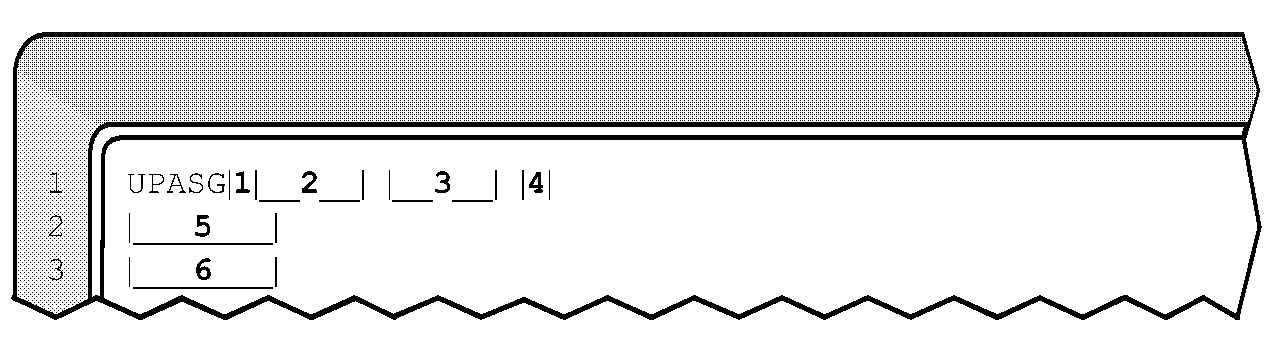
Title: Figure 3.12.32-1, CC UPASG screen individual case assignment. Pictured is a partial CC UPASG screen showing the placement for input items described in the text below.
Please click here for the text description of the image.
-
Line 1 (Item 1) - The Command Code definer "R" for individual case reassignment.
-
Line 1 (Item 2) - The 6-digit cycle of the case(s) being reassigned.
-
Line 1 (Item 3) - The 10-digit employee or unit number to whom the case is being assigned.
-
Line 1 (Item 4) - Functional Area Code of employee/unit to whom case is assigned.
Example:
AP = APPEALS
AT = AMTAP
EN = ENTITY
CI = CRIMINAL INVESTIGATION
EO = EXEMPT ORGANIZATION
EP = EPMF ENTITY UNPOSTABLES
EX = EXAMINATION
LB = LB&I
ST = STATUTES
UP = UNPOSTABLES -
Line 2 (Item 5) - Last six digits of the case cycle sequence number when cases have a common cycle. Delete leading zeros.
-
Line 2 (Item 6) - All twelve digits of the case cycle sequence number when the cases are from different cycles.
-
-
_Input Display- CC UPASG screen - (Batch):_See Figure 3.12.32-2.
Figure 3.12.32-2
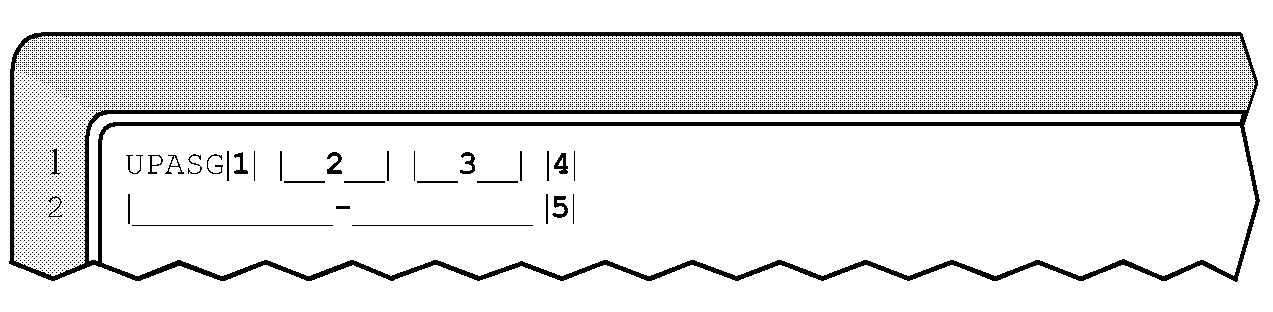
Title: Figure 3.12.32-2, CC UPASG Screen for batch case assignment. The list below describes the elements in the screen.
Please click here for the text description of the image.
-
Line 1 (Item 1): The Command Code definer "B" for batch case reassignment.
Note:
There is no break in the sequence of case numbers assigned.
-
Line 1(Item 2): The 6-digit cycle of the case(s) being reassigned.
-
Line 1(Item 3): The 10-digit employee or unit number to whom the case is being assigned.
-
Line 1(Item 4): Functional Area Code of employee/unit to whom case is assigned.
Example:
EN = ENTITY
AP = APPEALS
AT = RICS/RIVO (AMTAP on reports)
CI = INVESTIGATION
EO = EXEMPT ORGANIZATION
EP = EPMF ENTITY ORGANIZATION
EX = EXAM
LB = LB&I
ST = STATUTES
UP = UNPOSTABLES -
Line 2 (Item 5) - Last six digits of the first case cycle sequence number - Last six digits of the last case cycle sequence number.
-
Lines 3-24 - Additional cases input the same as Line 2.
-
-
Enter the sequence number for each individual unpostable case in the following format:
-
Format 1: When several cases all have the same "UP SEQ CYCLE" , input the code on line 1 as the common "UP SEQ CYCLE" . Then input the last 6-digits of the sequence number on lines 2 through 23 without entering the leading zeros. Input the common "UP SEQ CYCLE" in year and cycle format (YYYYCC).
-
Format 2: When the "UP SEQ CYCLE" of one individual case is different from the common "UP SEQ CYCLE" , enter the complete 10-digit sequence number for each case.
Note:
Enter one individual sequence number per line. Do not use commas and blanks to separate one case from another.
-
-
With CC UPASG, include both the common "UP SEQ CYCLE" and the complete 10-digit sequence numbers on the same screen input. Both types are valid for case reassignments of different cases during the same command code request.
-
The sequence numbers for each batch of unpostable cases may be entered in two different formats. With either format, enter the sequence numbers in pairs, separated by a dash. Enter only one pair of sequence numbers per line. Do not use commas and blanks to separate one case from another. Do not split a pair of numbers between two lines.
-
Format 1: When several batches have the same "UP SEQ CYCLE" , input it on line 1 as the common "UP SEQ CYCLE" . Then input the last 6-digits of the first sequence number, and the last sequence number may be input on lines 2 through 23 without entering the leading zeros. Enter the pairs on separate lines (e.g., 96-183 entered on line 2, 190-320 entered on line 3, 350-359 entered on line 4, etc.).
-
Format 2: When the "UP SEQ CYCLE" of one batch is different from the common "UP SEQ CYCLE" , enter the complete 10-digit sequence number for the first case and the last case of each batch. The pairs must be entered on separate lines (e.g., XXXX28000197-XXXX28000583 entered on line 2 and XXXX29000001-XXXX29000953 entered on line 3, etc.).
-
With CC UPASG, include both the common "UP SEQ CYCLE" and the complete 10-digit sequence numbers together on the same screen input; both types are valid for case reassignment of different cases during the same command code request.
Note:
Only one Functional Area Code can be used at a time. If cases require reassignment to Exam and Entity, input CC UPASG twice. The input of the Functional Area Code is important since it will decrease and increase the inventory of the respective functions.
-
-
CC UPASG with definer "R" (modifier "blank" ), immediately reassigns the case allowing correction activity the same day. Definer "B" (modifier "blank" ) reassigns the case overnight.
-
CC UPASG reassigns a maximum of 1,000 unpostable cases per line.
-
The status does not change when a case reassigns within the same function.
-
The status code and date updates when a case is reassigned to another function.
-
On all reassignments, the data in the "Remarks" section remain.
-
Output Display: The terminal output display for CC UPASG (INDIVIDUAL and BATCH input) is a blank screen with line 24 reflecting the terminal response if all input information was valid. If the information was not validated, it will display at the top of the screen with an asterisk (*) and an alpha character indicating why it did not validate.
-
Valid CC UPASG Request: The output terminal responses are "Single Case Reassigned," or "nn,nnn Batch Cases Reassigned."
Note:
The "nn,nnn" displays a total of batch cases reassigned. This valid response indicates that all input reassignments processed without any input error conditions.
-
Error Messages for Invalid CC UPASG Requests:
-
"REQUEST DENIED/INCORRECT DEFINER" : Indicates the command code definer is other than "B" or "R."
-
"EMPLOYEE NUM IS NOT NUMERIC or EMPLOYEE NUM HAS INVALID SC CODE" : Indicates the NEW employee number is non-numeric, and/or the first 2-digits are not a valid Campus or Area Office Code (e.g., 07–ATSC, 08–ANSC, 09–KCSC, 02–CSC, 06–AUSC, 01–BSC, 05–PSC, 04–OSC, 03–MSC and 10–FSC).
-
"INVALID CYCLE NUMBER" : Indicates the common unpostable sequence number cycle is invalid because the year of the common cycle is not in the range of "84" to the current year (year must be 84 or subsequent), and/or the week of the common cycle is not in the 1 to 53 range.
-
"FUNCTIONAL AREA CODE REQUIRED" : Indicates an attempt to reassign without identifying the functional area of occurrence.
-
"INVALID FUNCTIONAL AREA CODE" : Indicates the functional area code used was other than AP, AT, UP, EN, EO, EP, LB, ST, EX or CI.
-
"UP-SEQ-NUMBERS MISSING" : Indicates the common unpostable sequence cycle to be missing and the first and last sequence numbers as blank.
-
"INVALID SCREEN FORMAT FOR SEQ NUMBERS" : Indicates an invalid screen format when definer code "R" is used.
-
3.12.32.18.2 (01-01-2023)
CC UPBAT - Screen Formats
-
Use Command Code (CC) CC UPBAT to batch (MASS) close unpostable records containing a Campus or Unit employee number with the same resolution.
-
Input Display for CC UPBAT: See Figure 3.12.32-3.
FORMAT DESCRIPTION UPBATv nnnnnn nn vvvvvn-vvvvvn Batch (Mass) closure of unpostable records when all cases have the same "UP SEQ CYCLE" . UPBATv ---------nn vvvvvvvvvvvn-vvvvvvvvvvvn Batch (Mass) closure of unpostable records when the UP SEQ CYCLE is different than the common "UP SEQ CYCLE" . Figure 3.12.32-3
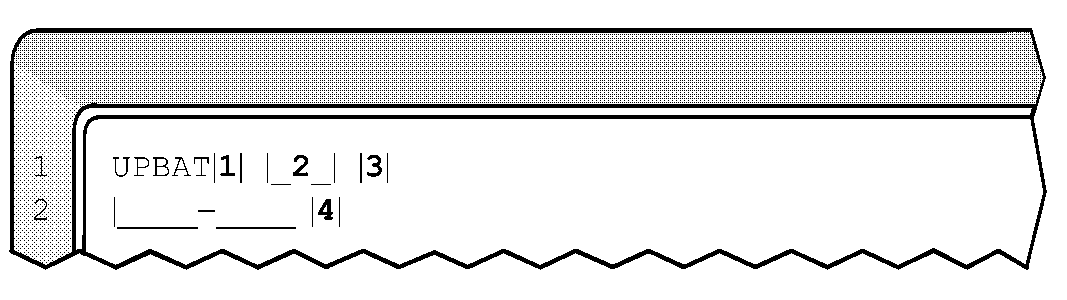
Title: Figure 3.12.32-3, Command Code UPBAT screen. The following text describes the format of the screen.
Please click here for the text description of the image.
-
Line 1 - Command Code Definer. For valid unpostable command code definers see IRM 3.12.32.9, Command Code Definers and Definer Modifiers.
-
Line 1 - The 6-digit cycle of batch being closed.
-
Line 1 - Nullify Area Code. For Nullify Area Codes and their receiving areas see IRM 3.12.32.14, Nullify Area Codes.
-
Line 2 - Last 6-digits of the first case cycle sequence number and the last 6-digits of the last case cycle sequence number, when cases have a common cycle.
-
Lines 3-22 - Additional cases input the same as Line 2.
-
-
The sequence numbers for each batch of unpostable cases may be entered in two different formats. With either format, enter the sequence numbers in pairs separated by a dash and enter only one pair of sequence numbers per line.
-
Format 1: When all the cases have the same UP SEQ CYCLE, it should be input on line 1 as the COMMON UP SEQ CYCLE. Then enter the last 6-digits of the first sequence number and the last sequence number on lines 2 through 22 without entering the leading zeros (e.g., line 2 = 1002-2010; line 3 = 2013-2089; line 4 = 2093-2214; etc.).
-
Format 2: When the UP SEQ CYCLE of one batch is different from the UP SEQ CYCLE of another batch, leave the COMMON UP SEQ CYCLE on line 1 blank. Enter the complete 12-digit sequence number for the first case and enter the last case of each batch (e.g., line 2 = XXXX39000883-XXXX39001234; line 3 = XXXX41000387-XXXX41000398).
-
The CC UPBAT unpostable sequence numbers (UP SEQ NUMBER-FIRST and UP SEQ NUMBER-LAST) are always in pairs for both closure requests. There is only one pair per screen line, with a maximum of twenty (20) screen lines input.
-
The common "UP SEQ CYCLE" and complete 12-digit sequence number formats are not valid on the same command code request when using CC UPBAT. CC UPBAT closes 1,000 cases per line.
-
-
Command code definers "T" and "W" provide the capability to delete erroneously batch closed unpostables.
-
Definer "T" matches beginning to ending sequence numbers against those batch closure records generated on the SAME day. If a match is found, do not attempt closure action.
-
Definer "W" matches beginning to ending sequence number to allow tax examiners to place batches of unpostable cases back into assigned status if the case(s) were previously batch closed in error.
Example:
Examples of Definer "T" and "W" : A Tax Examiner (TE) input Definer "T" and entered sequence numbers 001-025. Then added sequence 015-025 in error. The TE used CC UPBAT definer "T" to correct sequence numbers 001-025 and re-enter sequence numbers 001-014. With Definer "W" the cases were placed into "A" status.
-
-
Output Display: The terminal output screen format for CC UPBAT is the same as the input screen display format, except line 24 reflects the terminal response for the validity of the input request.
-
Valid CC UPBAT Request Response : Valid output terminal response for a CC UPBAT request is BATCH RECORD GENERATED. This valid response indicates that all input batch (MASS) closure requests for CC UPBAT that processed are without any input error conditions. Batch resolution records generate for all the records identified by each input UP SEQ NUMBER-FIRST through LAST.
-
Error Messages for Invalid CC UPBAT requests:
-
"NULLIFY AREA CODE INVALID/MISSING" : Indicates that a nullified area code used for a specific unpostable resolution code (URC) is invalid or that a nullified area code (NAC) is missing.
-
"PLEASE CORRECT INVALID DATA" : Indicates that a validity or consistency error exists for the input request.
-
REMARKS DATA REQUIRED WITH URC D, 1, 2, "8" : Indicates remarks missing if the unpostable attempts to close with URC "D," "1," "2," or "8."
-
-
For Definer Code "0," the Remarks (line 8 of the screen positions 1-20) automatically generate in this field for CC UPBAT. The remarks include "BATCH CLOSURE" followed by the employee IDRS number of the employee inputting CC UPBAT.
3.12.32.18.3 (01-01-2021)
CC UPREV - Screen Formats
-
Command Code (CC) CC UPREV validates requests for quality review action. The prior command code must be CC UPDIS (CC UPRES retrieved) to display the unpostable record. Use CC UPREV to review or delete CC UPRES and CC UPBAT closure actions.
-
See Figure 3.12.32-4 for the CC UPREV screen format.
FORMAT DESCRIPTION UPREV a nnnnnnnnnnnn n Preceded by CC UPDIS. Used to review or delete CC UPRES and CC UPBAT closure actions. Figure 3.12.32-4
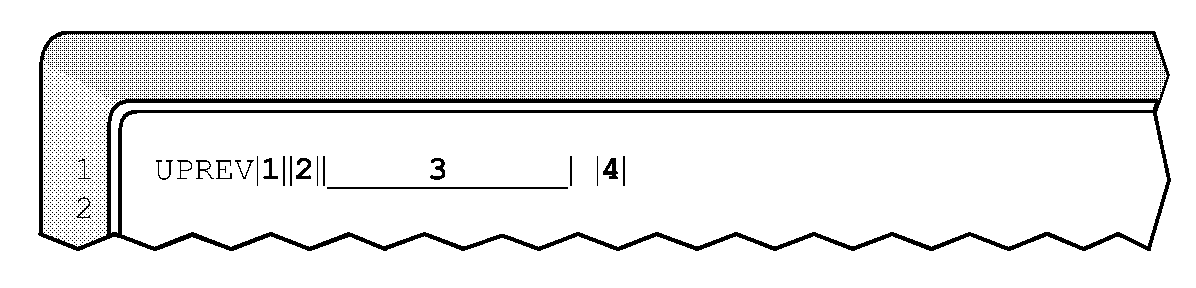
Title: Figure 3.12.32-4, Command Code UPREV screen format. The text below describes the format of the screen.
Please click here for the text description of the image.
-
Include the following information on line 1 of CC UPREV to review CC UPRES and CC UPBAT closure actions:
-
Definer - for valid unpostable command code definers see IRM 3.12.32.9, Command Code Definers and Definer Modifiers
-
Common modifier code - Always blank
-
UP sequence number - Generated by CC UPDIS
-
Error indicator - Generated
-
-
Include the following information on line 1 of CC UPREV to delete CC UPRES and CC UPBAT closure actions.
-
Definer
-
Common modifier code - Always blank
-
UP employee number QR hold - Input only with Definer Z
-
Error indicator - Generated
Note:
GUF releases the hold prior to the eighth day if CC UPREV is input without a modifier.
-
-
CC UPREV is valid for all Master Files. Use CC UPRES to close unpostable case closures. Use CC UPREV for quality review or to delete incorrect actions.
-
OUTPUT DISPLAY: The terminal output display for CC UPREV is the same as the input screen display format, except line 24 reflects the terminal response for the validity of the input request.
-
VALID CC UPREV REQUEST: Output terminal response "UPREV EXECUTED" indicates successful input of the command code.
-
Error messages for invalid CC UPREV requests:
-
REQUEST DENIED/INCORRECT DEFINER - Indicates the command code definer is other than blank, "E," "H," "Y," or "Z."
-
INVALID EMPLOYEE NUMBER - Indicates the employee number is not numeric or first 2-digits are invalid.
-
REVIEWER CANNOT REVIEW OWN CASE - Indicates reviewer is attempting to place hold on a unpostable case assigned to them.
-
PRIOR COMMAND IS NOT UPDIS - Indicates employee is entering CC UPREV with a blank, "E," "H," "Y" or "Z" definer without first entering UPDIS to display unpostable case.
-
STATUS INVALID FOR QR ACCEPT - Indicates definer is blank and status code is not "C" or "H."
-
STATUS INVALID FOR QR ERROR - Indicates definer is "E" and status code is not "C," "H," "Q," or "S."
-
STATUS INVALID FOR QR HOLD - Indicates definer is "H" and status code is not "C," "Q," or "S."
-
3.12.32.19 (01-01-2023)
Form 4251, Return Charge-Out
-
The Generalized Unpostable Framework (GUF) generates a Form 4251, Return Charge-Out, for unpostable cases requiring the return or document (or information from these records) to resolve the unpostable condition. Form 4251 also generates for certain auto-closed unpostable records that may require follow-up action by the originator or a designated area.
-
The Form 4251 always contains the following items:
-
TIN
-
MFT
-
Tax Period
-
Status Date
-
DLN
-
Name Control
-
Receiving Area
-
Category Code
-
Cycle Sequence Number
-
Unpostable Reason Code (UPC)
-
Transaction Code
-
Master File of the unpostable record
-
-
The following chart provides more Form 4251 content:
IF THEN The unpostable record is in Category Y1, Y2, F1 or F3 The transaction entity code (IMF only), filing status code (IMF only), master file name line and master file name control may also appear on the Form 4251. The unpostable record is an Electronic Funds Transfer (EFT) The Electronic Federal Tax Payment System (EFTPS) number generates. The unpostable record meets credit interest criteria The interest reduction overpayment amount generates as an alert requiring expeditious handling. The unpostable is EPMF The plan number will generate on Form 4251. The unpostable transaction is Document Code 18 The IDRS source document file folder number of Area Office payments (transaction code 670 or 640) will generate. The unpostable is a long entity IMF return The transcribed name and address will generate on the Form 4251. This information should be used as part of the research tools in resolving unpostables prior to requesting the return from Files. It should also be used to correspond for missing returns. -
The following chart lists the Form 4251 elements:
Element No. Element Description E1 Page Number E2 Taxpayer Identification Number (TIN) E3 Invalid TIN Type E4 Literal "MFT" E5 MFT Code E6 Literal "PN" (Plan Number) E7 Plan Number E8 Tax Period E9 Status Date E10 DLN E11 Name-Line-2 E12 Unpostable Sequence Number E13 Name Control E14 Name-Line-1 E15 Street Address E16 Literal "EFT" E17 EFT number E18 City E19 State E20 ZIP Code E21-E21.3 Unpostable Document Recipient Miscellaneous Information: * Displays UP-DOC-REQUEST-REMARKS when the request is made using CC UPCAS * Contains the literal "BKRUPT" on Categories Z1 and Z2 * Contains variable recipient data E22 Literal "CAT" for Category Code found on E23 E23 Unpostable Category Code E24 Service Center Abbreviation E25-E32 Literals: * E25 - Literal SEQ NUM (sequence number) for E33 * E26 - Literal UPC (unpostable code) for E35 * E27 - Literal TC-P (transaction code-primary) for E37 * E28 - Literal TC-S (transaction code-secondary) for E38 * E29 - Literal EC (entity code) for E39 * E30 - Literal FSC (filling status code) for E40 * E31/32 - Literal IDRS-EMP-NUM or Payment No found under the literal line E33 Unpostable Sequence Number E34 Repeat Indicator * Displays as "R," "Blank, " or "S" E35 Unpostable Code E36 Unpostable Reason Code E37 Primary Transaction Code E38 Secondary Transaction Code E39 Entity Code E40 Filing Status Code E41 Literal "MF" for Master File on E47 E42 Literal "Name" for E48 E43-E46 Literals: * E43 Literal "N/C," Name Control for E49 * E44 Literal "FYM," Fiscal Year Month for E50 * E45 Literal "FS," Filing Status for E51 * E46 Literal "PJ-Amount/Refund" for E52 E47 Master File Code E48 Master File Name Line E49 Master File Name Control E50 Fiscal Year Month E51 Filing Status Code E52 Pre-journalized Amount or Interest Reduction Overpayment Amount (Refund) E53 Variable UPC Data: * Literal "COM ZONE" - generates the Combat Zone if applicable * Literal "VEST CYCLE" - generates Vestigial Cycle for UPC 197 and 347 only, otherwise blank * Literal "AO" - generates Vestigial Area Office for UPC 197 and 347 only, otherwise blank * Literal "XREF" - generates when the record cross references to another TIN or Sequence number * Document Request Remarks -
See Figure 3.12.32-5. for an example of a Form 4251.
Figure 3.12.32-5
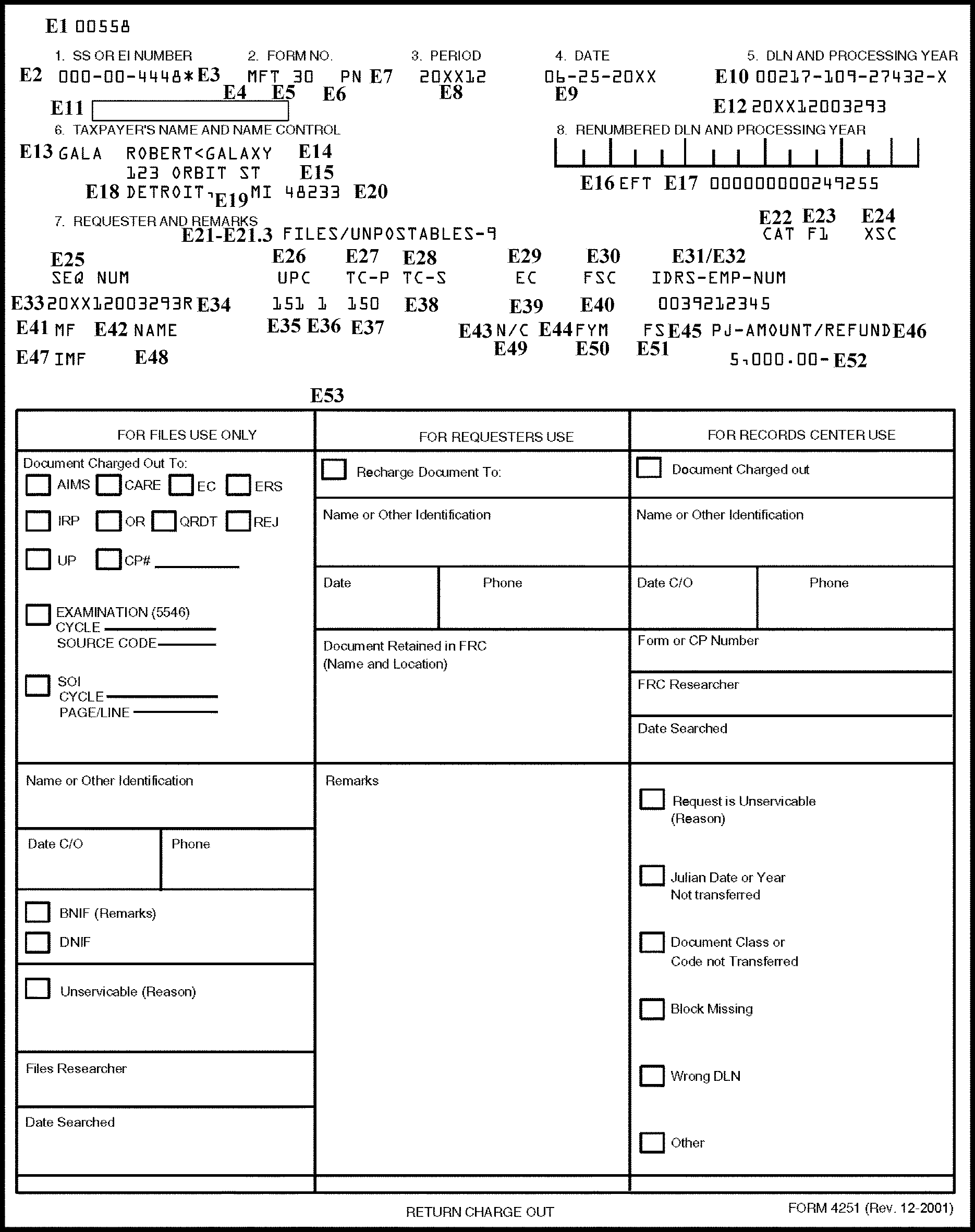
Title: Figure 3.12.32-5, Form 4251, Return Charge-Out. Pictured is an example of the Form as described in paragraph four above.
Please click here for the text description of the image.
-
Element 21.2 will contain the Nullify IDRS Control Number (employee number assigned to the record either from the original input or the employee number GUF assigned to the record) if AUTO-voided with URC "2." It will display the employee number assigned if the case is a repeat unpostable.
-
If CC UPCAS is used with Definer "D" and Definer modifier "1," "2," "3," or "4" is used, then Elements 21.2 and 21.3 will print on the UP-DOC-REQUEST Remarks.
-
Element 21.3 will print the literal "BKRUPT" if the unpostable is a bankruptcy Category Code Z1 case.
3.12.32.19.1 (01-01-2022)
Routing of Form 4251, Return Charge-Out
-
The following table identifies where the Form 4251, Return Charge-Out, is routed to based off on the Category of the unpostable case.
Form 4251 Recipient Code Category Receiving Area Expedite Routing Closure Action Files/Unpostables-1 F1 Unpostables No Unpostables closures Files/Unpostables-2 F3 Unpostables No Unpostables closures Files/Unpostables-2 Y1 Unpostables No Remittance processing closures Files/Unpostables-2 Y2 Unpostables No Remittance processing closures for Prior Year and Repeats Criminal Investigation A1 Criminal Investigation No CI closures Entity Control B1, B3 Entity Control No Entity closures Examination E1 Examination No Examination closures Examination/Statute E2 Examination Yes Examination Statute closures Examination E3 Examination No Examination batch void closures Unpostables to Preparer D3 Unpostables No Adjustment void closures Unpostables to Preparer V1 Preparer No Adjustment closures Statute Protection C1 Statute Protection Yes Statute Reject closures Statute Protection C2 Statute Protection Yes Statute batch void closures Unpostables-8 C3 Unpostables Yes Potential Statute closures Unpostables-8 C5 Unpostables Yes Credit Interest Returns closures Unpostables-8 G1 Unpostables Yes Individual Electronic Federal Tax Payment System closures Unpostables-9 R1 Unpostables No Individual closures Unpostables-9 L1 Unpostables No Individual closures (FOD only) Unpostables-9 L5 Unpostables No Individual closures Unpostables-9 L7 Unpostables Yes Individual closure-Unpostable credit transfer Unpostables-9 W3 Unpostables No Individual closures Unpostables-9 W5 Unpostables No Individual closures Unpostables-9 Y1 Unpostables No All Remittance processing closures, except UPC 151, 152, 153, 156, 166, 176, 301 and 303 Unpostables-9 Y2 Unpostables No All Remittance processing, Closures for Prior Year and Repeats, Individual Closures Unpostable-10 Z1 Unpostables No Individual bankruptcy closures Electronic Filing Unit ALL Electronic Filing No Individual closures Unpostable F3, F1 Unpostables No Individual PMF closures Note:
The Form 4251 with "Files to Nullify Area" in the recipient field will be routed from Files to the correct area.
-
The Form 4251 generates for IMF, BMF, PMF, and EPMF unpostable records weekly, for each unpostable cycle, and sorts in Master File, Recipient Code and DLN sequence (DLN within the master file and recipient code sort) and for the 2nd, 3rd, or 4th requests generated daily.
-
The Form 4251 routed to the Unpostable, Entity Unpostable, Criminal Investigation, Examination and Statute functions is received in DLN sequence within the master file recipient code sort, except for requests filled after the initial document pull (i.e., Form 4251 routed to the Federal Records Center - FRC).
-
UPC 191 sorts to the front of all other unpostables in Category E1.
-
-
The following conditions do not generate a Form 4251:
-
Categories L3, P1, V3, V5, V7, V8, W1, and W5
-
Category Y1 for UPC 140/399 cases with matching With - Remittance (ISRP/RPS) transaction code (TC) 150 and With - Remittance (ISRP/RPS) TC 610
-
TC 42X and Doc Code is 77
-
TC 740 or 841 Doc Code is 45
-
UPC 152 or 159 and TC is 120, 140, 141, 142, and Doc Code is 14, 49, 63, 77, 78, 79, 80 or 81 and category is not F1 or F3
-
Magnetic Tape PMF records
-
UPC 324
-
TC 290 and the Blocking Series (BS) is 590 thru 599 and the MFT is 13 or 55
-
Check Digit Correction
-
AIMS Closure
-
Category B1, Entity Control With - Remittance (ISRP/RPS) TC 610 unpostables
-
3.12.32.20 (01-01-2021)
GUF Listings and Reports - General Information and Distribution
-
GUF generates reports and listings of unpostable cases found on the Control-D application system. Management uses the reports and listings to identify, control, and manage inventories.
-
Each function must review the GUF 51-41, List of Correction Errors report each cycle for potential errors. Resolve the unpostable condition by reworking the case following original unpostable instructions. See IRM 3.12.32.20.15, GUF 51-41, List of Correction Errors.
-
IRM 3.13.62, Media Transport and Control contains more information on Unpostable Document Summary Reports.
GUF Report Run/File ID No. Title GUF 07-40 UNP INTEREST REDUCTION GUF 07-41 NEW-UP-ERROR-REPORT-GUF 07 GUF 07-42 NEW UNPOSTABLES WITH INTEREST FREE PERIOD DUE TO EXPIRE GUF 07-43 UNPOSTABLE CREDIT INTEREST SUMMARY GUF 07-49 RUN CONTROL REPORT - GUF 07 GUF 07-90 UP-DOC-REQUEST SUMMARY REPORT GUF 11-40 NEW UNPOSTABLE REPORT AND SUMMARY GUF 11-41 NO-MATCH-PURGE-LIST - GUF 11 GUF 11-49 RUN CONTROL REPORT - GUF 11 GUF 12-49 RUN CONTROL REPORT - GUF 12 GUF 13-40 UNPOSTABLE ISRP/LB TC 150 PMT MATCH LIST TC 150 GUF 13-41 UNPOSTABLE ISRP/LB TC 150 NO MATCH LIST GUF 13-42 UNPOSTABLE ISRP/LB TC OTHER THAN UPC 140/399 GUF 13-43 GUF13 CHARGE-OUTS GUF 13-49 RUN CONTROL REPORT - GUF 13 GUF 13-90 UP-DOC-REQUEST SUMMARY REPORT GUF 15-40 New UNPOSTABLE REPEATS HISTORY REPORT GUF 15-41 NEW UNPOSTABLE REPEATS HISTORY SUMMARY GUF 15-42 NEW UP REPEATS ERROR REPORT - GUF 15 GUF 15-49 RUN CONTROL REPORT - GUF 15 GUF 21-40 UNPOSTABLE CASE ASSIGNMENT LIST (Daily) GUF 21-41 UNPOSTABLE REJECTED ACTIVITY LIST (Daily) GUF 21-42 UNPOSTABLE REJECTED ACTIVITY SUMMARY (Daily) GUF 21-43 UP CLOSED CASE LIST (Daily) GUF 21-44 UP CLOSED CASE SUMMARY (Daily) GUF 21-45 UNPOST DOC REQ (Daily) GUF 21-46 BATCH DELETE LIST (Daily) GUF 21-49 RUN CONTROL REPORT - GUF21 (Daily) GUF 21-90 UP-DOC-REQUEST SUMMARY REPORT (Daily) GUF 22-40 UNP RES CD 8 LIST (Daily) GUF 22-42 UNP RES CD 1 LIST (Daily) GUF 51-40 LIST OF UNMATCHED GUF DATA BASE AND TRANSACTION FILE RECORDS GUF 51-41 LIST OF CORRECTION ERRORS GUF 51-42 LIST OF GUF 5131 RECS WITHOUT MATCHING UP-TIN-RECS GUF 51-43 INT-REDUCT-PRINT-FILE GUF 51-44 UNPOSTABLE CREDIT INTEREST SUMMARY GUF 51-45 ACCOUNTS RECEIVABLE LISTING FOR UNPOSTABLES GUF 51-46 GUF IMF LONG ENTITY INFORMATION REPORT GUF 51-49 GUF EXTRACT RUN CONTROL REPORT GUF 52-49 RUN CONTROL REPORT - GUF 52 GUF 53-40 IMF UNPOSTABLE CONTROL REPORT GUF 53-41 UNPOSTABLE WORKLOAD REPORT GUF 53-42 REVENUE RECEIPT CONTROL SHEET NULLIFIED UNPOSTABLES GUF 53-43 WEEKLY RESOURCE AND INVENTORY REPORT FOR O/F/P GUF 53-44 ACCOUNTS RECEIVABLE REPORT FOR UNPOSTABLES GUF 53-49 RUN CONTROL REPORT - GUF 53 GUF 55-40 UNPOSTABLE EMPLOYEE ASSIGNMENT AGED LIST GUF 55-41 SUMMARY OF UNPOSTABLE BANKRUPTCY CASES UPC 322 GUF 55-42 UP EMPLOYEE ASSIGNMENT/AGED SUMMARY GUF 55-43 UPC INVENTORY REPORT GUF 55-44 QUARTERLY FORM 720 UNRESOLVED UNPOSTABLE LISTING GUF 55-45 CAF UNIT WEEKLY HISTORICAL UP REPORT GUF 55-46 NULLIFIED DISTRIBUTION SUMMARY GUF 55-47 NULLIFIED DISTRIBUTION LIST GUF 55-48 WEEKLY CAF SUMMARY REPORT GUF 55-49 RUN CONTROL REPORT -GUF 55 GUF 55-50 CCP, EXAM AND APPEALS UP INVENTORY GUF 57-49 RUN CONTROL REPORT - GUF 57 GUF 60-40 UNPOSTABLE PCD LISTING GUF 60-41 PCD DATA CONTROL GUF 60-49 RUN CONTROL REPORT - GUF 60 GUF 87-40 UNPOSTABLES ANNUAL O/F/P WORK PERFORMANCE AND CONTROL REPORT (Yearly)
3.12.32.20.1 (01-01-2021)
GUF 07-42, New Unpostable with Interest Free Period Due to Expire Report and GUF 07-43, Unpostable Credit Interest Summary Report
-
The GUF 07-42, New Unpostable With Interest Free Period Due to Expire report, generates for all IMF and BMF transaction codes (TC) 150, 295, and 299 unpostable records where the credit interest date is in jeopardy or has expired. Use this report to reduce the amount of interest paid by the Internal Revenue Service due to untimely processing, See Figure 3.12.32-6.
Figure 3.12.32-6
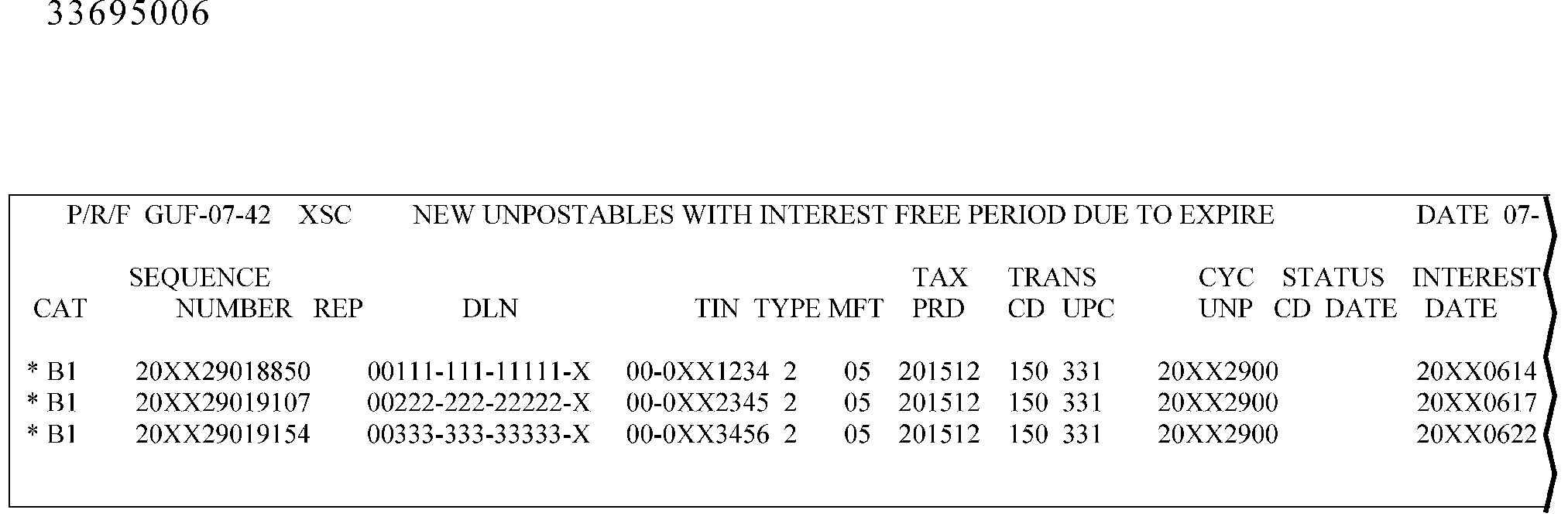
Title: Figure 3.12.32-6, GUF 07-42, New Unpostables with Interest Free Period Due to Expire report. Pictured is an example of the report with columns entitled: “CAT”, “SEQUENCE NUMBER”, “REP”, “DLN”, “TIN”, “TYPE”, “MFT”, TAX PRD”, “TRANS CD”, “UPC”, “CYC UNP”, “STATUS CD DATE”, “INTEREST DATE”.
Please click here for the text description of the image.
-
The report lists:
-
Overpayments from returns ≡ ≡ ≡ ≡ ≡ ≡ ≡ ≡ ≡ ≡ and/or carryback claims (TC 295/299) for the current year in excess ≡ ≡ ≡ ≡ ≡ ≡ ≡ that may not be processed within the 45-day interest free period.
-
Items with a tax class 2 or 3 and MFT code of 02, 05, 30, 33 and 34 on which 25 days or more have elapsed from the Credit Interest Date (the Return Due Date, the Return Received Date, or the Correspondence Received Date, whichever is later).
Exception:
The report excludes UPC 189 and 353, True Duplicates.
-
-
The GUF 07-42 report provides Unpostables, Exam, Statutes, CI, and Entity Control a way to identify overpayment documents requiring corrective action to refund the overpayment within the 45-day interest free period.
-
Expedite the unpostable cases appearing on the GUF 07-42 report to protect the interest free period.
-
The Interest Date used for determining the records to appear on this report is latest of the following:
-
The latest return correspondence received date, or
-
The received date, or
-
The return due date if a correspondence received date is not present, and/or a received date (late filed) is not present.
-
The date shows on the report as the INTEREST DATE.
-
-
The report is sorted by:
-
Expired Date Indicator
-
UP-Category Code
-
Unpostable Sequence Number
-
-
This report contains the following for each record identified:
-
New Unpostable receipt Indicator
-
Unpostable Category Code
-
UP SEQ NUM
-
Repeat Indicator
-
DLN
-
TIN and TIN type
-
MFT
-
Tax Period
-
Transaction Code
-
UPC
-
Original Unpostable Cycle
-
UP Status Code and Date
-
Interest Date
-
Interest Date +45 Days
-
Overpayment amount
-
Employee assignment number
-
-
The GUF 07-43, Unpostable Credit Interest Summary report shows the number of credit interest cases in each overpayment range.
-
The GUF 07-42 and GUF 07-43 reports generate as a management tool for each functional area, to pinpoint the range of overpayments and the number of returns falling into each category and monetary range. The following categories should be reviewed to expedite resolution of the unpostable return and return the amount of interest paid.
-
Category A1
-
Category Z1
-
Category B1
-
Category B3
-
Category B4
-
Category C1
-
Category C2
-
Category C3
-
-
Any returns or carryback claims in Categories F1, F3, L1, L3, L5, R1, W3, Y1, and Y2, may appear on the report.
-
See Figure 3.12.32-7.
Figure 3.12.32-7
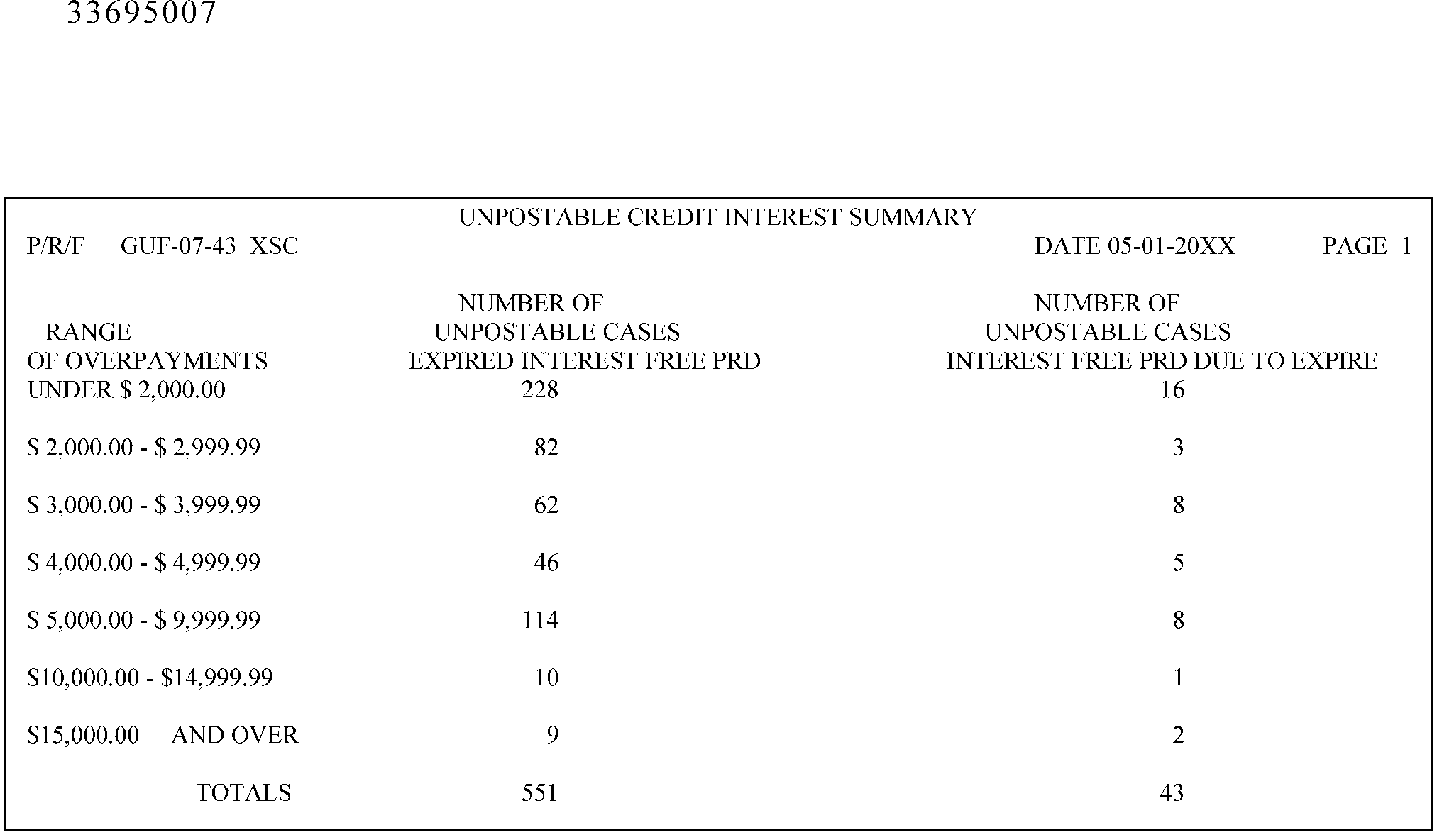
Title: Figure 3.12.32-7, GUF 07-43, Unpostable Credit Interest Summary report. Pictured is an example of the report. The first column is titled “RANGE OF OVERPAYMENTS”. The second column is titled “NUMBER OF UNPOSTABLE CASES EXPIRED INTEREST FREE PRD”. The third column is titled “NUMBER OF UNPOSTABLE CASES INTEREST FREE PRD DUE TO EXPIRE”.
Please click here for the text description of the image.
3.12.32.20.2 (01-01-2023)
GUF 07-90 and GUF 13-43, Unpostable Document Request Summary Report, and GUF 21-45, Subsequent Requests Report
-
The following reports generate when a document is requested, both daily and weekly, from:
-
GUF 07-40: Initial document requests / Original charge-out requests, or
-
GUF 07-90: Unpostable Document Request Summary Report (UP-DOC-REQUEST SUMMARY REPORT), or
-
GUF 13-90: Unpostable Document Request Summary Report (UP-DOC-REQUEST SUMMARY REPORT), or
-
GUF 21-45: Subsequent Requests Report (UNPOST DOC REQ) from CC UPCAS with definer code "D" and modifier codes "1," "2," "3," and "4."
-
-
Use these reports to verify all document requests generated and are received from Files.
-
The Unpostable function provides the Files function with a copy of this report to help determine if they received all charge-outs from Machine Services.
-
The following lists the content and format of the GUF 07-90 report in Figure 3.12.32-8.
Figure 3.12.32-8
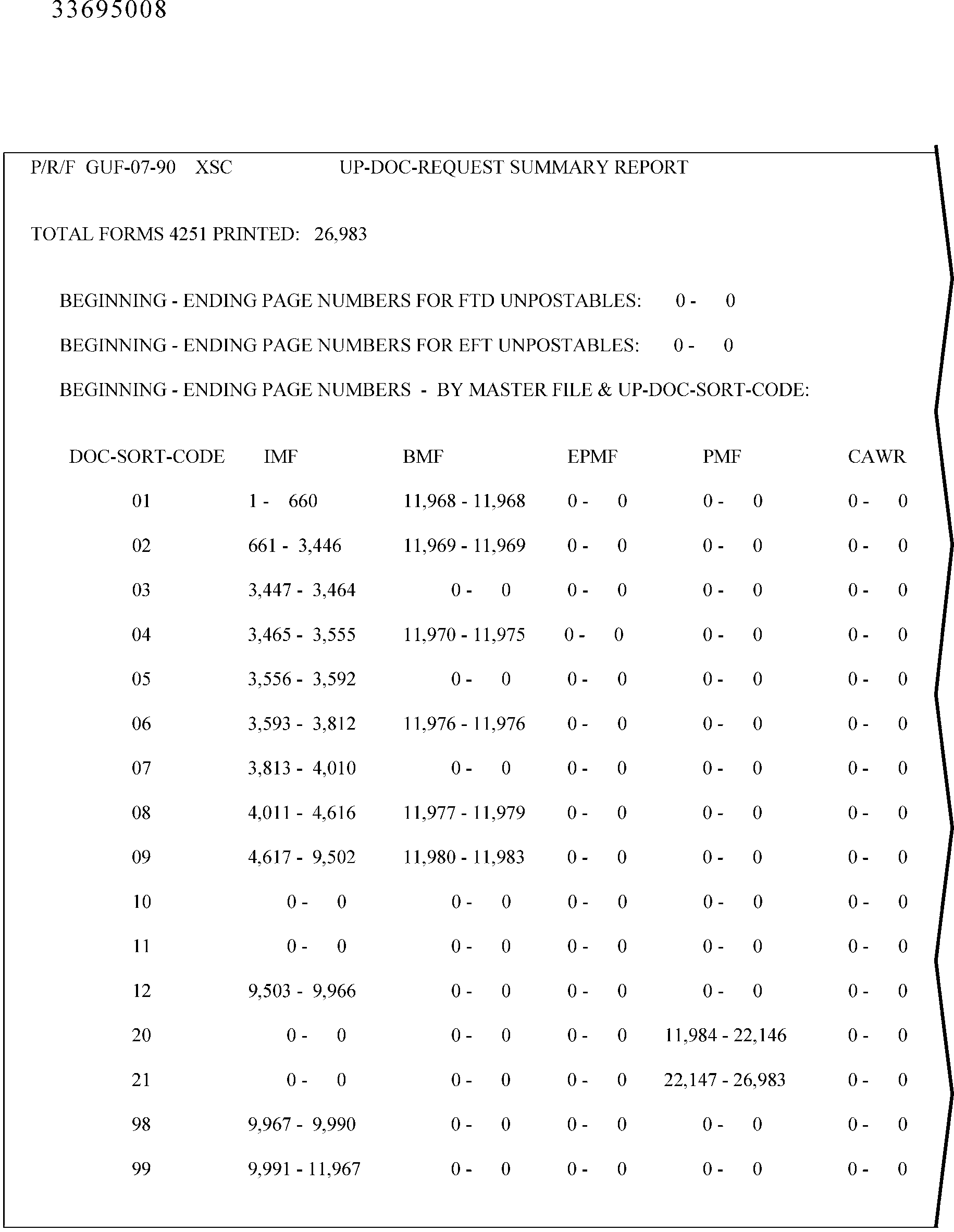
Title: Figure 3.12.32-8, GUF 07-90, UP DOCUMENT REQUEST SUMMARY REPORT. The report includes the document sort code and the total number of document requests per Master File. The title line has the report name and the Service Center abbreviation. The next line has the total number of Forms 4251 printed. There are columns titled “DOC-SORT-CODE”, “IMF”, “BMF”, “EPMF”, “PMF” and “CAWR”.
Please click here for the text description of the image.
-
The DOC-SORT-CODE represents the recipient field on the Form 4251, Return Charge-Out.
-
The following chart lists the recipient field area and the category code associated with the DOC-SORT-CODE:
Note:
The category code determines the recipient field area.
DOC-SORT-CODE RECIPIENT FIELD CAT-CODE "01" Files/Unpostable F1 except UPC 503 "02" Files/Unpostable F3 except UPC 501 Y1 and Y2 (Only for UPCs 151, 152, 153, 156, 166, 176, 301, and 303) "03" Criminal Investigation (CI),Systems & Operational Support (SOS) TC 914 Criminal Investigation (CI),Systems & Operational Support (SOS) TC 916 Criminal Investigation (CI), Systems & Operational Support (SOS) TC 918 Criminal Investigation (CI), Systems & Operational Support (SOS) TC 016 A1 "04" Entity Control B1/B3/B4 "05" Examination Examination-Statute Examination-Void E1 E2 E3 "06" Files to Nullify Area D3 All Auto-voided Documents "06" Unpostable to Preparer Manually voided Documents "07" Statute Protection C1 C2 "08" Unpostables C3 C5 G1 "09" Unpostables D1 L1 L5 I1 L7 R1 W3 W5 (TC 150 or 370) "10" Unpostables Z1 "11" Electronic Filing Unit ALL "20" Files/Unpostables F1 (PMF) UPC 503 "21" Files/Unpostables F3 (PMF) UPC 501 "98" Unpostables (ALL) ALL "99" Route to Rejects ALL (The Category Code determines the Recipient field area)
3.12.32.20.3 (01-01-2022)
GUF 11-40, New Unpostable Report and Summary
-
The GUF 11-40, New Unpostable Report, generates for new unpostables in all master files.
-
This report identifies the new unpostable cases (except AUTO closures) and generates weekly for each cycle.
-
Dependent upon the master file, the unpostable generates daily or weekly.
-
Each time a New Unpostable Report generates, a summary report generates.
-
The summary sheet breaks down the total of each category by master file, repeats, and AUTO closures.
-
Based on the master file of the New Unpostable Report, the content and format of the report varies as shown in Figure 3.12.32-9 and Figure 3.12.32-10.
Figure 3.12.32-9
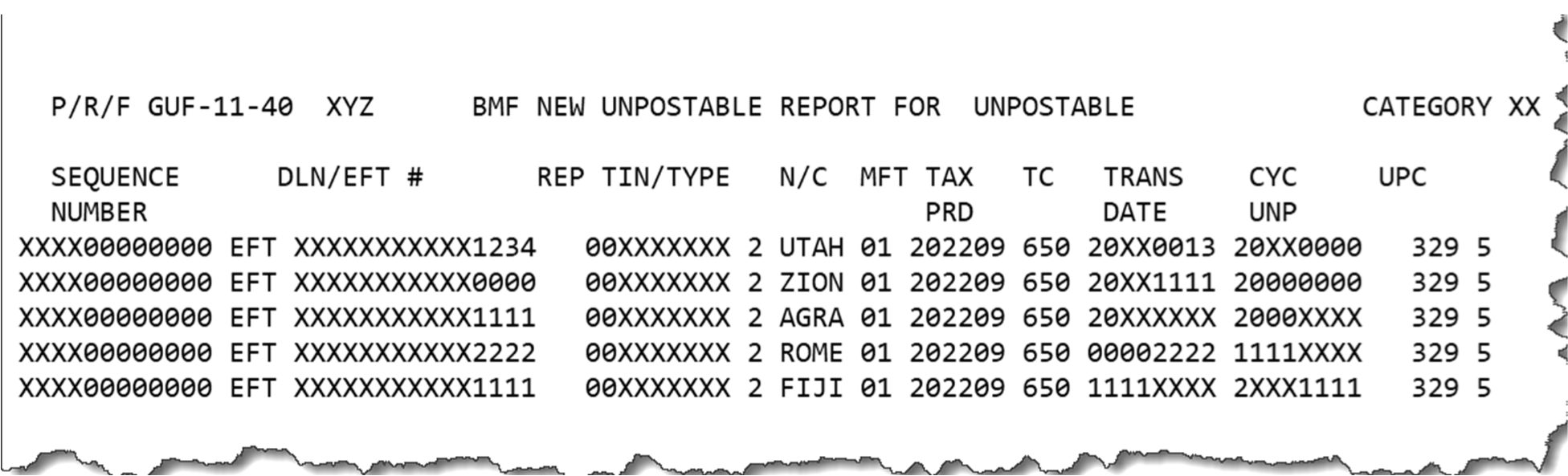
Title: GUF 11-40, New Unpostable Report For Unpostable. Pictured is a portion of the report generated for a campus. The report is titled BMF NEW UNPOSTABLE REPORT FOR UNPOSTABLE. There are columns entitled: SEQUENCE NUMBERDLN/FTD/EFT No.REPTIN/TYPEN/CMFTTAX PRDTCTRANS DATECYC UNPUPC
Please click here for the text description of the image.
Figure 3.12.32-10
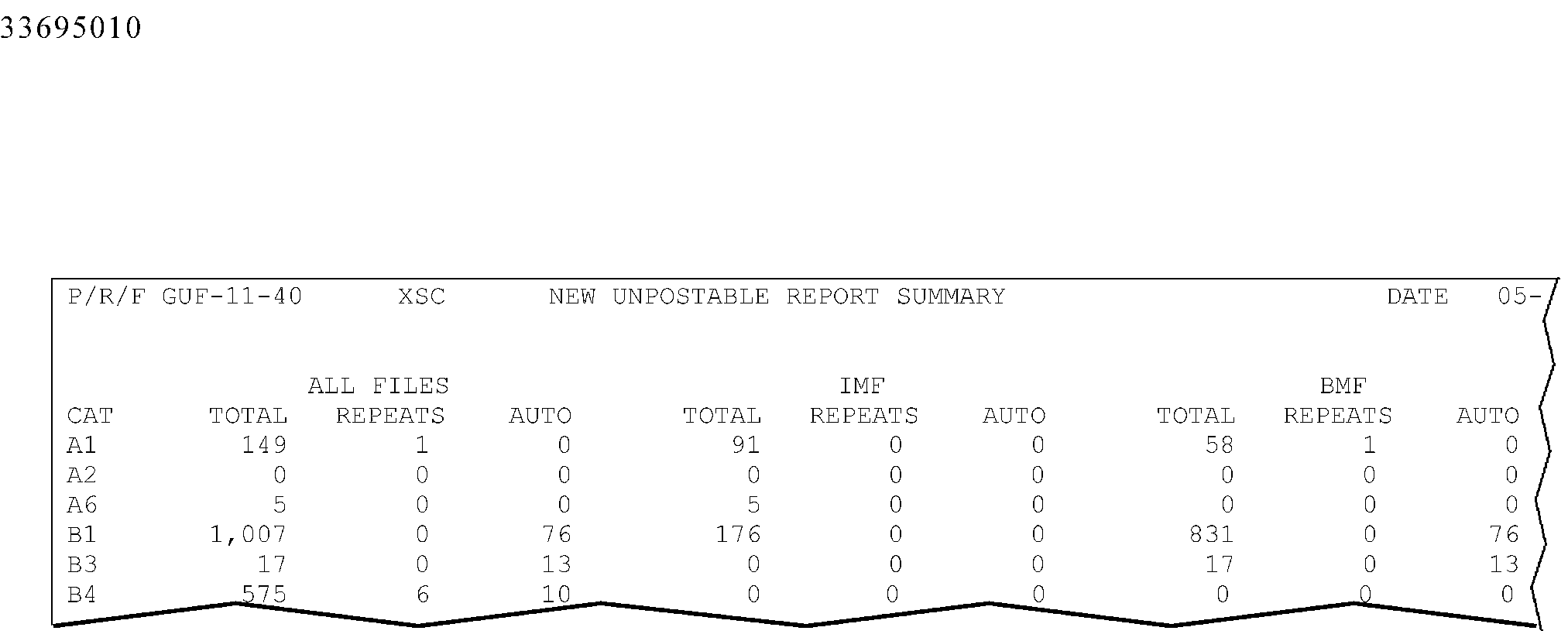
Title: GUF 11-40 Summary Report. Pictured is a portion of the report generated for a campus. The report is titled NEW UNPOSTABLE REPORT SUMMARY.
Please click here for the text description of the image.
-
-
The sequence number assigns to the records after they are sorted into DLN or Payment Sequence Number order.
-
The GUF 11-40 Report starts a new page with each category change.
-
Criminal Investigation, Entity Control, Examination and Statutes can access the GUF 11-40 Report through the Control D system.
-
Use the report to:
-
Reassign cases to individual tax examiners; and
-
Mass (CC UPBAT) close cases.
-
-
Expedite the reassignment of Category "C3" and "C5" cases to tax examiners with CC UPASG and route the related unpostable documents to these individuals.
-
Reassign Category "L3" cases to tax examiners with CC UPASG. No documents are received and a copy of the report is given to each individual tax examiner.
-
Reassign Category "D1" , "L1" , "L5" , "L7" , "W1" , "W3" , and "Y2" cases to tax examiners with CC UPASG. Route the related unpostable documents and transcripts (Category "W1" /****"W3" ) to the appropriate individuals.
-
Route category "V5" reports to the supervisor:
If Then Any TC other than 120, 140, 141, 142, and/or 922, Notify immediate supervisor (or designated responsible individual). * The supervisor will contact the CSA or Planning and Analysis Staff Analyst regarding a possible "program problem for these generated transactions." * MASS (URC D or "2" - CC UPBAT voided) close cases as directed by the supervisor. Generated TC 120, Notify supervisor (or designated responsible individual). 1. The supervisor will determine if the TC 120 must be MASS closed using URC" D" or "2" . 2. Use CC UPBAT to void or reassign to tax examiners for INDIVIDUAL case closures. ### Note: Generated TC 120 cases can generally be identified by the unique DLN. Non-generated TC 120, Reassign to a tax examiner for INDIVIDUAL case closure. TC 140, 141, or 142, Reassign to a tax examiner for INDIVIDUAL case closure. * If these transactions involve a "program problem," they may be MASS voided (URC "D" or" 2" ) using CC UPBAT. * The supervisor (or designated responsible individual) will determine if MASS closure is necessary for Category V5 unpostable records. -
MASS close (URC "D" or "2" with CC UPBAT) any CAWR Category V8 records that cannot be worked as an individual case. Generally, this action is designated by separate guidelines involving CAWR workload completion dates. If no such guidelines are received, reassign the CAWR Category "V8" (MFT 88, TC 980/982) cases to tax examiners for individual case closure with CC UPASG.
-
Review Category "F1" Forms 4251, Return Charge-Out, and the unpostable record (CC UPDIS) for closure, if possible, for obvious errors, for URC"A," "0," "5," "6," or quick closures (URC"D" or "2" ), and destroy the Form 4251. If closure is not possible, route the Form 4251 to Files in strict DLN order.
-
Use the GUF 11-40, New Unpostable Report and request microfilm (retention register) for Category "W5" cases. Use the original Category "W5" report to reassign cases to tax examiners (CC UPASG) for individual case closure. When microfilm is received, route to appropriate tax examiner.
-
Upon receipt of Category "F1" , "F3" , and "Y1" Form 4251s from Files, reassign cases to a tax examiner with CC UPASG for individual case closure. Route the returns and/or documents to the appropriate individuals.
-
The GUF 11-40, New Unpostable Report includes Category "Y1" , With-Remittance (ISRP/RPS) TC 150/610 information and is retained for research and an audit trail. The ISRP/RPS listings GUF 13-40, 13-41, and 13-42 are used to reassign Category "Y1" cases to tax examiners using (CC UPASG). The Form 4251 generates, if the UPC is other than UPC 140 or 399 or if a UPC 140 or 399 does not match a recirculating TC 610. See ISRP/RPS Listing procedures in IRM 3.12.32.8.2, General Information for GUF Command Codes and Definers, for specific processing of Category "Y1" cases.
-
Category "Z1" bankruptcy cases:
-
Use the report to help identify certain bankruptcy cases for immediate closure.
-
Review the bankruptcy return or document, the GUF 11-40, New Unpostable Report, and the specific procedures in the appropriate Unpostable IRM to determine closure.
-
The Area Office (AO) Bankruptcy listings are used to process Category "Z1" cases.
-
Bankruptcy information is retained for research.
-
Category "Z1" records that are not MASS closed will be referred to the appropriate Area Offices using the "AO List of Unresolved Unpostable Bankruptcy Cases." Refer to the procedures for this list regarding specific guidelines for "Z1" cases.
-
-
Areas receiving CI, Entity, Statute and Examination New Unpostable Reports:
-
CI function (Category "A1" ), Entity function (Category "B1" and "B3" ), Statute function (Category "C1" and "C2" ), and Examination function (Category "E1" , "E2" , and "E3" ) cases must be reassigned upon receipt of the report.
-
Category "A1" , TC 016, Blocking Series 700-799 cases (PSC only), are reassigned as either CI or an Inspection Assignment Number, but these cases are handled by Internal Security Inspection.
-
3.12.32.20.4 (01-01-2021)
GUF 11-41, No Match Purge List
-
The GUF 11-41, No Match Purge List report generates at the beginning of the year only if there are purged records that didn’t match on the database. The report is produced for all Master Files.
-
For each record, the report identifies:
-
Unpostable Sequence Number
-
Master File
-
UPC
-
MFT
-
Tax Period
-
Transaction Code
-
DLN
-
Pre-Journalized Amount
-
-
See Figure 3.12.32-11 for an example of the report.
Figure 3.12.32-11
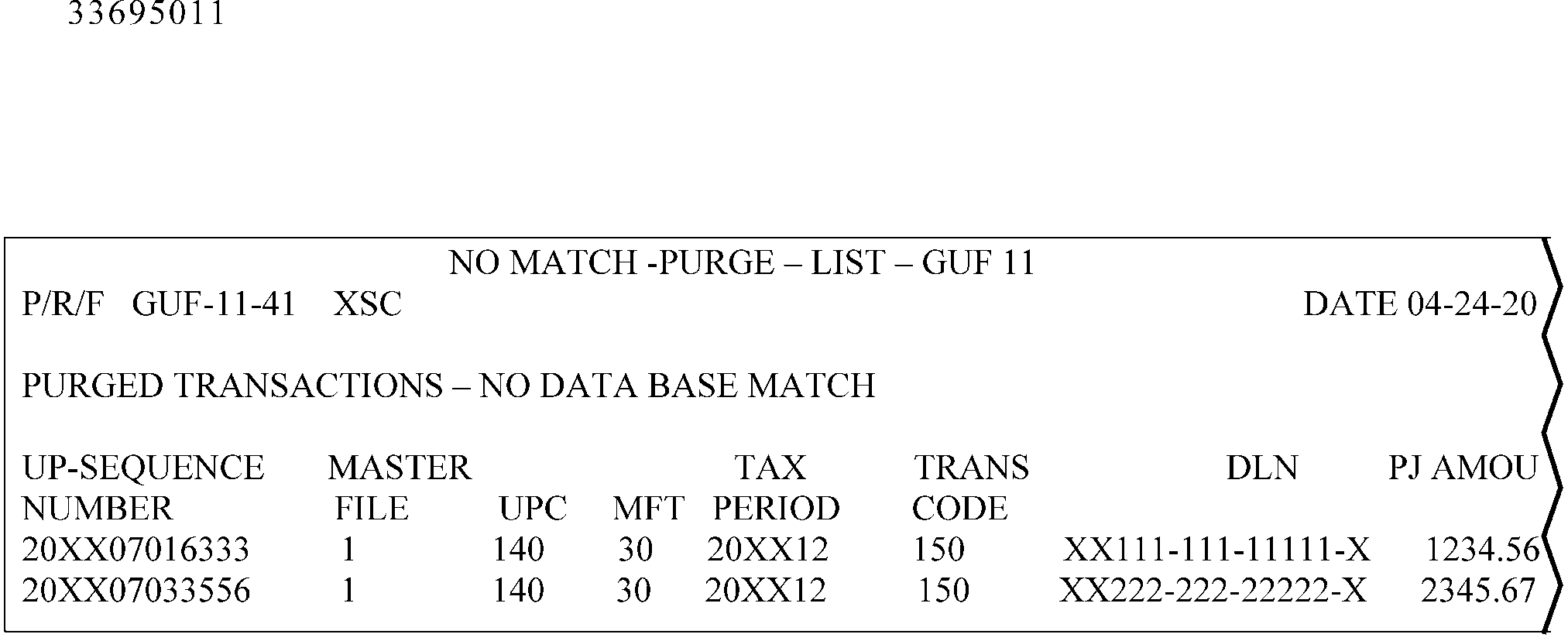
Title: Figure 3.12.32-11, GUF 11-41, No Match Purge Report. Pictured is an example of the report described in the text above.
Please click here for the text description of the image.
3.12.32.20.5 (01-01-2024)
GUF 13-40, Unpostable Payment and Returns Match Listing for Categories Y1 and Y2 of IMF/BMF Records
-
The GUF 13-40, Unpostable Payment and Return Match listing (ISRP/LB TC 150-PMT MATCH LIST) report matches With-Remittance, Integrated Submission and Remittance Processing (ISRP) system and Returns Processing Subsystem (RPS) Transaction Code (TC) 150 and TC 610 Unpostable records and provides a listing of the matches:
-
GUF automatically matches the Taxpayer Identification Number (TIN) and money amount for all Category "Y1" and "Y2" , With-Remittance (ISRP/RPS) TC 150/610 unpostable records.
-
The new unpostable TC 610 (Document Codes 70 and 76) payments are added to the CUMULATIVE-With-Remittance (ISRP/RPS)-610-FILE in TIN sequence order.
-
Each cycle, all new unpostable with-remittance (ISRP/RPS) TC 150 returns (regardless of unpostable code) are included in TIN sequence and passed against the CUMULATIVE-With-Remittance (ISRP/RPS)-610-FILE.
-
-
GUF reviews with-remittance (ISRP/RPS) Individual Master File (IMF) TC 150 UPC 140 and Business Master File (BMF) UPC 399, and the TIN and balance due to match the with-remittance (ISRP/RPS) TC 610, on TIN and money amount for automatic correction. The following is a list of conditions that automatically correct the unpostable:
-
The TIN, Name Control, Master File Tax (MFT), Tax Period, and money amount all match
-
Only two digits of the TIN mismatches and Name Control, MFT, Tax Period, and money amount matches
-
Name Control mismatches and TIN, MFT, Tax Period and money amount matches
-
Tax Period mismatches and TIN, Name Control, MFT, and money amount matches
-
-
GUF includes records not AUTO closed but match on TIN and money amounts on the GUF 13-40.
-
With-remittance (ISRP/RPS) TC 150 IMF UPC 140 or BMF UPC 399 not locating a TC 610 with the same TIN, and money amount, are included on the GUF 13-41 report. See IRM 3.12.32.20.6, GUF 13-41, Unpostable Payment and Returns No Match List.
-
GUF does not auto correct with-remittance (ISRP/RPS) TC 150 if unpostable is other than UPC 140 or UPC 399. The cases are included on the GUF 13-42, Unpostable Payment and Returns Other than UPC 140/399 Match/No Match List. This list displays the CYCLE SEQUENCE NUMBER of all TC 610 cases matching on the TIN and money amount. See IRM 3.12.32.20.7, GUF 13-42, Unpostable Payment and Returns Other than UPC 140/ UPC 399 Match/No Match List.
-
An asterisk (*) appears on the GUF 55-40, EMPLOYEE ASSIGNMENT/AGED LIST after 10 cycles for IMF and BMF.
Note:
Do not reassign the TC 610 to an individual employee number, until the asterisk (*) appears on the list because it will not allow the automatic correction process to work.
-
With-Remittance (ISRP/RPS) TC 150 and TC 610 unpostables appear on the GUF 55-40, Employee Assignment/Aged List every week until they are resolved and removed from Service Center Unpostable Master File (SCUPMF). See IRM 3.12.32.20.21, GUF 55-40, Unpostable Employee Assignment/Aged List and GUF 55-42, Unpostable Employee Assignment/Aged Summary, for detailed information of GUF 55-40.
3.12.32.20.6 (01-01-2021)
GUF 13-41, Unpostable Payment and Returns No Match List
-
The GUF 13-41, Unpostable Payment and Returns No Match List (ISRP/LB-TC 150 NO MATCH LIST) contains all Category Y1 and Y2 With-Remittance (ISRP/RPS) returns (TC 150) with UPC 140 and UPC 399 that failed to locate its related With-Remittance (ISRP/RPS) TC 610 payment.
-
Reassign records to an individual IDRS employee number using this list.
-
A Form 4251, Return Charge-Out, is generated for each case on the list.
-
The procedures for processing no match UPC 140 With-Remittance (ISRP/RPS) returns are in IRM 3.12.179, Individual Master File (IMF), Payer Master File (PMF) Unpostable Resolution. The procedures for processing UPC 399 With-Remittance (ISRP/RPS) returns are in IRM 3.12.279, BMF/CAWR/PMF Unpostable Resolution.
-
The report has two records printed on each line, and the records are in unpostable sequence order. The report shows the following information for each transaction:
-
Sequence number
-
Money amount
-
TIN/ Indicator
-
Name Ctrl
-
MFT
-
Tax Period
See an example of GUF 13-41 in Figure 3.12.32-12.
Figure 3.12.32-12
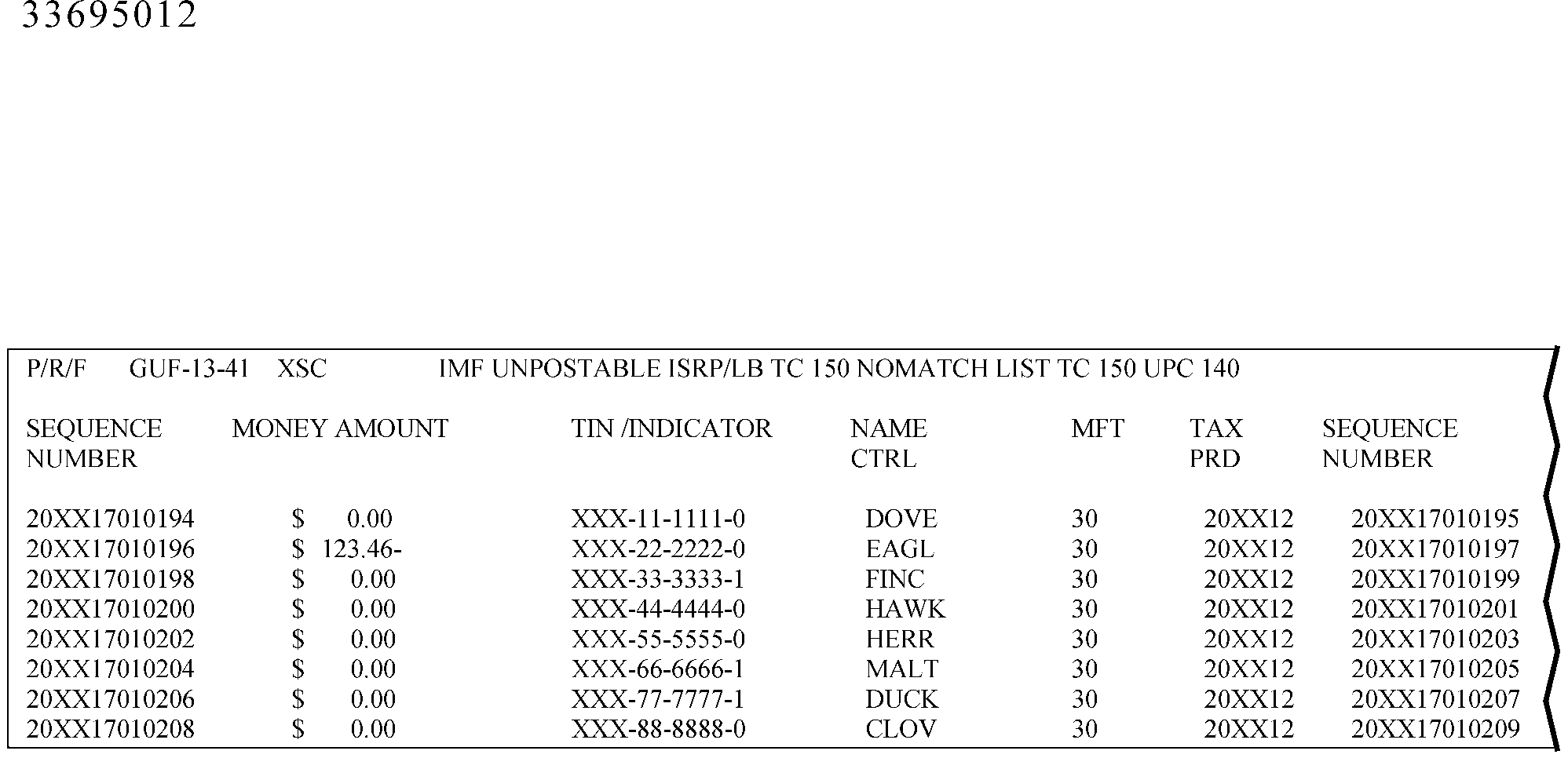
Title: GUF 13-41, Unpostable ISRP/LB TC 150 NO MATCH List. Pictured is an example of the report described in the text above.
Please click here for the text description of the image.
-
3.12.32.20.7 (01-01-2021)
GUF 13-42, Unpostable Payment and Returns Other than UPC 140/399 Match/No Match List
-
The GUF 13-42, Unpostable Payment and Returns Other than UPC 140/399 Match/No Match List (ISRP/LB TC 150 OTHER THAN UPC 140/399 MATCH/NOMATCH LIST) report, contains all Category**"Y1"** and "Y2" With-Remittance (ISRP/RPS) TC 150 returns with an unpostable code other than UPC 140 for IMF and UPC 399 for BMF.
-
The list matches the same Taxpayer Identification Number (TIN), Name Control, Master File Tax (MFT) code, Tax Period, and money amount. Transaction code (TC) 610 case information is also provided if the return finds the related TC 610 during GUF 13 matching process. Also:
-
Both numbers will appear on the listing when the matching data is on the with-remittance (ISRP/RPS) TC 150 and TC 610 and each have a different unpostable cycle sequence number.
-
Reassign the return and the payment to the same tax examiner for resolution of both unpostable conditions.
-
-
A Form 4251, Return Charge-Out, generates for all with-remittance (ISRP/RPS) TC 150 records on this list.
-
The procedures for processing Category "Y1" and "Y2" are in IRM 3.12.179, Individual Master File (IMF), Payer Master File (PMF) Unpostable Resolution and IRM 3.12.279, BMF/CAWR/PMF Unpostable Resolution.
-
Figure 3.12.32-13 contains an example of the report.
Figure 3.12.32-13
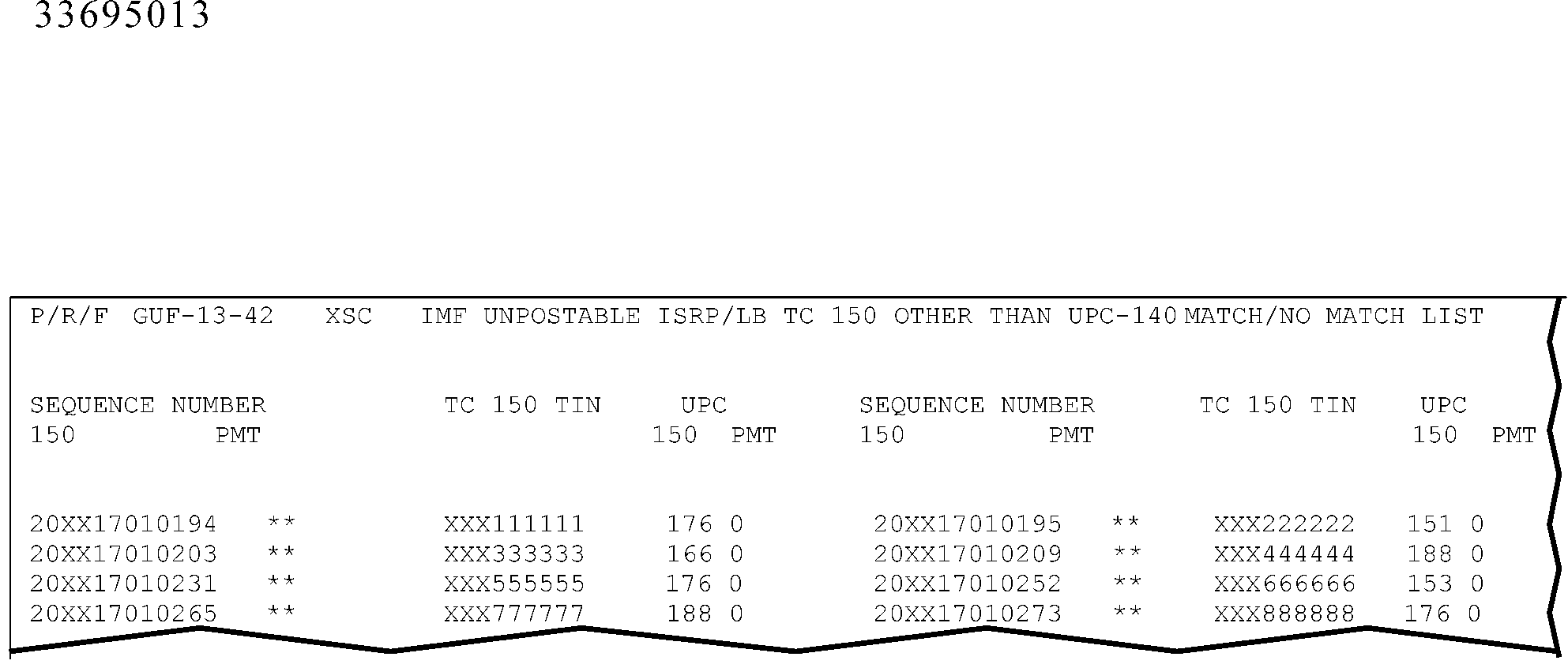
Title: GUF 13-42, IMF UNPOSTABLE ISRP/LB TC 150 OTHER THAN UPC 140 MATCH/NOMATCH LIST. The report has the following information for each record. There are two records on each line:SEQUENCE NUMBER 150PMTTC 150 TINUPCPMT
Please click here for the text description of the image.
3.12.32.20.8 (01-01-2022)
GUF 15-40, New Unpostable Repeats History Report
-
The GUF 15-40, New Unpostable Repeats History Report, is produced on a weekly basis and provides the prior closing history of repeating unpostable cases.
-
GUF assigns the repeat case to the employee who initially closed the unpostable. In the following situations, GUF assigns the repeat case to the campus:
-
The prior closing was a category "A1" and repeats in a category other than "A1" .
-
The prior closing was a category B1 or B3 and repeats in a category other than "B1" or "B3" .
-
The prior closing was a category "C1" or "C2" and repeats in a category other than "C1" or "C2" .
-
The prior closing was a category "E1" , "E2" , or "E3" and repeats in a category other than "E1" , "E2" , or "E3" .
-
-
Consider repeat Unpostables a higher priority to processing. Practice review and resolution of repeat unpostables on the same day of receiving the GUF 15-40 report.
-
Immediately review and reassign incorrect GUF assignments to the correct function/area when resolution jurisdiction is applicable.
Example:
An Unpostable tax examiner resolved a UPC 176 RC 0 and it repeats as a UPC 126 RC 0 to the unpostable employee. Immediately reassign the unpostable to the campus using the correct area "AT."
-
Use the report as a management tool to identify training issues or trends of improper closures. Determine if the original unpostable condition was initially resolved when determining the correct closing action needed to resolve repeats.
-
The report includes the total number of repeat cases for each employee with the following:
-
Same UPC as the prior closing.
-
Different UPC from the prior closing.
-
-
See an example of the GUF 15-40 report in Figure 3.12.32-14.
Figure 3.12.32-14
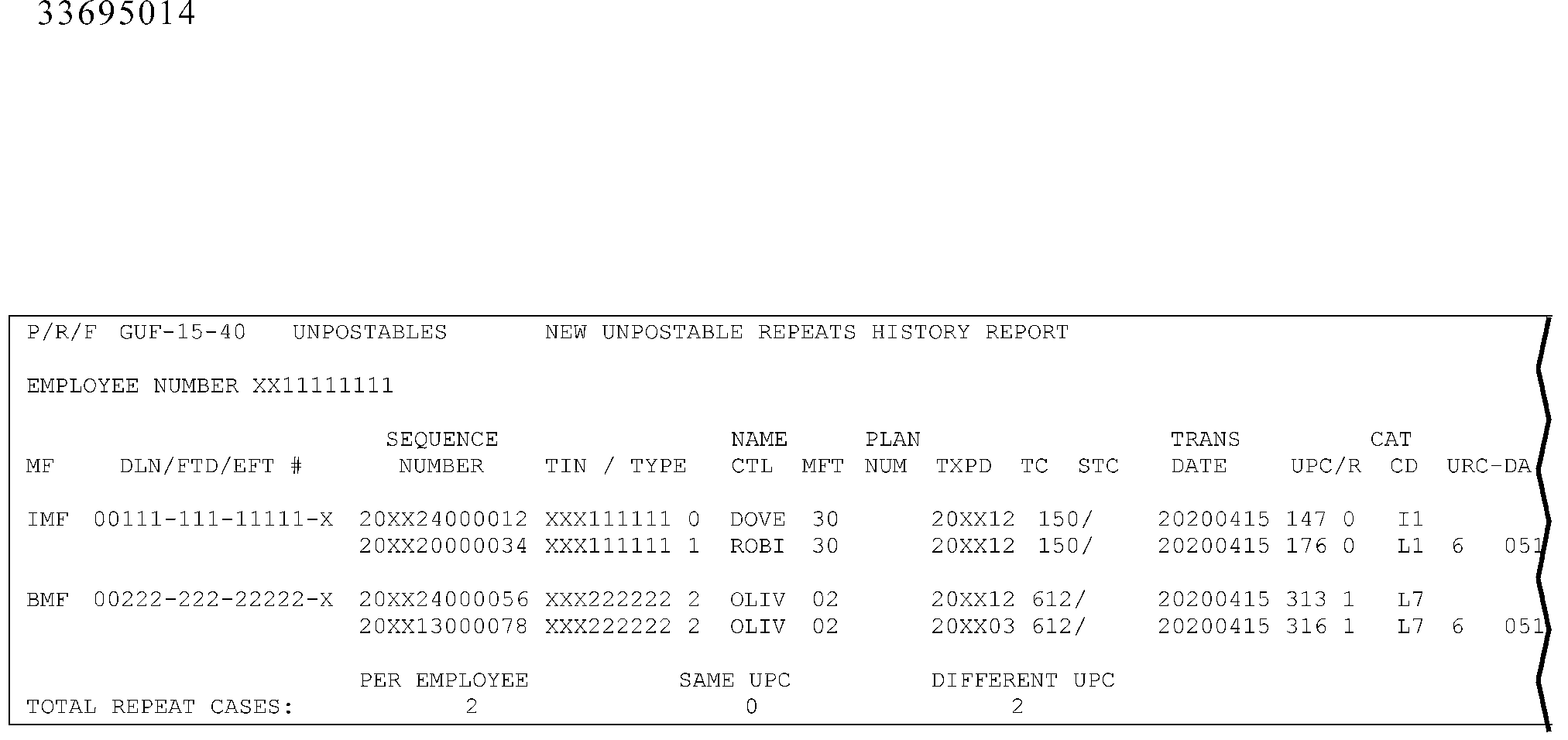
Title: Figure 3.12.32-14, GUF 15-40, New Unpostable Repeats History Report. Pictured is a excerpt from the report. The report is sorted by Area and then by Employee Number. The first line shows the report name “GUF - 15-40, then the area, “UNPOSTABLES”, report title, “NEW UNPOSTABLE REPEATS HISTORY REPORT”. The next line has the literal “EMPLOYEE NUMBER” and a dummy number. The transactions associated with the employee number are shown underneath. The layout has twelve columns entitled:MFDLN/FTD/EFT No.SEQUENCE NUMBERTIN/ TYPENAME CTLMFTPLAN NUMTXPDTCSTCTRANS DATEUPC/R.After the repeat transactions are listed for each employee then total data is shown - TOTAL REPEAT CASES, SAME UPC AND DIFFERENT UPC.
Please click here for the text description of the image.
3.12.32.20.9 (01-01-2021)
GUF 15-41, New Unpostable Repeats History Summary Report
-
The GUF 15-41, "New Unpostable Repeats History Summary" report generates weekly and provides the volume of repeat unpostables by:
-
employee number
-
total repeats for the employee
-
same UPC as the prior closing
-
different UPC of the prior closing
-
total for the functional area (Unpostable, Entity, Exam, Statute and CI) by total repeat cases
-
-
Use the Summary report as a management tool to determine if:
-
An employee is creating repeats for the same unpostable code.
-
An employee is creating repeats for different unpostable codes.
-
An employee needs training for resolving the cases.
-
-
Figure 3.12.32-15 shows an excerpt from the GUF 15-41 report.
Figure 3.12.32-15
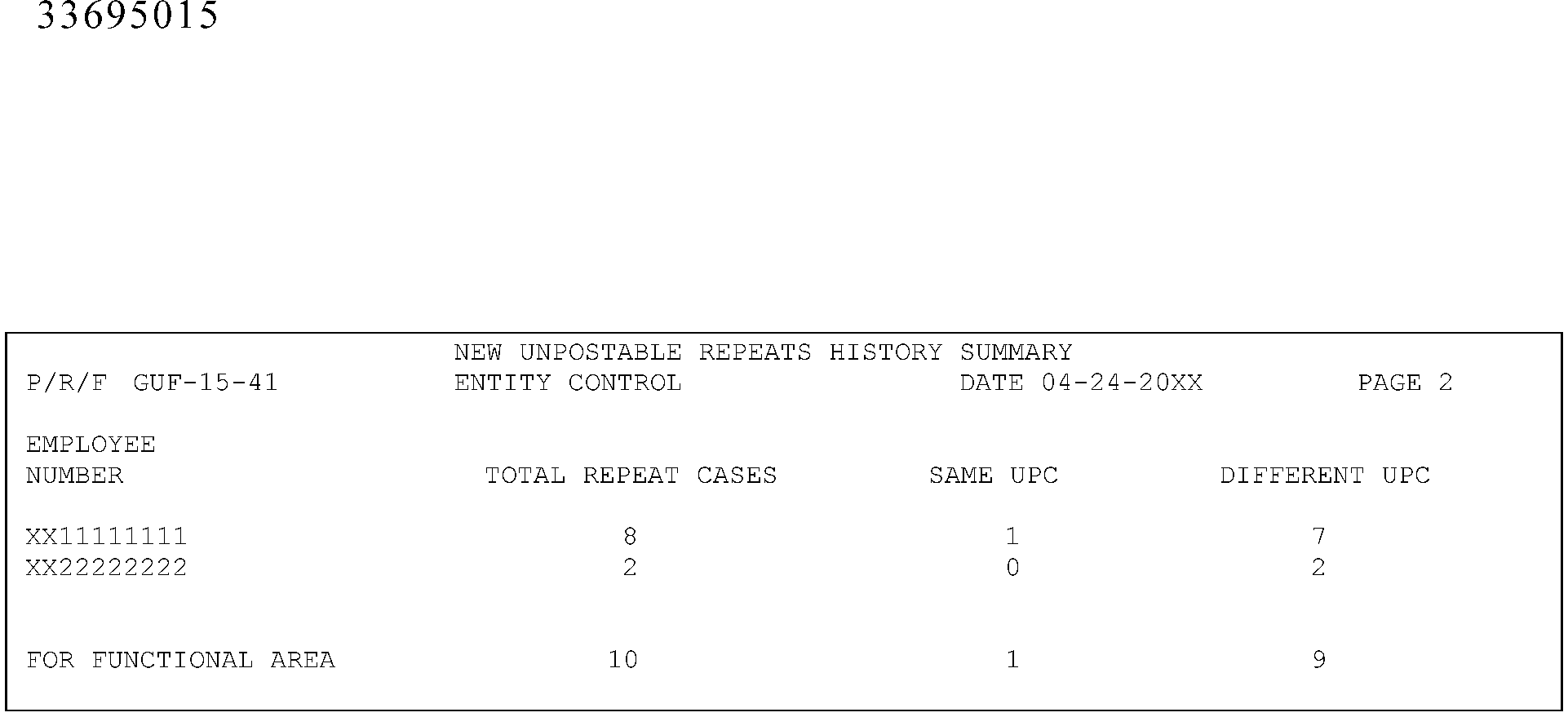
Figure 3.12.32-15 provides an example of the GUF 15-41, New Unpostable Repeats History Summary.
Please click here for the text description of the image.
3.12.32.20.10 (01-01-2021)
GUF 21-40, Daily Unpostable Case Assignment List
-
The GUF 21-40, "Daily Unpostable Case Assignment List" report, includes the prior day case reassignment and case status change (i.e., suspense or closed) for an employee IDRS number. The list is sorted in ascending order by area, employee number, master file, status code, history indicator and unpostable cycle sequence number (UP SEQ NUM).
-
The report contains each employee IDRS number with assigned cases.
-
The following data is included in the report:
-
STATUS CODE
-
MASTER FILE
-
SEQUENCE NUMBER
-
CAT CD
-
UPC
-
STATUS DATE
-
REASSIGNED BY
-
AGED IND
-
-
The following defines the single alpha indicator as it appears when applicable to the specific transaction:
-
"R" - Repeat
-
"S" - Special repeat
-
"C" - Refund
-
"H" - History
-
"*" - Potential aged case
-
"+" - Aged case
-
-
The status code and cases assigned to each employee totals are included in the report.
-
See Figure 3.12.32-16 for an example of the GUF 21-40 report.
Figure 3.12.32-16
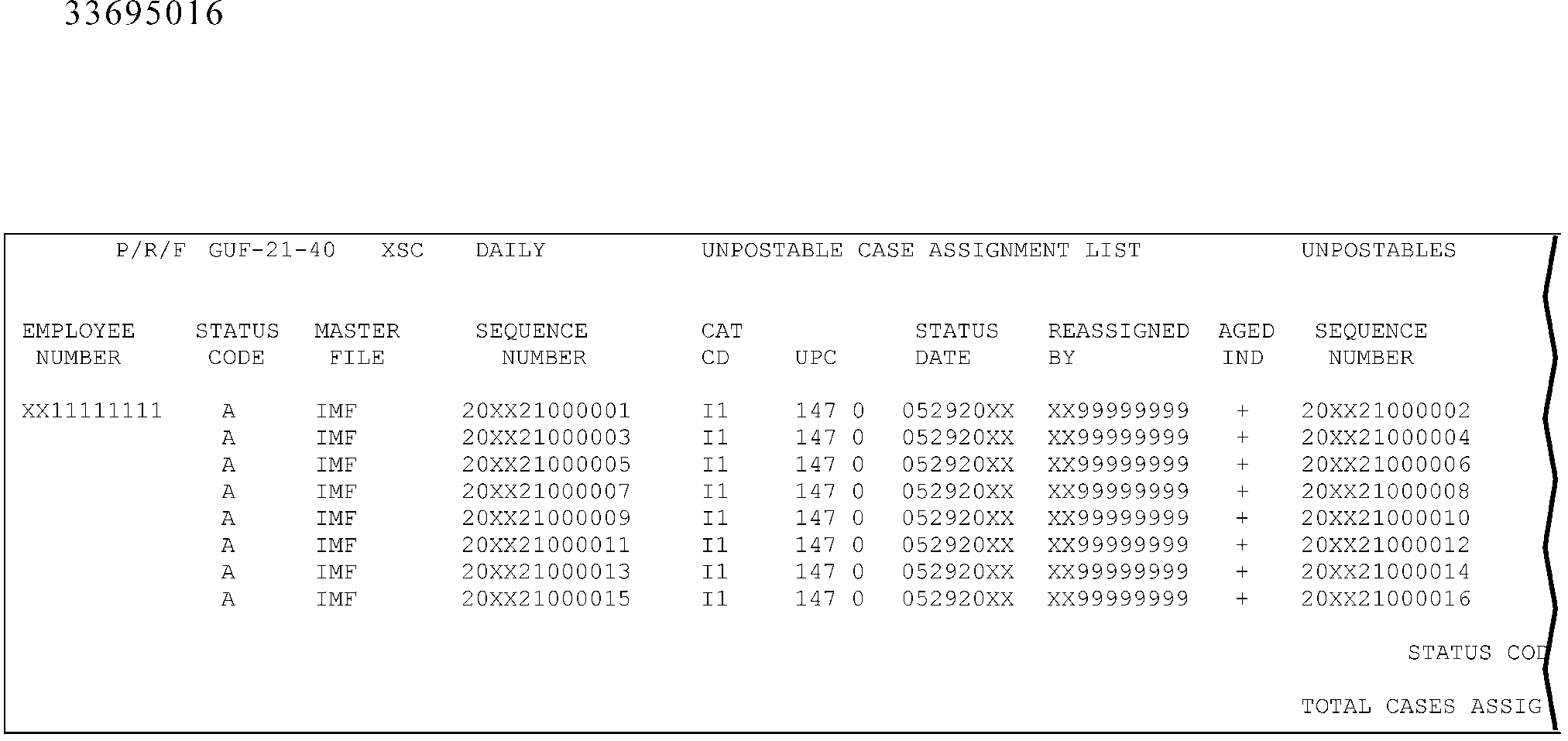
Title: Figure 3.12.32-16, GUF 21-40, Unpostable Case Assignment List. Pictured is an except from the report as described above.
Please click here for the text description of the image.
3.12.32.20.11 (01-01-2021)
GUF 21-41, Unpostable Rejected Activity List and GUF 21-42, Unpostables Rejected Activity Summary
-
The GUF 21-41, "Unpostable Rejected Activity List" is a listing of reassignment, batch resolution, and With-Remittance (ISRP/RPS) resolution activities that failed GUF validity checks and dropped from further unpostable processing.
-
The rejected activity list is sorted by area, employee IDRS number of the unpostable closure, master file and unpostable sequence number (UP SEQ NUM).
-
The list contains the UP SEQ NUM, command code, activity code, status code, status date, reject code, and the new employee number (if applicable).
-
The unpostable activity code is used to determine what information is to be updated on the Service Center Unpostable Master File (SCUPMF). Activity Codes 0, 1, 2, 3, 6, and 8 are valid for individual case closures, but they result in a record and an activity code of "C." The activity code values and meanings are as follows:
Values Meanings "B" Batch reassignment, updates the SCUPMF. "C" Individual case closure, SCUPMF updated. "D" Charge-Out Request (Form 4251, Return Charge-Out) generated. Updates unpostable record to "Suspense" status. "E" Error, Quality Review identified; updates the SCUPMF; and Status Code is changed from "C" to "A." The Remarks and all Corrections are deleted. "H" Quality hold, updates the SCUPMF. Closed cases are delayed from being purged from the SCUPMF. "J" With-Remittance (ISRP/RPS) cross reference number updates cross reference number of SCUPMF with sequence number of matching With-Remittance (ISRP/RPS) transaction code (TC) 150 unpostable record. "K" With-Remittance (ISRP/RPS) cross reference number updates cross reference number of SCUPMF with sequence number of matching With-Remittance (ISRP/RPS) TC 610 unpostable record. "M" Microfilm Replacement System (MRS) transcript request. A partial, complete or entity module transcript generated. Updates unpostable record to "Suspense" status. "Q" Quality Review accept of a closed (corrected) case, SCUPMF updated. "R" Individual reassignment, updates the SCUPMF; deletes the "old" assignment and establishes a "new" case assignment during real time. "S" Open case in suspense status, updates the SCUPMF. "T" Batch Delete, drops from processing a batch closure activity record; does not update the SCUPMF. "W" Reversal of Batch Closure. Updates a previously batch-closed SC–UNPOSTABLE-REC to assigned status. "3," "6," "F," "G" With-Remittance (ISRP/RPS) case closure because of a With-Remittance (ISRP/RPS) TC 150 and TC 610 match; updates SCUPMF. "D," "0," "1," "2," "8" Mass closures, updates the SCUPMF to a closed status. Valid only when mass closing groups of cases assigned to a "unit" employee IDRS number. "Z" Unpostable history section of CC UPCAS entered, updates the SCUPMF. "4" Fourth Charge-out Request (Form 4251) generated, SC-UNPOSTABLE-REC, closed by CC UPCAS with "Rejects Resolution" remarks (8). -
The Real-time Activity Priority Sort Code is a value derived from the unpostable activity code which is used to determine the sequence information (command code requests) attempts to post to the SCUPMF. The priority sort code values are as follows; (listed from highest priority (01) to lowest (13)).
Values Meanings 01 Individual reassignment (real time) 02 Batch reassignment 05 Suspense 06 Individual closed case 07 Batch closed cases 08 Automatic With-Remittance (ISRP/RPS) Corrections 09 Quality Hold 10 Quality Accept 11 Quality Error 12 With-Remittance (ISRP/RPS) cross reference sequence number entered 13 Reversal Batch closure Activity 99 Unpostable history section entered -
The various unpostable records are prioritized and sorted in the proper sequence for application to update the SCUPMF.
-
All actions to update the SCUPMF are subject to "Unpostable Activity Code and Unpostable Status Code" valid combination checks as shown by the "Unpostable Update Code."
-
The valid status and activity code combinations are determined by an "Unpostable Activity Status Table."
-
-
The conditions causing the record to reject are described on the Unpostable Reject Codes.
-
Except for reject code "X," the reject code will contain a value extracted from the Unpostable Activity Status Table.
-
The codes from this table are used to determine the validity of each request to update the SCUPMF.
Code Condition "H" An attempt to update an unpostable record With-Remittance (ISRP/RPS) closure (correction) data and the unpostable status code is "C," "H," "S," or "Q," or if it is not campus or unit assigned, the request is invalid. "J" An attempt to batch reassign an unpostable record with a new employee IDRS number and the current unpostable record status is "C," "H," or "Q," the request is invalid. "K" An attempt to obtain a fourth Charge-Out Document (Form 4251) for a case closed to Rejects and the case subsequently changed via other activities. "L" An attempt to obtain a charge-out document (Form 4251) and the status of the unpostable case is not "Suspense" except for CC UPCAS definer "D" with definer modifier "4." "M" An attempt to update an unpostable record with batch closure correction data and the unpostable record status is not "A" or the case is assigned to an individual. "R" An attempt to update an unpostable case with a batch closure using an unpostable resolution code not valid with the transaction being corrected. "T" An attempt to reverse a batch closure action and the unpostable case has not batch closed. "X" An attempt to update an unpostable case with a sequence number that is not on the data base. "Y" An attempt to reassign the same unpostable case more than once on the same day with CC UPASG, definer "B." "Z" An attempt to batch reassign a case that is individually reassigned the same day with CC UPASG definer "R." -
-
See Figure 3.12.32-17 for an example of the GUF 21-41 report.
Figure 3.12.32-17
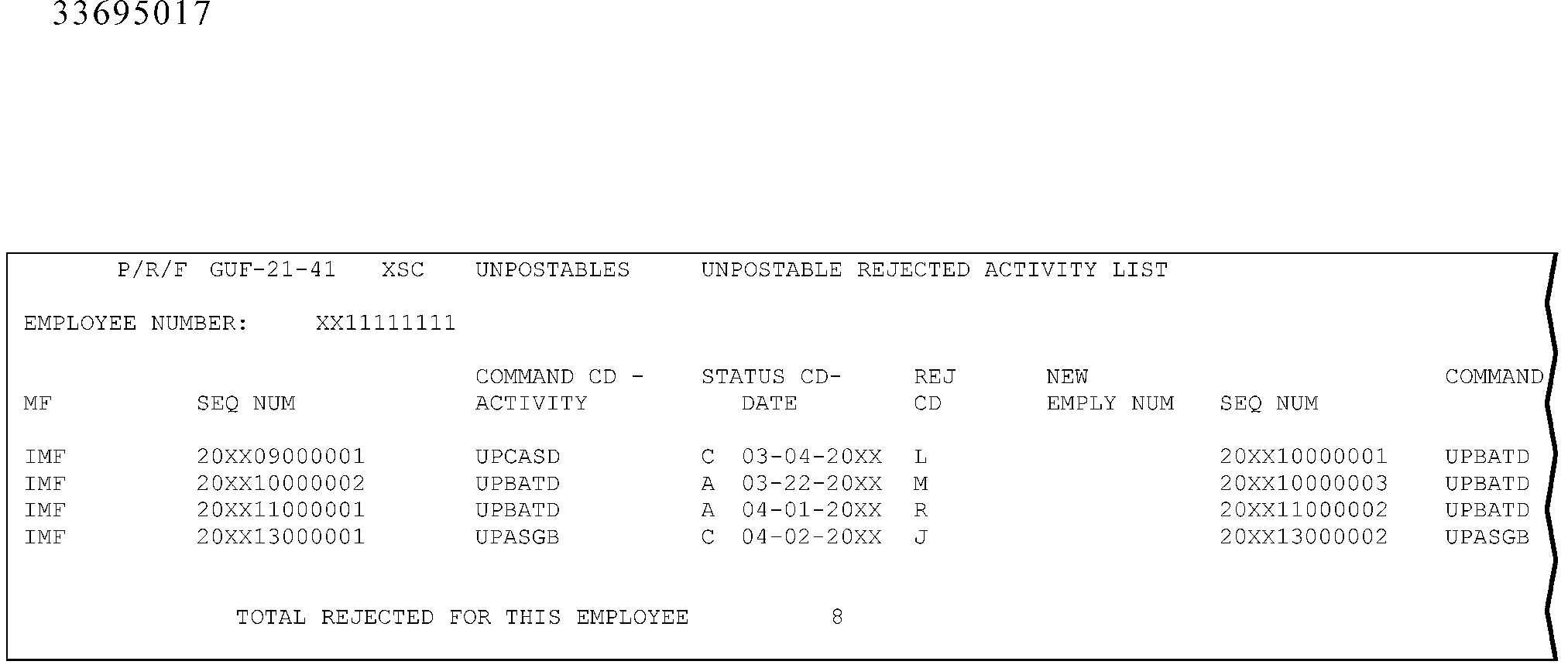
Title: GUF 21-41, Unpostable Rejected Activity List. Pictured is an example of a report for Ogden. The report is sorted by “EMPLOYEE NUMBER”. Under the “EMPLOYEE NUMBER” are all the rejected cases for that employee. The following items are listed for each record:SEQ NUMCOMMAND CD-ACTIVITYSTATUS CD-DATEREJ CDNEW EMPLY NUM After all the records for an employee, then there is a line item, “TOTAL REJECTED FOR THIS EMPLOYEE”.
Please click here for the text description of the image.
-
All rejected codes reflect the unpostable status code and status date.
-
Reject codes "B," "H," "J," "L," and "M" appear on the list to identify invalid activity code and status code combinations.
-
If the reject code is "H" or "J," then the employee assignment number appears on the list.
-
Reject code "A" should not appear on the list because the code identifies a valid combination of the activity code and the status code.
-
Reject code "X" identifies a failure to match the record on UP SEQ NUM.
-
-
The GUF 21-42, Unpostable Rejected Activity Summary report, lists the employee number within each functional area of assignment, reassignment, individual and batch resolutions, suspense and quality review activities that failed validity checks. This report summarizes the GUF 21-41, Unpostable Rejected Activity List.
-
See Figure 3.12.32-18 for an example of the GUF 21-42 report.
Figure 3.12.32-18
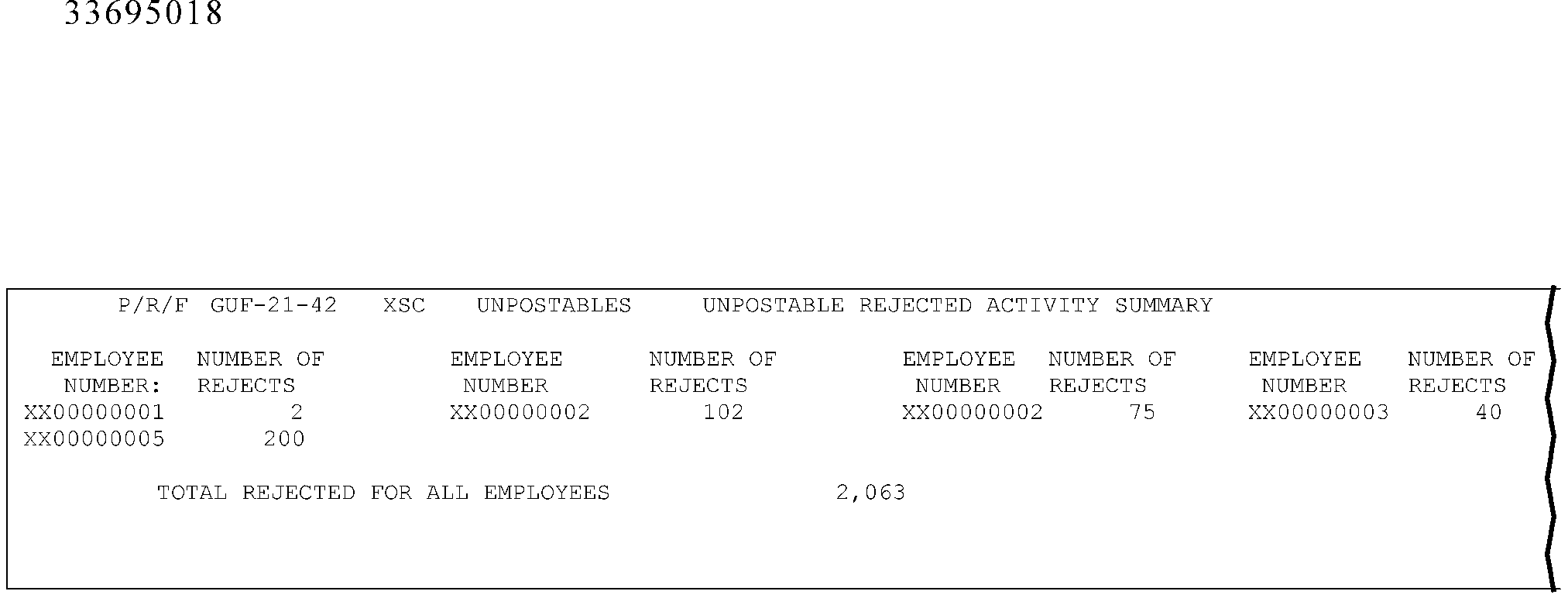
Title: GUF 21-42, Unpostable Rejected Activity Summary. Pictured is an example of the GUF 21-42 report for Ogden. The report is sorted by Functional Area and then by Employee Number. At the top of the report is the functional area “UNPOSTABLES”. Next are individual records under the column headings, “EMPLOYEE NUMBER” and “NUMBER OF REJECTS”. There are five sets of records on each line. After all the records for the “UNPOSTABLE” functional area, there is a line entitled “TOTAL REJECTED FOR ALL EMPLOYEES”.
Please click here for the text description of the image.
3.12.32.20.12 (01-01-2023)
GUF 21-43, Unpostable Closed Case List and GUF 21-44, Unpostable Closed Case Summary
-
The GUF 21-43, "Unpostables Closed Case List" report, provides information about the cases closed by each employee.
-
For each case closed, the report provides:
-
Sequence Number
-
Category
-
Unpostable Resolution Code
-
Type of closure, individual (I) or batch (B)
-
Status Date
-
-
The GUF 21-43, Unpostable Closed Case List and the GUF 21-44, Unpostable Closed Case Summary are sorted by area, employee number(s), Master File, and sequence number.
-
The Total Closed Cases is also shown for each employee number by Organization, Function and Program (OFP) code designation:
-
F1 and F3
-
L1
-
BATCH
-
INDIV (Individual)
-
CAF
-
TOTAL
-
-
The employee number is the employee who closed the unpostable case.
-
The Unpostable Closed Case Lists are used to:
-
Identify closed cases (CC UPRES, CC UPCAS with definer "D" and modifier "4," and CC UPBAT) to the Quality Review function.
-
Provide closed case information (volumes) to the employee and manager.
-
Help prepare employee time sheets by recording the correct volume under the applicable OFP Code.
-
-
See Figure 3.12.32-19 for a partial GUF 21-43 report.
Figure 3.12.32-19
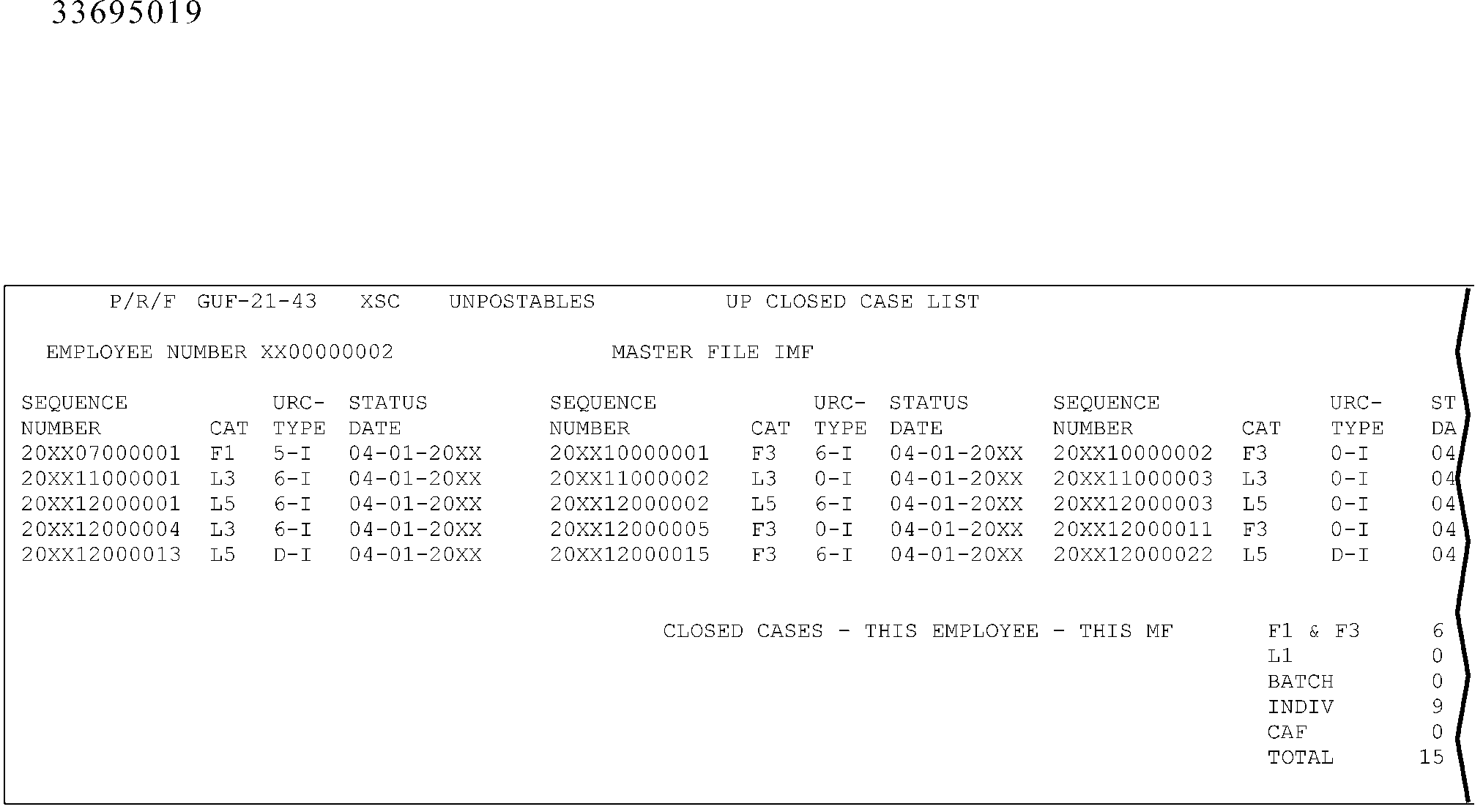
Title: GUF 21-43, UP Closed Case List. Pictured is a partial report as described in the text above.
Please click here for the text description of the image.
-
See the example of the GUF 21-44 Report, UP Closed Case Summary below.
Figure 3.12.32-20
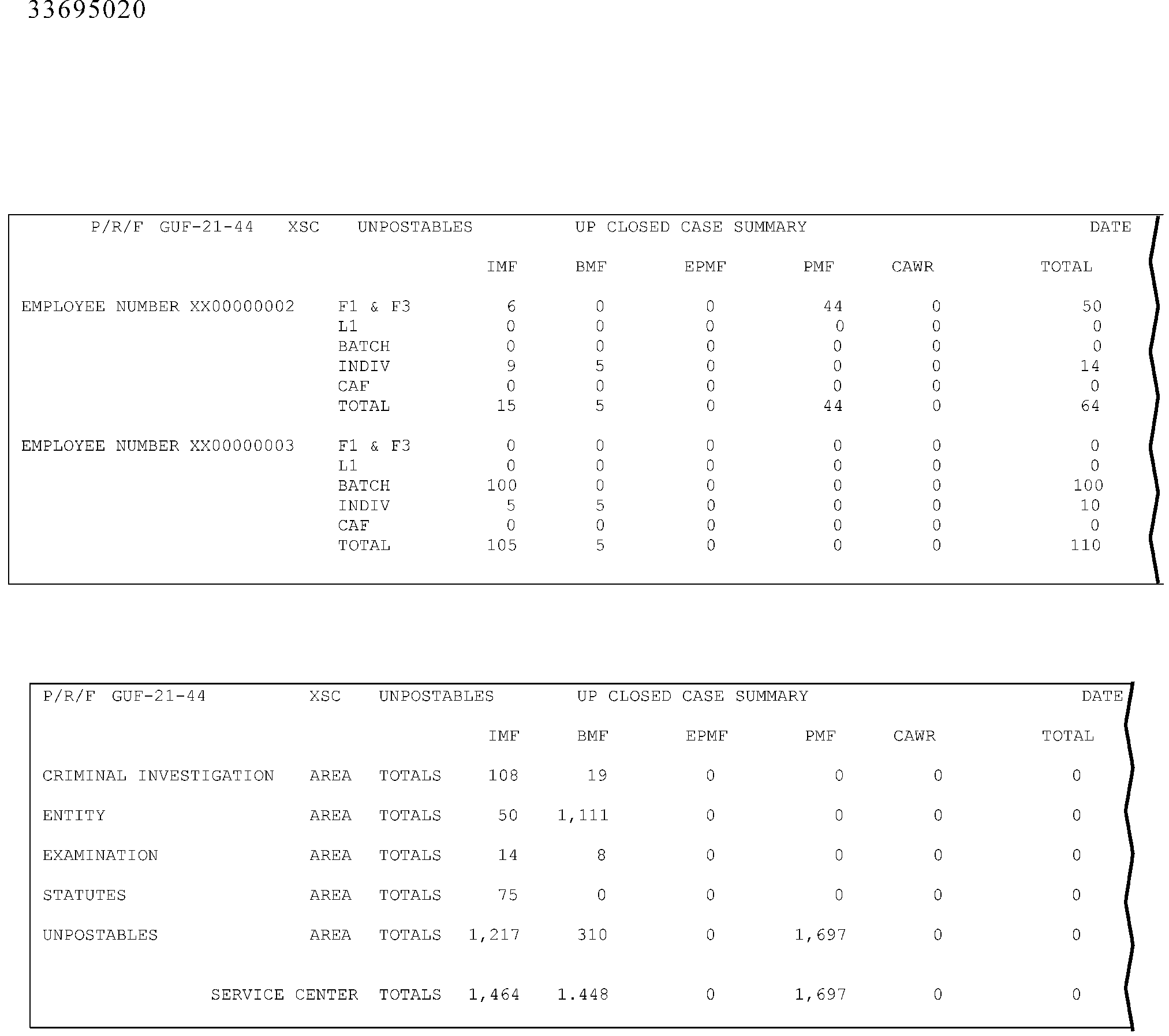
Title: GUF 21-44, UP Closed Case Summary. Pictured are two sections from the report. The first excerpt shows the total number of closed cases for each employee number, by OFP category and Master File. The second excerpt shows the section at the bottom of the report with total numbers for each functional area by Master File.
Please click here for the text description of the image.
-
The GUF 21-44 summary report should be used by management to ensure the correct volume of cases are used with the appropriate OFP codes on the employee time sheets.
3.12.32.20.13 (01-01-2021)
GUF 21-46, Batch Delete List
-
The GUF 21-46, Batch Delete List report identifies the disposition of all CC UPBAT activity records with definer code "T" (batch delete) that were processed during the day.
-
For each employee number, the report lists:
-
Command Code Activity
-
Beginning Unpostable Sequence Number
-
Ending Unpostable Sequence Number
-
Remarks/Results
-
Total UPBAT (T) Records Processed
-
-
See Figure 3.12.32-21 for an example of the GUF 21-46 report.
Figure 3.12.32-21
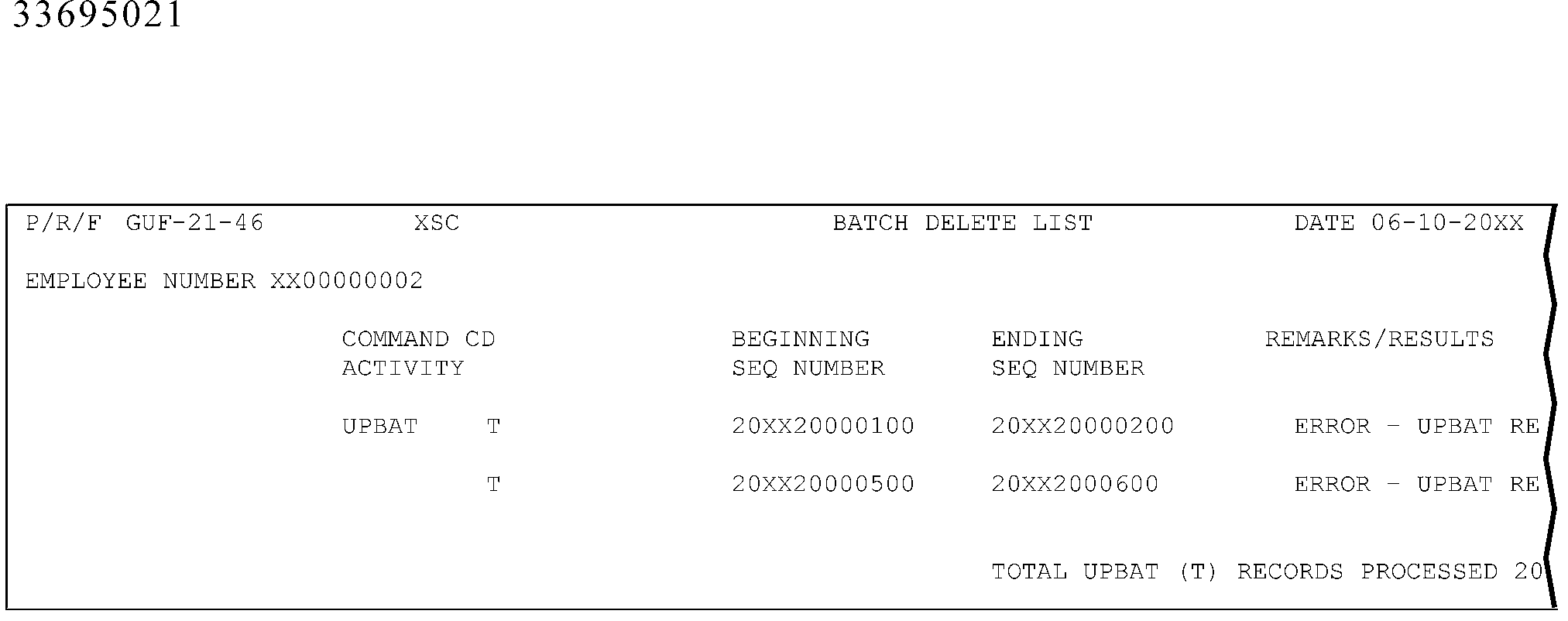
Title: Figure 3.12.32-21, GUF 21-46, Batch Delete List. Pictured is an example of the GUF 21-46 report described in the text above.
Please click here for the text description of the image.
3.12.32.20.14 (01-01-2021)
GUF 51-40, List of Unmatched GUF Data Base and Transaction File Records
-
The GUF 51-40, List of Unmatched GUF Data Base and Transaction File Records report identifies possible processing and/or program problems due to unmatched GUF correction data with the original unpostable transaction record.
-
For each unmatched record, the report provides the following data:
-
Type
-
Page/Record
-
Unpostable Sequence Number
-
Master File
-
DLN
-
TIN
-
-
Contact the CSA for necessary action (if any). See Figure 3.12.32-22 for an example of the GUF 51-40.
Figure 3.12.32-22
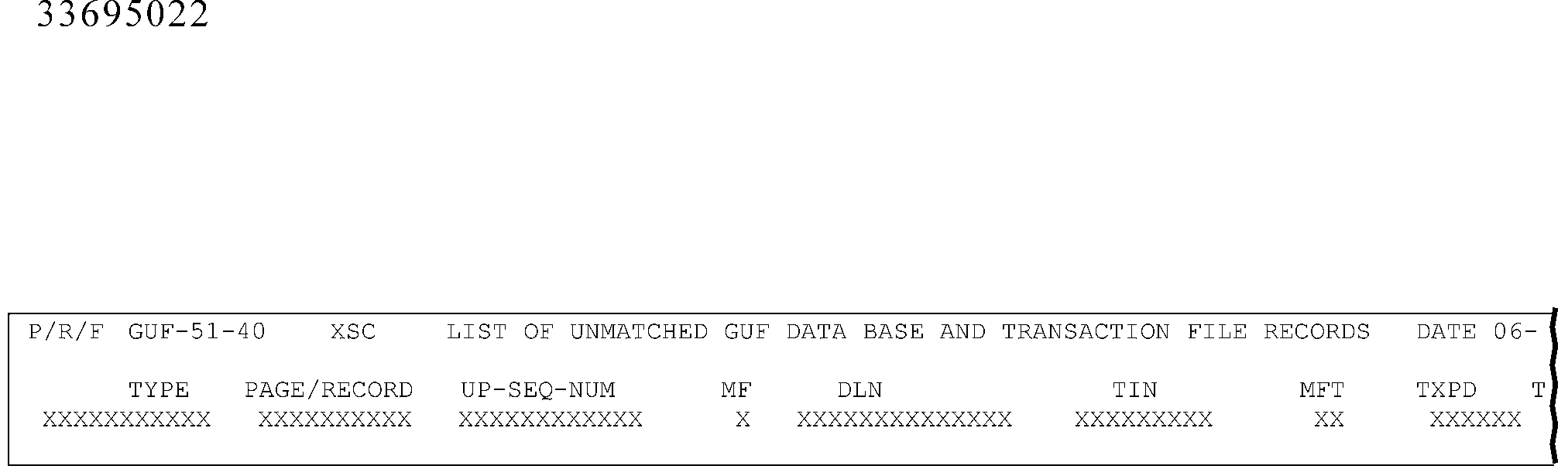
Title: Figure 3.12.32-22, GUF 51-40, List of Unmatched GUF Data Base and Transaction File Records. Pictured is an example of the report described in the text.
Please click here for the text description of the image.
3.12.32.20.15 (01-01-2021)
GUF 51-41, List of Correction Errors
-
The GUF 51-41, List of Correction Errors report identifies possible processing or program problems including invalid database corrections.
-
GUF programming will run consistency checks to ensure the resolution code (URC) agrees with the data elements in the GUF correction record. If an inconsistency is found, the unpostable case will be treated as unresolved and placed on the "error list." The case will not be removed from the Service Center Unpostable Master File (SCUPMF).
-
See Figure 3.12.32-23 for an example of the GUF 51-41 report.
Figure 3.12.32-23
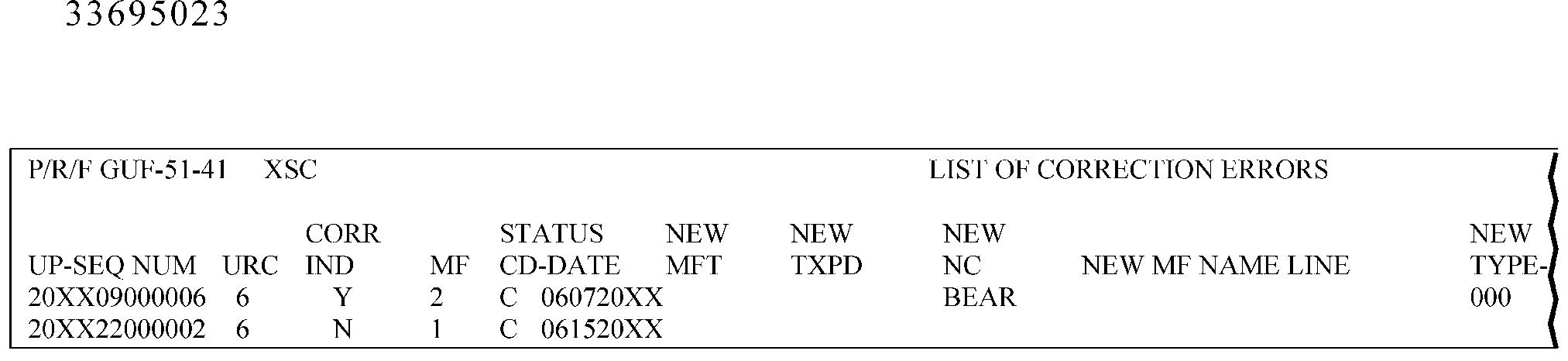
Title: Figure 3.12.32-23, GUF 51-41, List of Correction Errors. Pictured is an example of a partial GUF 51-41 report. The report has the following columns:Unpostable Sequence NumberURCCORR INDMF (Master File)Status CD-DateNew MFTNew TXPDNew N/C STORNew MF Name Line
Please click here for the text description of the image.
-
Resolve the unpostable condition by reworking the case following original unpostable instructions.
3.12.32.20.16 (01-01-2021)
GUF 51-45, Accounts Receivable Listing for Unpostables and GUF 53-44, Accounts Receivable Report for Unpostables
-
The GUF 51-45, Accounts Receivable Listing for Unpostables report is a weekly cumulative listing of all open (unresolved) Accounts Receivable cases.
-
Cases are sorted by Master File, and then by cycle sequence order.
-
A separate list is created for each functional unpostable area.
-
-
The listing provides information on the cases in the unpostable inventory which meet Accounts Receivable criteria. The following is the criteria set for cases on this report:
-
A transaction with a pre-journalized amount ≡ ≡ ≡ ≡ ≡ ≡ ≡ ≡ ≡ ≡ ≡ and is a Document Code 17, 18, 19, 24, 34, 48, or 58.
-
A transaction code 290 with a secondary transaction code 291, 295, or 299 ≡ ≡ ≡ ≡ ≡ ≡ ≡ ≡ ≡ ≡ ≡ ≡ ≡ ≡ ≡ ≡ ≡ ≡ ≡ ≡.
-
A transaction code 300 with a secondary transaction code 301, 305, or 309 ≡ ≡ ≡ ≡ ≡ ≡ ≡ ≡ ≡ ≡ ≡ ≡ ≡ ≡ ≡ ≡ ≡ ≡ ≡.
-
-
See Figure 3.12.32-24 for an example of the GUF 51-45 report.
Figure 3.12.32-24
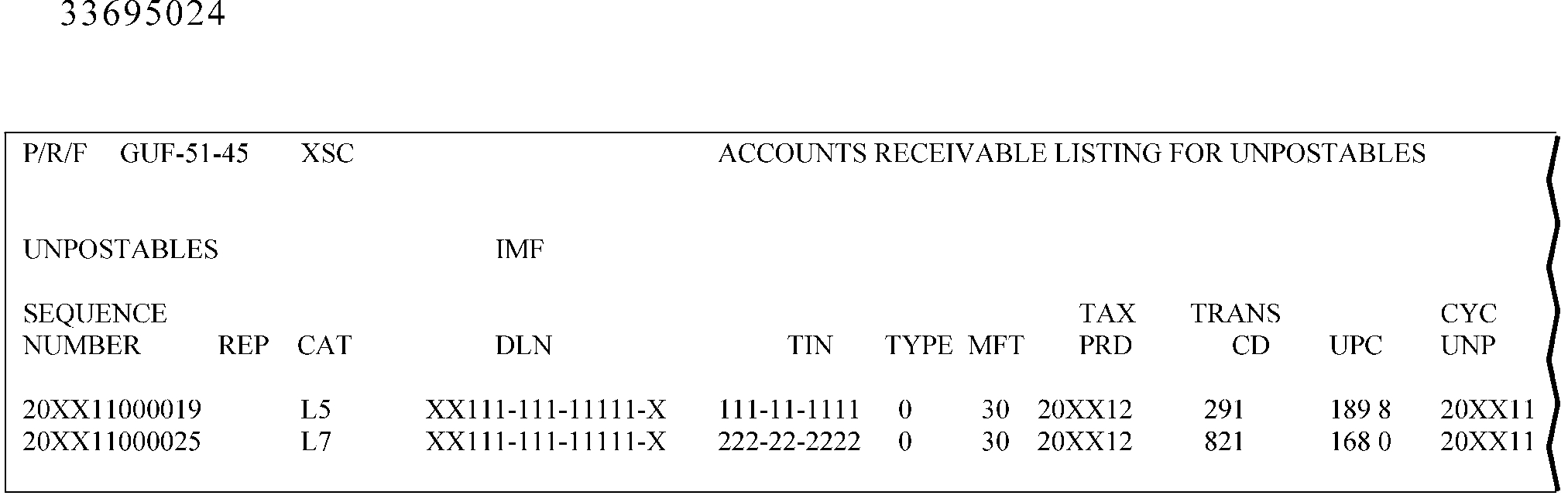
Title: Figure 3.12.32-24, GUF 51-45, Accounts Receivable Listing For Unpostables. Pictured is an excerpt from the listing. It shows the BMF unpostable transactions that meet accounts receivable criteria. The listing has the following columns:Sequence NumberREP (repeat)CAT (category)DLNTINTYPEMFTTAX PRDTRANS CDUPCCYC UNP
Please click here for the text description of the image.
-
The GUF 53-44, Accounts Receivable Report for Unpostables is a monthly listing consisting of counts and amounts of payments and abatements ≡ ≡ ≡ ≡ ≡ ≡ ≡ ≡ ≡ ≡ ≡, by Master File within a functional area.
-
See Figure 3.12.32-25 for an example of the GUF 53-44 report.
Figure 3.12.32-25
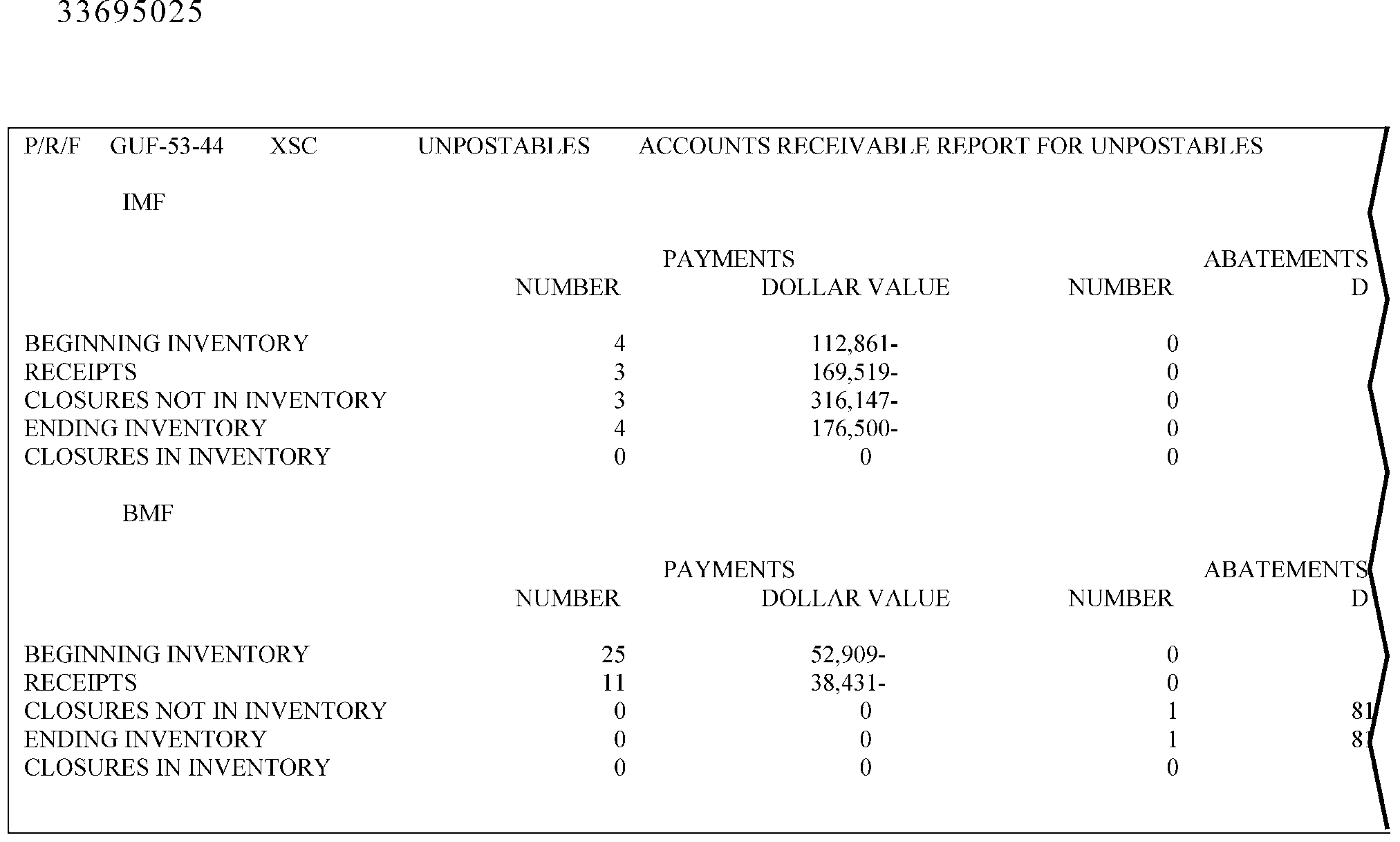
Title: Figure 3.12.32-25, GUF 53-44, Accounts Receivable Report for Unpostables. Pictured is an excerpt from the report. described in the text below.
Please click here for the text description of the image.
-
The listing provides:
-
Beginning inventory count and dollar amount of payments and abatements.
-
Current receipts count and dollar amounts of payments and abatements.
-
Closures not in the inventory count and dollar amounts of payments and abatements.
-
Ending inventory count and dollar amounts of payments and abatements.
-
Closures in inventory count and dollar amounts of payments and abatements.
-
3.12.32.20.17 (01-01-2021)
GUF 51-46, GUF IMF Long Entity Information Report
-
The GUF 51-46, GUF IMF Long Entity Information Report provides taxpayer information from returns that unpost as UPC 140, 151, 153, 154 and 176. The listing is an extract of Individual Master File (IMF) cases from the GUF 5101 SC-UNPOSTABLE-TRANSACTION-FILE.
-
The IMF Long Entity Report provides the following information for each case:
-
Unpostable Sequence Number (sorted by)
-
Primary and Secondary TINs
-
Tax Period
-
Primary and Secondary Taxpayer Name and Address
-
Unpostable Code
-
-
See Figure 3.12.32-26 for an example of the GUF 51-46 report.
Figure 3.12.32-26
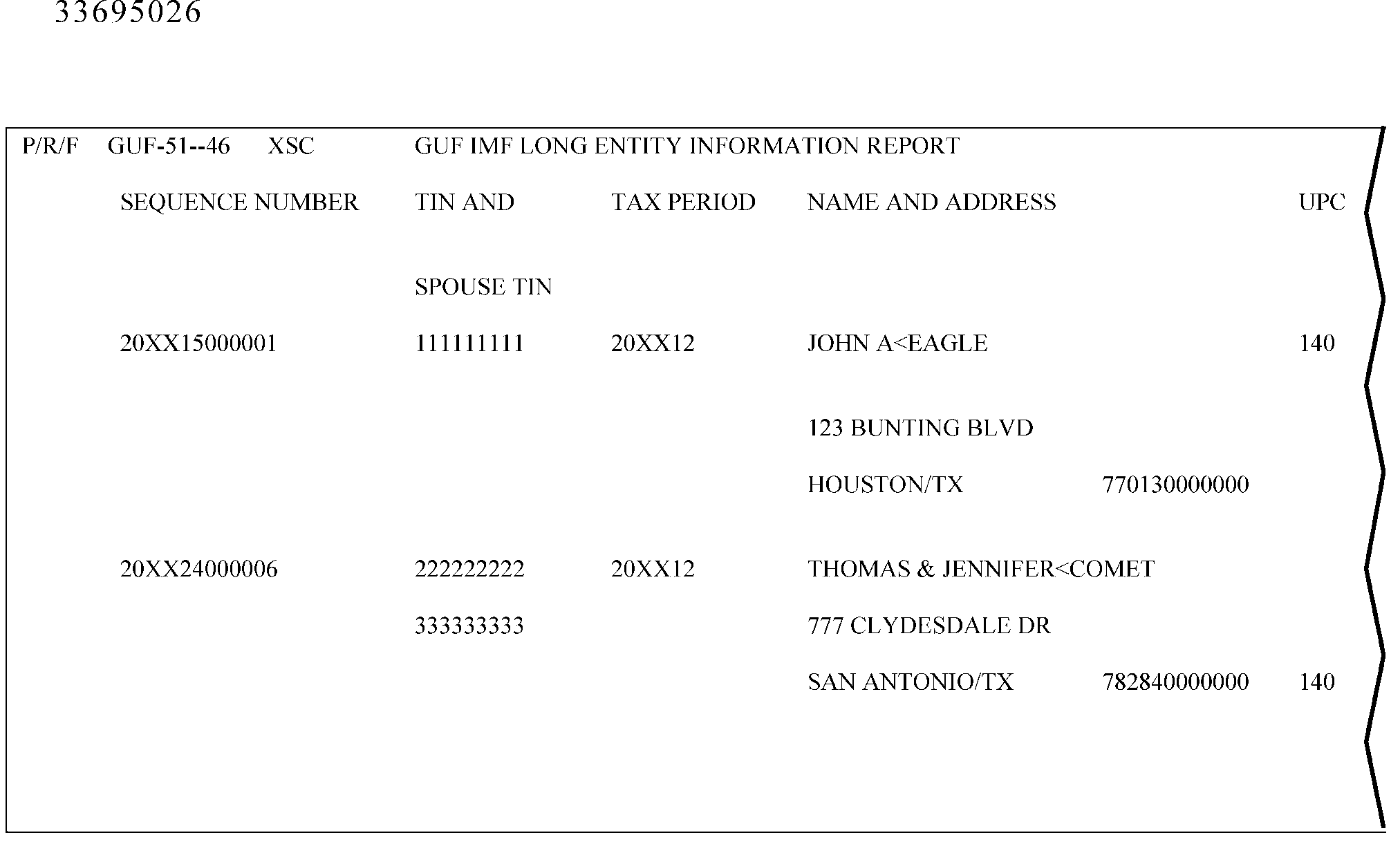
Title: Figure 3.12.32-26, GUF 51-46, GUF IMF Long Entity Information Report. Pictured is an excerpt of the report described in the text above.
Please click here for the text description of the image.
3.12.32.20.18 (01-01-2021)
GUF 53-40, Unpostable Control Report
-
The GUF 53-40, "Unpostable Control Report," is used as a management tool to monitor unpostable case closures sorted by Unpostable Resolution Code (URC) and the unresolved unpostable inventory by cycle. A separate Unpostable Control Report is produced for each Master File.
-
The GUF 53-40 report is not produced for separate areas processing unpostable cases.
-
The GUF 53-40 report is used by Accounting. See IRM 3.17.30, SC Data Controls.
-
See Figure 3.12.32-27.
Figure 3.12.32-27
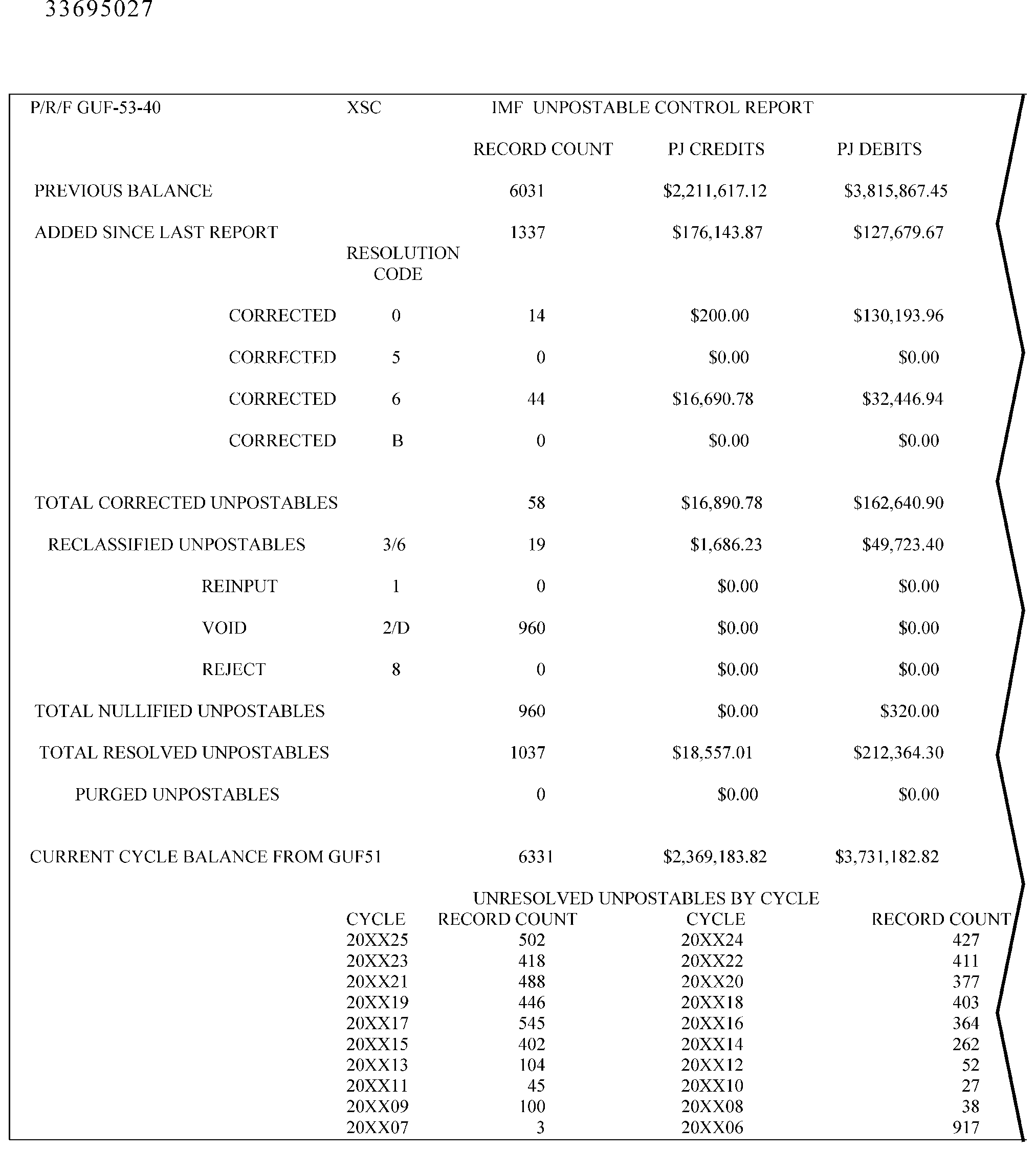
Figure 3.12.32-27 provides an example of the format for the GUF 53-40, Unpostable Control Report.
Please click here for the text description of the image.
3.12.32.20.19 (01-01-2021)
GUF 53-41, Unpostable Workload Report
-
The GUF 53-41, Unpostable Workload Report, lists the inventory count of workable, unworkable, and closed - unreleased cases for Individual Master File (IMF), Business Master File (BMF), and Employee Plan Master File (EPMF) for each area working unpostables (CI, Entity, Exam, Statutes, Unpostables, EPMF Entity Unpostables, Exempt Organization, AMTAP and LB&I).
-
The inventory report can be used as a management tool to identify the current workload and to determine the necessary resources for maintaining a manageable inventory.
-
This report should also be used to monitor the "unworkable" volumes, especially the suspended cases and cases awaiting documents. Follow-up action should be taken for these cases to ensure timely processing per each function’s unpostable procedures and guidelines.
-
The GUF 55-40, Unpostable Employee Assignment/Aged Listing can also be used to help identify and monitor the specific status of the cases on the inventory reports for each area. See IRM 3.12.32.20.21, GUF 55-40, Unpostable Employee Assignment/Aged List and GUF 55-42, Unpostable Employee Assignment/Aged Summary for detailed information on the GUF 55-40 report.
-
See Figure 3.12.32-28.
Figure 3.12.32-28
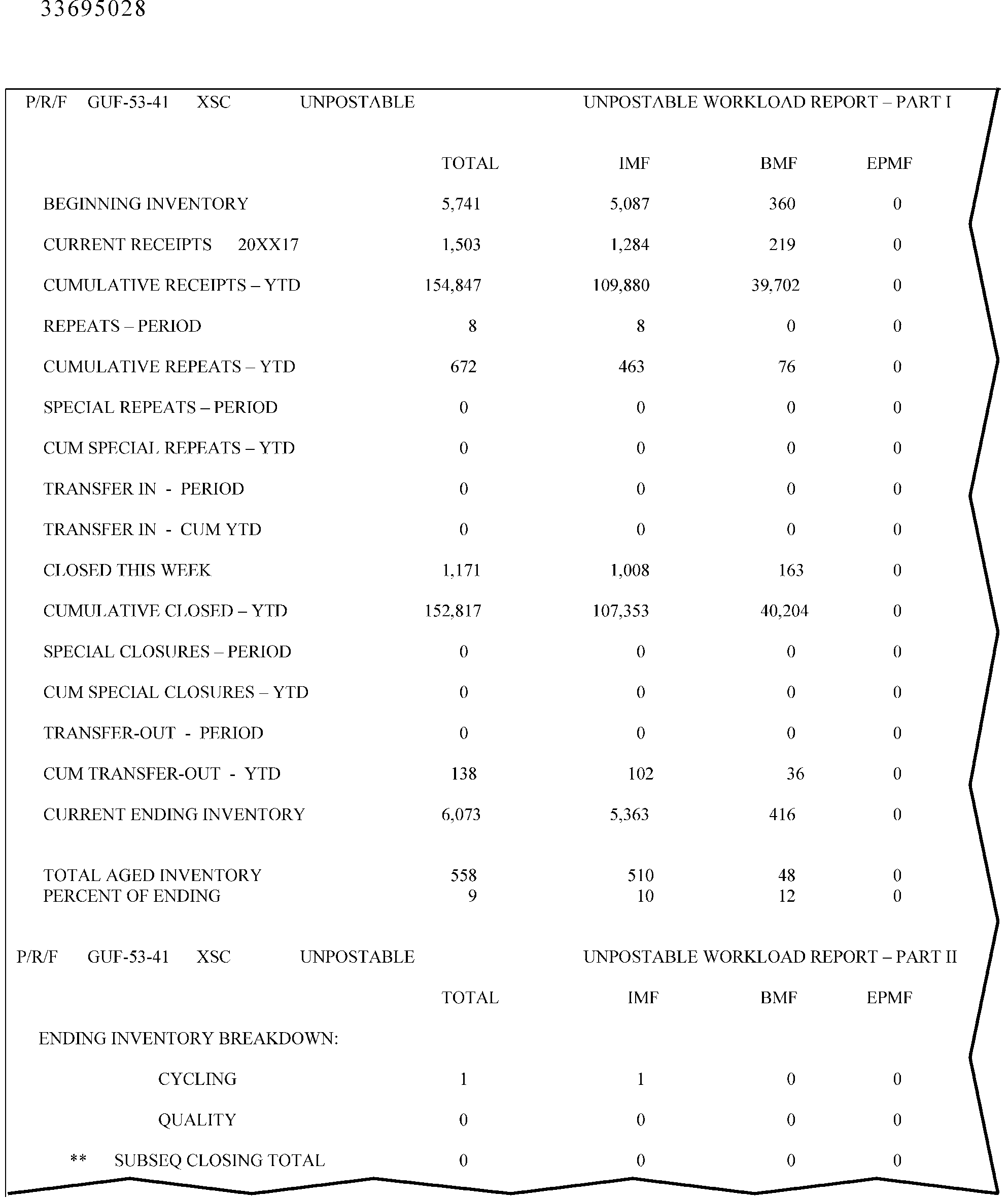
Figure 3.12.32-28 provides an example of the format for the GUF 53-41, Unpostable Workload Report.
Please click here for the text description of the image.
Note:
"CURRENT RECEIPTS" will display all receipts run in the GUF system for the processing week. The cycle identified will be the most current cycle (as shown for your cycle sequence number that week) run into GUF.
-
-
"Repeats-Period" and "Cumulative Repeats-YTD" are counts of all repeats generated for the week and year to date.
-
"Special Repeats-Period" and "Cum Special Repeats-YTD" are counts of only repeat unpostables that were closed from the special closure program.
-
"Special Closures-Period" and "Cum Special Closures-YTD" are counts of closed unpostables from the special closure program (URC B).
-
"TRANSFER-IN PERIOD," "TRANSFER-IN-CUM YTD," "TRANSFER-OUT PERIOD," and "TRANSFER-OUT-CUM YTD" identifies the cases being re-assigned will be reflected in this report as Transferred-in or Transferred-out by functional area.
-
The report provides the "Current Ending Inventory," "Total Aged Inventory," and "Percent of Ending" for aged cases.
-
The "XXXs" shown after the Current Ending Inventory are where volumes would show if an Out-of-Balance condition existed.
-
The "unworkable" cases on this report include "open" (unworked) unpostable records that meet one of the following conditions:
-
Bankruptcy and With-Remittance (ISRP/RPS) Unit Assigned - For With-Remittance (ISRP/RPS) cases, the employee number is a "campus" or "unit" number and the category code is "Y1" /"Y2" . For Bankruptcy cases, the employee number is a "campus," "unit," or "individual" number and the category code is "Z1" . Bankruptcy unpostables will not be included in aged inventory.
Note:
Although cases show as "unworkable" for normal case closure, Categories "Y1" and "Z1" are subject to initial unpostable processing guidelines per the New Unpostable Report, the With-Remittance (ISRP/RPS) Listings and the Bankruptcy AO Listings.
-
SUSPENSE - These cases should be monitored by the responsible tax examiner and management to ensure cases do not incur incorrect and/or lengthy suspense periods. The cases should also be monitored for statute and credit interest considerations.
-
FILES REQ - Cases in this group are files requests entered through GUF by CC UPCAS with definer "D" and modifiers "1," "2," or "3."
-
Microfilm Replacement System (MRS)TRANSCRIPTS - Cases in this group are MRS or MCC transcript requests entered through GUF by CC UPCAS with definer "M" and modifiers "A-T."
-
CORRESPONDENCE - Cases in this group are unpostables that needed corresponding. A case is automatically placed in this group when CC UPCAS with definer "S" and modifier "C" is used.
-
ALL OTHER - Includes any other suspended unpostables.
-
-
SUBSEQ CLOSING TOTAL - The "closed" cases on this report include corrected cases that are closed (includes cases being cycled), and cases that are in a quality review accepted or a quality review "hold" status on the Service Center Unpostable Master File (SCUPMF). These "closed" cases (except certain cycling cases) should be removed from the SCUPMF during the next weekly update and will not be included in the percentage of aged inventory.
-
The "workable" cases on this report include all individual, campus or unit assigned cases that are available for case assignment and/or closure action that are not included in unworkable, suspense or closed inventory.
3.12.32.20.20 (01-01-2021)
GUF 53-43, Weekly Resource and Inventory Report for OFP
-
The GUF 53-43, Weekly Resource and Inventory Report for OFP (Organization, function and program codes) provides the volume for all unpostable records in processing. The volumes are used for input to the Workload Performance and Control (WP&C) report.
-
The report is organized by functional area and then by Master File.
-
Under each Master File, the volumes of unpostables are broken down into two sections by status in processing. The first section contains: Beginning Receipts, Add Transfer-In and Adjustments, Less Transfer-Out, Auto Closures, RPS Auto Closed and Adjustments, Ending Receipts. The second section contains Beginning Closures, Less Auto Closures, RPS Auto Closed, Adjustments and Ending Closures.
-
The volumes in each processing phase are further identified by program type:
-
INDIVIDUAL
-
F1/F3
-
ELF
-
BATCH
-
L1
-
CAF
-
CAWR
-
PMF
-
-
At the bottom of the report are the volumes for "TOTAL ENDING RECEIPTS - ALL MFs" and "TOTAL ENDING CLOSURES - ALL MFs."
-
"ENDING RECEIPTS" and "ENDING CLOSURE" volumes are the figures used when preparing the unit production cards.
Note:
A unit production card is prepared for CAF unpostables, using the Total lines for all Master Files, as shown at the end of the report.
-
It is strongly recommended that the Criminal Investigation, Examination, and Statute function use this report.
-
See Figure 3.12.32-29 for an example of the GUF 53-43 report.
Figure 3.12.32-29
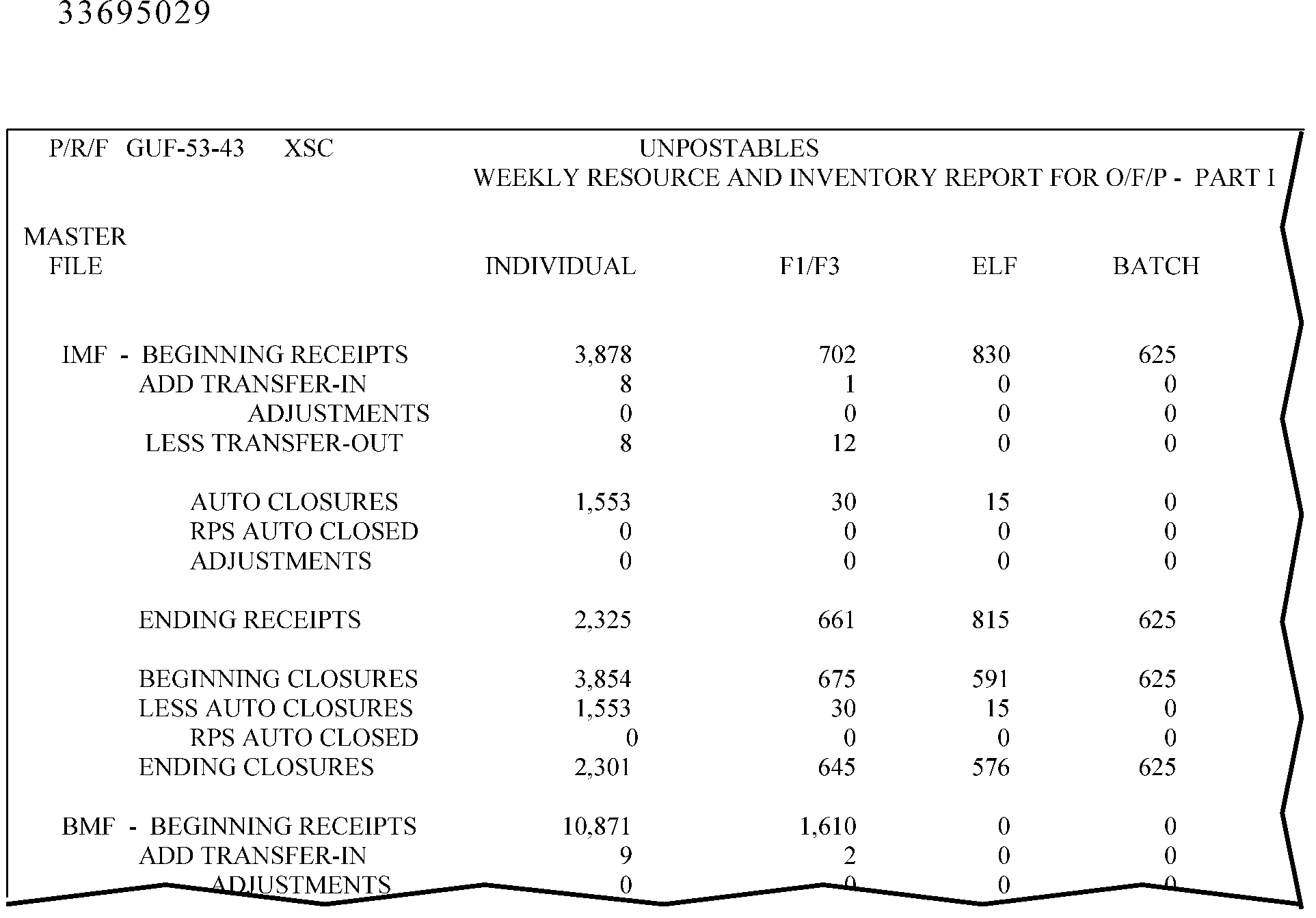
Title: Figure 3.12.32-29, GUF 53-43, Weekly Unpostables Resource and Inventory Report for O/F/P. Pictured is an example of the report described in the text above.
Please click here for the text description of the image.
3.12.32.20.21 (01-01-2021)
GUF 55-40, Unpostable Employee Assignment/Aged List and GUF 55-42, Unpostable Employee Assignment/Aged Summary
-
The GUF 55-40, Unpostable Employee Assignment/Aged List is an inventory listing generated from GUF for all open cases for each employee assignment number (campus, unit, or individual).
-
The listing generates for each Area including Criminal Investigation, Entity, Examination, Statutes, Unpostables, EPMF Entity Unpostable, Exempt Organization, AMTAP and Appeals.
-
Separate sub-listings generate for each employee assignment number within each area.
-
The list sort in ascending order as follows:
-
Area
-
Employee Assignment Number
-
Master File
-
Category Code
-
Status Code
-
History indicator "H"
-
Cycles Aged
-
Cycle Sequence Number
-
-
The list displays the following elements for each unpostable case:
-
Master File
-
Category Code
-
Status code and date
-
History indicator "H"
-
Sequence number
-
Overaged or potential overaged indicator
-
Cycles Aged
-
Document Locator Number (DLN)
-
TIN and TIN validity indicator ("I" )
-
Name Control
-
MFT
-
Tax period
-
Transaction code
-
Refund return indicator
-
Unpostable and reason code
-
Pre-journalized money amount
-
Transaction date
-
Reassignment employee number
-
Statute indicator ("S" or "*" )
-
ASED
-
-
Each employee number sub-listing contains the following totals at the bottom:
-
Total this employee
-
Aged
-
Potential Aged
-
Assigned Status
-
Files Request Status
-
MFTRA Request Status
-
Correspondence Action Status
-
Other Suspense Status
-
Quality Hold Status
-
Quality Accepted
-
Closed Status
-
Potential Statute
-
Repeat Code
-
-
See Figure 3.12.32-30, an example of the GUF 55-40, UP Employee Assignment/Aged List.
Figure 3.12.32-30
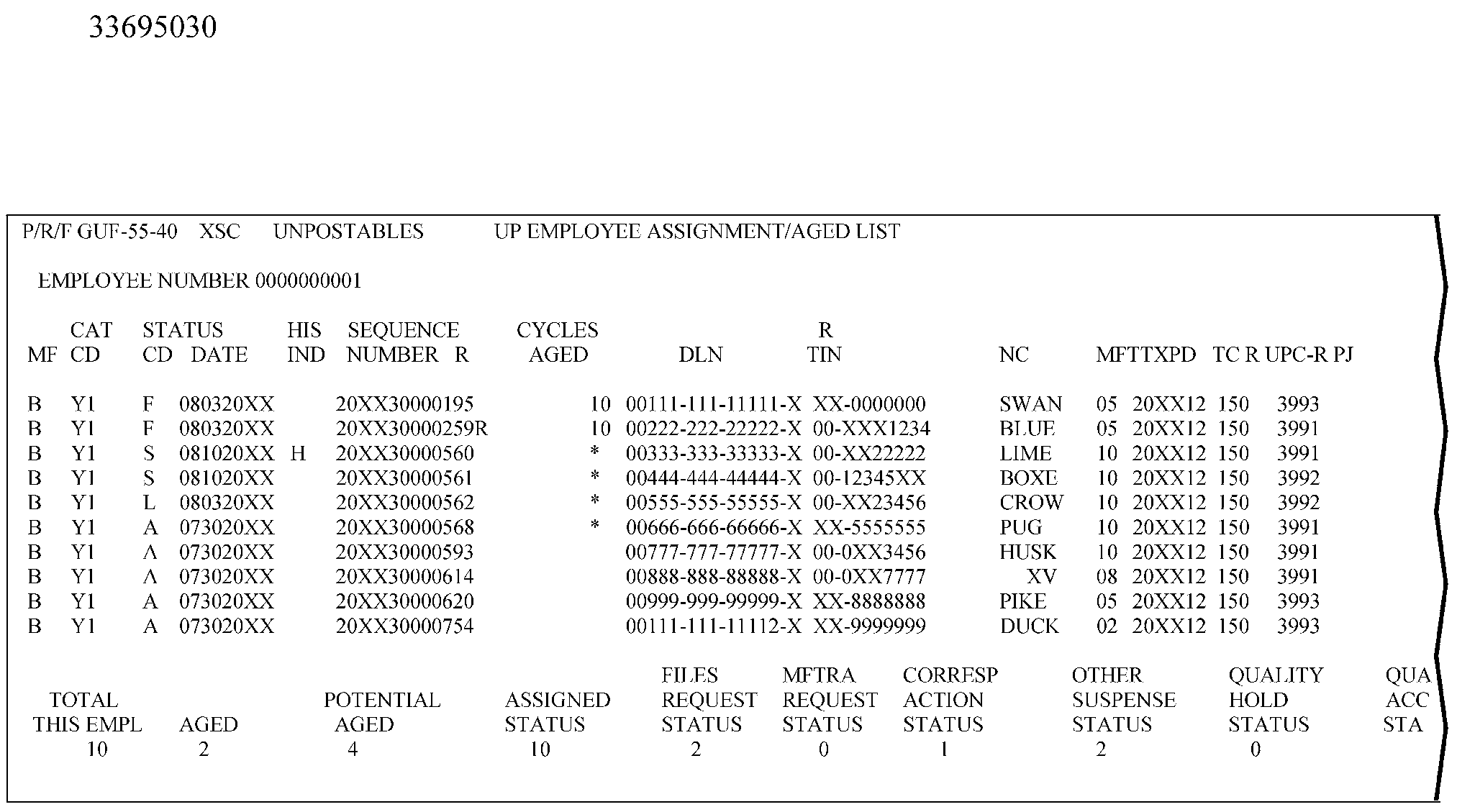
Title: Figure 3.12.32-30, GUF 55-40, UP Employee Assignment/Aged List. Pictured is an example of the report described in the text above.
Please click here for the text description of the image.
-
Under the Cycles Aged Column, the report identifies cases that have exceeded the maximum processing cycle or will become aged in the subsequent week. The potential aged indicator (*) is set in the cycle prior to the cycle a transaction will become overaged.
-
Bankruptcy cases are reflected on this list, but this is not a bankruptcy aged list.
-
See IRM 3.12.32.21, Unpostable Category Code Aging Criteria Chart, for the specific aging criteria related to each category code.
-
A "Campus" or "unit number" With-Remittance (ISRP/RPS) TC 610 record will be identified as aged on the GUF 55-40 per the following:
-
If the case is an IMF record and the current unpostable cycle minus the original unpostable cycle is greater than "29."
-
If BMF record and the current unpostable cycle minus the original unpostable cycle is greater than "19."
-
-
A With-Remittance (ISRP/RPS) TC 610 record must be reassigned to an individual employee IDRS number.
-
Management will monitor aged cases and ensure the overage percentage does not exceed established guidelines.
-
Each employee will follow-up on the status of their aged cases and take the necessary action to expedite the resolution of each case per applicable IRM procedures.
-
The GUF 55-40 provides a case workload and status report for each employee IDRS number.
-
It may be used by management to identify and to determine future assignments for employee and control purposes.
-
It may be used by employees to identify, resolve and monitor their current case assignments.
-
-
Statute cases: The GUF 55-40 report is a working tool to show unpostable cases that originally did not meet statute criteria but are now approaching statute criteria. It will identify TC 150 cases with MFT 02, 05, 30, 33, or 34 that are within 90 days of their assessment statute expiration date (ASED). Each week the new cases will be highlighted with an asterisk (*).
-
Employee and management should review the list to prevent any loss of revenue from potentially assessable cases.
-
If the case cannot be closed immediately, it should be reassigned to the Statute function.
-
-
The GUF 55-42, Unpostable Employee Assignment/Aged Summary report provides summary volumes of the cases shown on the GUF 55-40 Unpostable Employee Assignment/Aged List.
-
For each employee number, the listing provides the number of cases in each category:
-
Total
-
Aged
-
Potential Aged
-
Assigned Status
-
Files Request Status
-
MFTRA Request Status
-
Correspondence Action Status
-
Other Suspense Status
-
Quality Hold Status
-
Quality Accepted
-
Closed Status
-
Potential Statute
-
Repeat Code
-
-
After volumes for each employee number, the report shows total volumes for all employee numbers. The last line of the report identifies how many cases are overage in each range of cycles:
-
<15 CYC (less than 15 cycles)
-
15-29 CYC (15 to 29 cycles)
-
30-51 CYC (30 to 51 cycles)
-
52+ CYC (52 cycles and more)
-
-
See Figure 3.12.32-31, an example of the format for the GUF 55-42, UP Employee Assignment/Aged List.
Figure 3.12.32-31
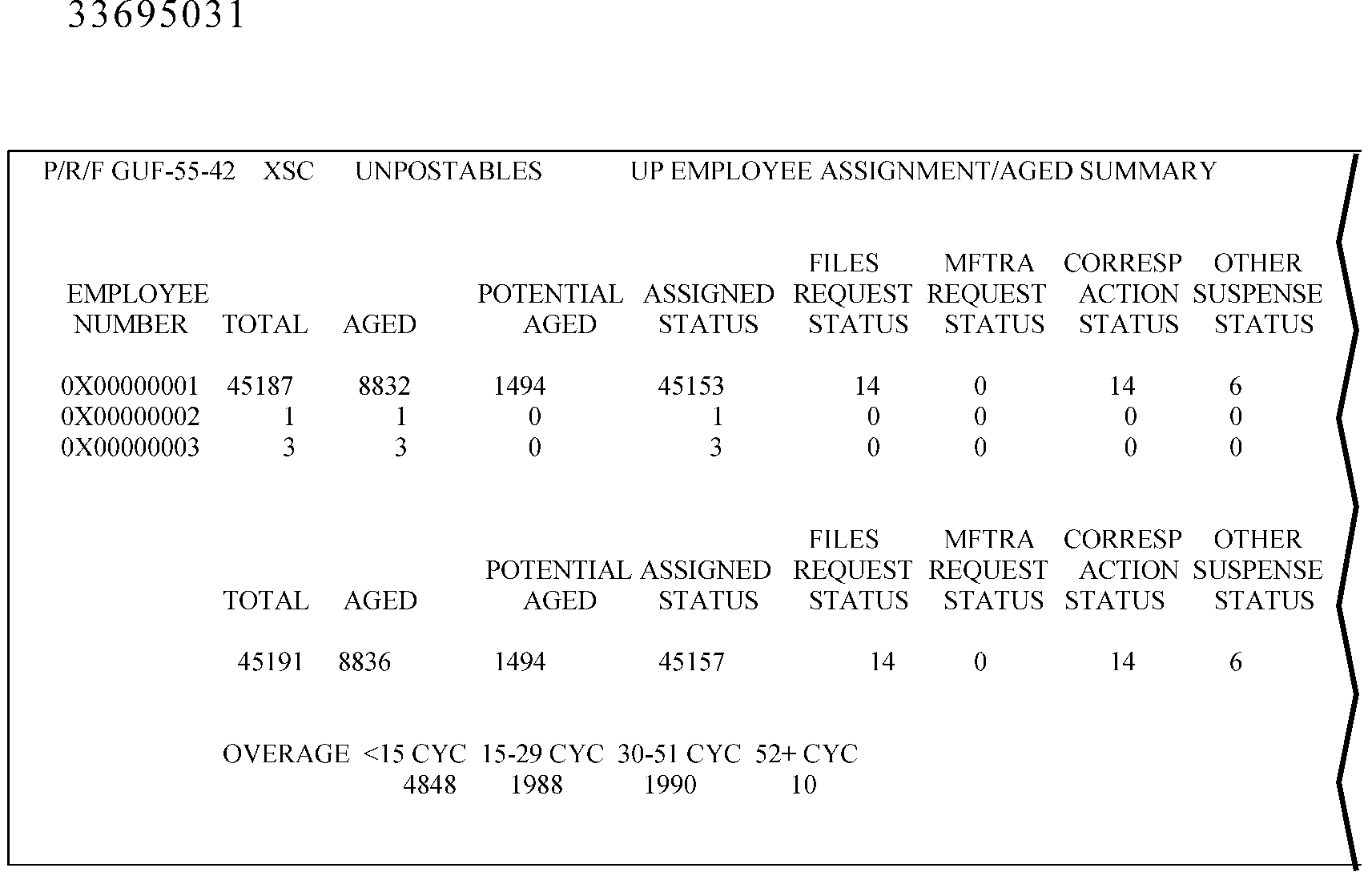
Title: Figure 3.12.32-31, GUF 55-42, UP Employee Assignment/Aged List. Pictured is an example of the report described in the text above.
Please click here for the text description of the image.
3.12.32.20.22 (01-01-2021)
GUF 55-41, Open Bankruptcy Unpostable Cases and Campus Bankruptcy Summary
-
The GUF 55-41, Open Bankruptcy Unpostable Cases report is a weekly cumulative listing of all "old" and "new" open (unresolved) bankruptcy unpostables cases.
-
The report is sorted by Master File (MF), Area Office (AO) of the posted TC 520 or MF primary location code (Area Office). A separate list for each Area Office is sorted in TIN sequence.
-
The listing provides the following information about each case:
-
NEW IND ( display of an (*) is an indication of a new case)
-
DLN
-
TYPE-TIN
-
Name CTRL (Name Control of the return)
-
MFT
-
Tax Period
-
Transaction Code
-
Trans Date
-
PJ Amount
-
Master File Name Control
-
Master File Name Line
-
Sequence Number
-
Petition Date
-
-
The total number of cases per Area Office and the total pre-journalized money amount is provided at the end of each AO bankruptcy list.
-
The GUF 55-41 also contains the "Summary of Unpostable Bankruptcy Cases" (UPC 171 and 322) listing. This is a weekly cumulative summary listing containing:
-
The total number of bankruptcy records (old and new) for each Area Office and Service Center.
-
The total pre-journalized money amount for each Area Office and Service Center.
-
-
A second unpostable bankruptcy case listing is generated on the GUF 55-41 in name control order. The Name Control List of Open Bankruptcy Unpostable Cases contain the same data as the "List of Unresolved Unpostable Bankruptcy Cases."
-
The total volume of cases on the GUF 55-41, "List of Unresolved Bankruptcy Cases and Campus Bankruptcy Summary" should agree with the volume shown on the GUF 53-41, "Unpostable Workload Report."
-
All records on the lists are in Category Z1. See the Category Z1 information on bankruptcy case identification.
-
The bankruptcy listings are used to identify cases and route bankruptcy information to the Area Offices. Cases will be maintained under the unit number and never placed in suspense status, while waiting for processing guidance from the Compliance Area Office.
-
See Figure 3.12.32-32.
Figure 3.12.32-32
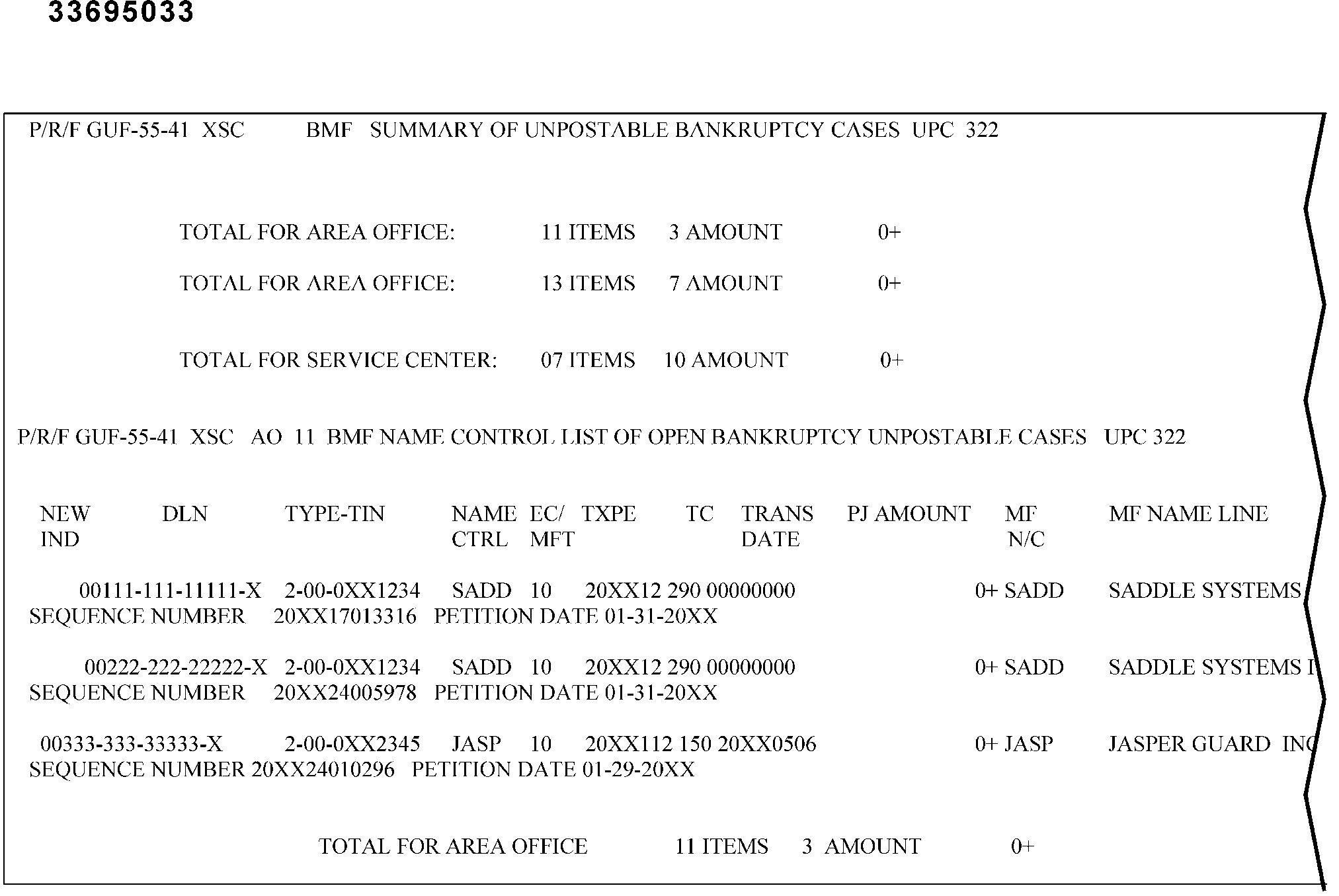
Title: Figure 3.12.32-32, GUF 55-41, BMF Summary of Unpostable Bankruptcy Cases and Name Control List of Open Bankruptcy Unpostable Cases. Pictured are two sections from the GUF 55-41 as described in the text above.
Please click here for the text description of the image.
3.12.32.20.23 (01-01-2021)
GUF 55-43, Unpostable Inventory Report
-
The GUF 55-43, Unpostable Inventory Report displays the current inventory of unpostables by specific unpostable and reason code. Use this report as a management tool to identify:
-
Volume and percentage of aged of specific unpostable and reason codes
-
Volume of refund returns for MFT 02, 05, 30, 33, 34 or 44
-
Incorrect area/function assignments for UPC
-
Ending inventory, workable, unworkable and subsequent closing volumes
-
-
Use the report to identify certain inventory bottlenecks when reviewing the data or to review specific causes of unpostables (e.g., Refund UPC 140).
-
GUF generates the report weekly for each Master File and functional area.
-
The report is sorted in ascending order as follows:
-
Functional Area
-
Master File
-
Unpostable Code (UPC)
-
Reason Code
-
-
The following lists the categories of the report, volume of UPC and reason code cases:
-
Prior Receipts
-
New Receipts
-
Closed
-
Ending Inventory
-
Ending Inventory - Workable
-
Ending Inventory - Unworkable
-
Subsequent Closure
-
Aged
-
Aged Percentage
-
Refund Returns
-
-
Each functional area begins a new page.
-
Each UPC and Reason Code (RC) is listed on a separate line.
-
Each UPC provides a separate line containing the total volumes, including all reason codes.
-
The report will skip one (1) line whenever the UPC changes and between UPC totals.
-
See Figure 3.12.32-33
Figure 3.12.32-33
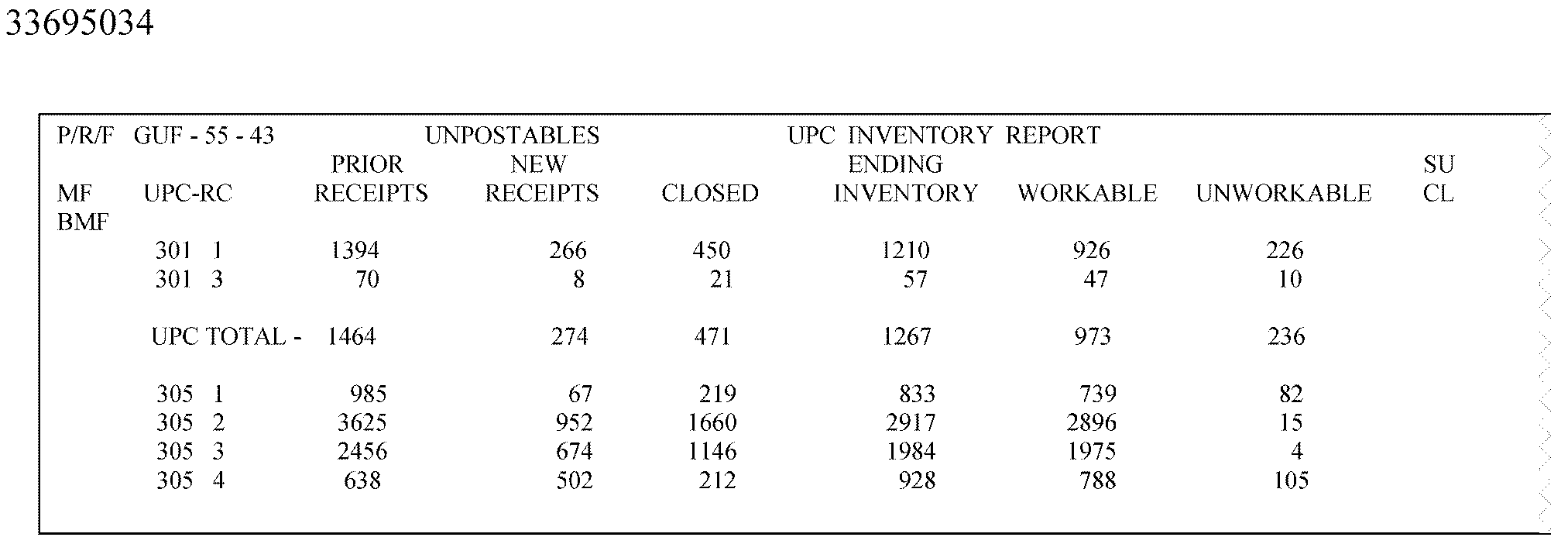
Title: Figure 3.12.32-33, GUF 55-43, UPC Inventory Report. Pictured is an example of the report described in the text above.
Please click here for the text description of the image.
3.12.32.20.24 (01-01-2021)
GUF 55-45, Centralized Authorization File (CAF) Unit Weekly Historical Unpostable Report
-
The GUF 55-45, CAF Unit Weekly Historical Unpostable Report identifies the following:
-
TIN TYPE
-
TIN
-
DLN
-
TRANSACTION CODE
-
MFT
-
PLAN NUMBER
-
TAX PERIOD
-
NAME CONTROL
-
UPC
-
REASON CODE
-
UNPOSTABLE RESOLUTION CODE
-
NEW TRANSACTION CODE
-
NEW TIN TYPE
-
NEW TIN
-
NEW MFT
-
NEW PLAN NUMBER
-
NEW TAX PERIOD
-
NEW NAME CONTROL
-
NEW TRANSACTION CODE
-
EMPLOYEE NUMBER RESOLUTION
-
-
The CAF count excludes Reporting Agent’s File (RAF) cases.
-
See Figure 3.12.32-34, for an example of the CAF Unit Weekly Historical UP Report:
Figure 3.12.32-34
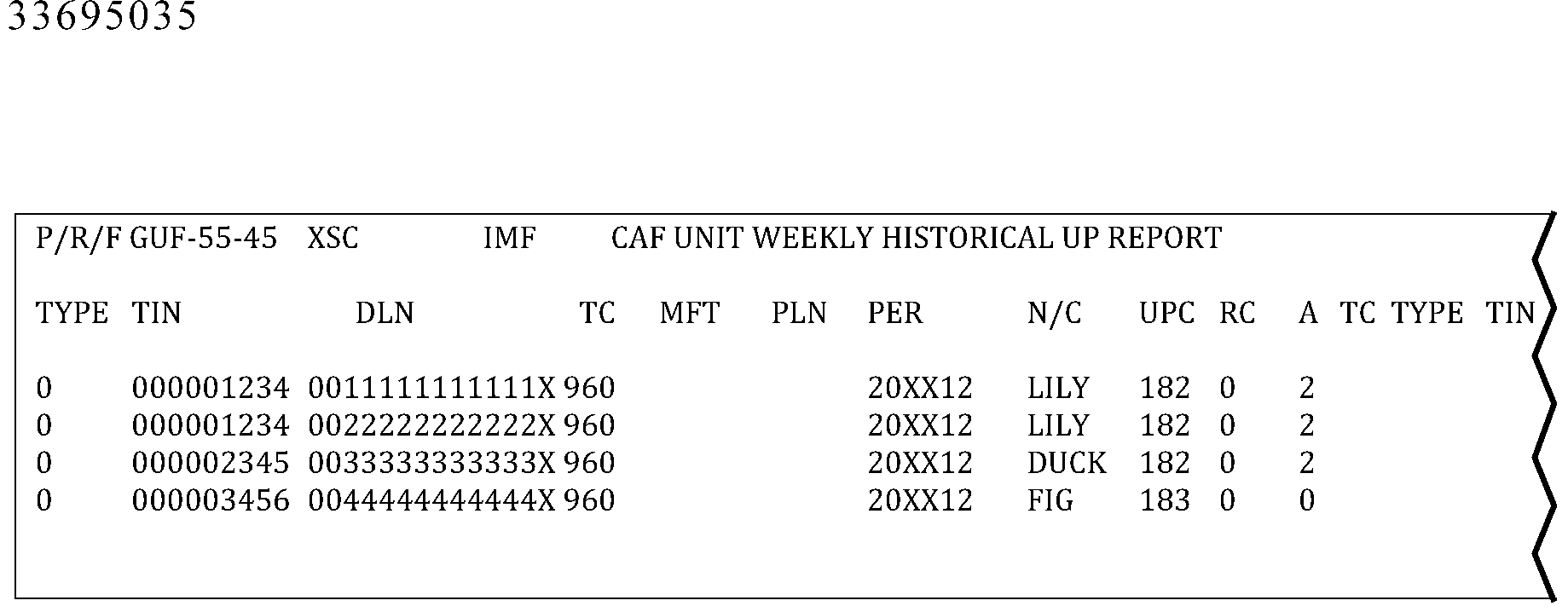
Title: Figure 3.12.32-34, GUF 55-45, CAF Unit Weekly Historical UP Report. Pictured is an example of the report as described in the text above.
Please click here for the text description of the image.
3.12.32.20.25 (01-01-2021)
GUF 55-46, Nullified Distribution Summary and GUF 55-47, Nullified Distribution Listing
-
The GUF 55-47, Nullified Distribution Listing contains the unpostable cases that are nullified closures (URC "D," "1," "2," or "8" ). Use the report to identify and route closed cases for further action. The report also provides an audit trail for researching closed cases that are either manually or systemically nullified depending on its attributes.
-
The report is separated by Nullify Area which is the area or function responsible for the next processing action. The title is based on the nullify area code input when the unpostable was closed.
-
See IRM 3.12.32.14, Nullify Area Codes for more information.
-
The GUF 55-47, Nullified Distribution Listing is sorted in ascending sequence by closure type - URC "1," "2," "8" and "D" and then by:
-
Area Sort
-
Nullify Area Code
-
AO-SC-KDO Code
-
Master File (MF)
-
IDRS Employee Number or IDRS Control Number
-
DLN
Note:
The IDRS Employee Number will not be part of the sort for URC 1 and 8. The information will continue to print on the listing only.
-
-
The employee number is displayed in two separate areas.
-
IDRS Control number - number assigned by GUF in specific situations.
-
IDRS Employee number - the employee number of the original input transaction.
-
-
A new page will be started each time the URC, Area Sort, Nullify Area Code, AO-SC-KDO Code, MF, or IDRS Employee or Control number changes.
-
Functions can use the Nullified Distribution List as a check list to ensure that all documents received or otherwise accounted for.
-
The area that closes the unpostable will associate any return, document, or IDRS printout (e.g., TXMOD), in their possession, to the Nullified Distribution List.
-
All areas should review their listings and notate when a case is assigned to the wrong area.
-
Any return or document sent directly from Files, will be sent to the proper function and associated to the listings. All Forms 4251, Return Charge-Out, with "Files to Nullify Area" in the recipient field are routed to the preparer.
-
Nullify Area Code "11," "Auto Void/Contact N.O." and Nullify Area Code "13," "Manual Void/Employee Number Problem," will generate whenever a control base cannot be established due to a problem with the employee IDRS number. Unpostables will attempt to identify the problem and take the necessary corrective action. Establish a control base and route the case to the proper function.
Note:
If unable to identify the problem, contact your Planning & Analysis Staff Analyst for assistance in resolving the campus unpostable campus. If the campus is still unable to resolve the unpostable, contact the Unpostable Headquarters Analyst for assistance.
-
See Figure 3.12.32-35 for an example of the GUF 55-47.
Figure 3.12.32-35
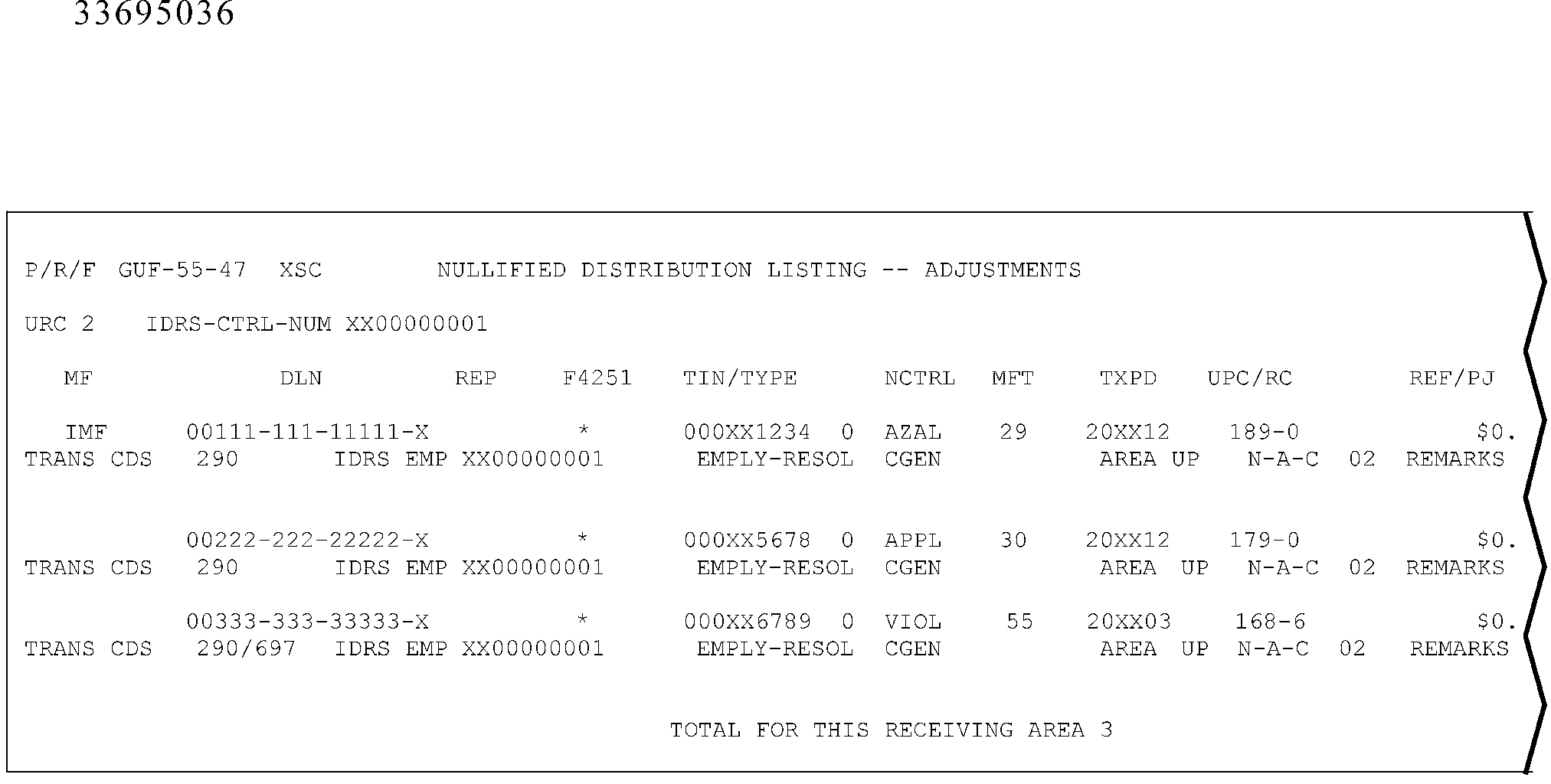
Title: Figure 3.12.32-35, GUF 55-47, Nullified Distribution Listing. Pictured is an example of the report. The report shows the nullified transactions under each IDRS Control Number. The following items are shown for each transaction:Transaction CodeDLNForm 4251 indicatorTINTIN TypeName ControlMFTTax PeriodUnpostable Code/Reason CodePre-journalized AmountIDRS Employee (Originator)Employee Resolution (shows CGEN if systemically closed)Area (Functional Area)NAC (Nullify Area Code)Remarks
Please click here for the text description of the image.
-
The GUF 55-46, Nullified Distribution Summary report generates for the nullified distribution cases.
-
Use the report to provide feedback to the other areas in the Campuses, Area Offices, and National Office.
-
GUF creates a separate page for each receiving area (e.g., Accounts Management) and will be broken down by; Master File (e.g., IMF, BMF, etc.); IDRS Employee Number or IDRS Control Number. Each IDRS employee number displays the total volume of nullified transactions, then the total volume for each Master File and then the total volume for the Receiving Area.
See Figure 3.12.32-36.
Figure 3.12.32-36
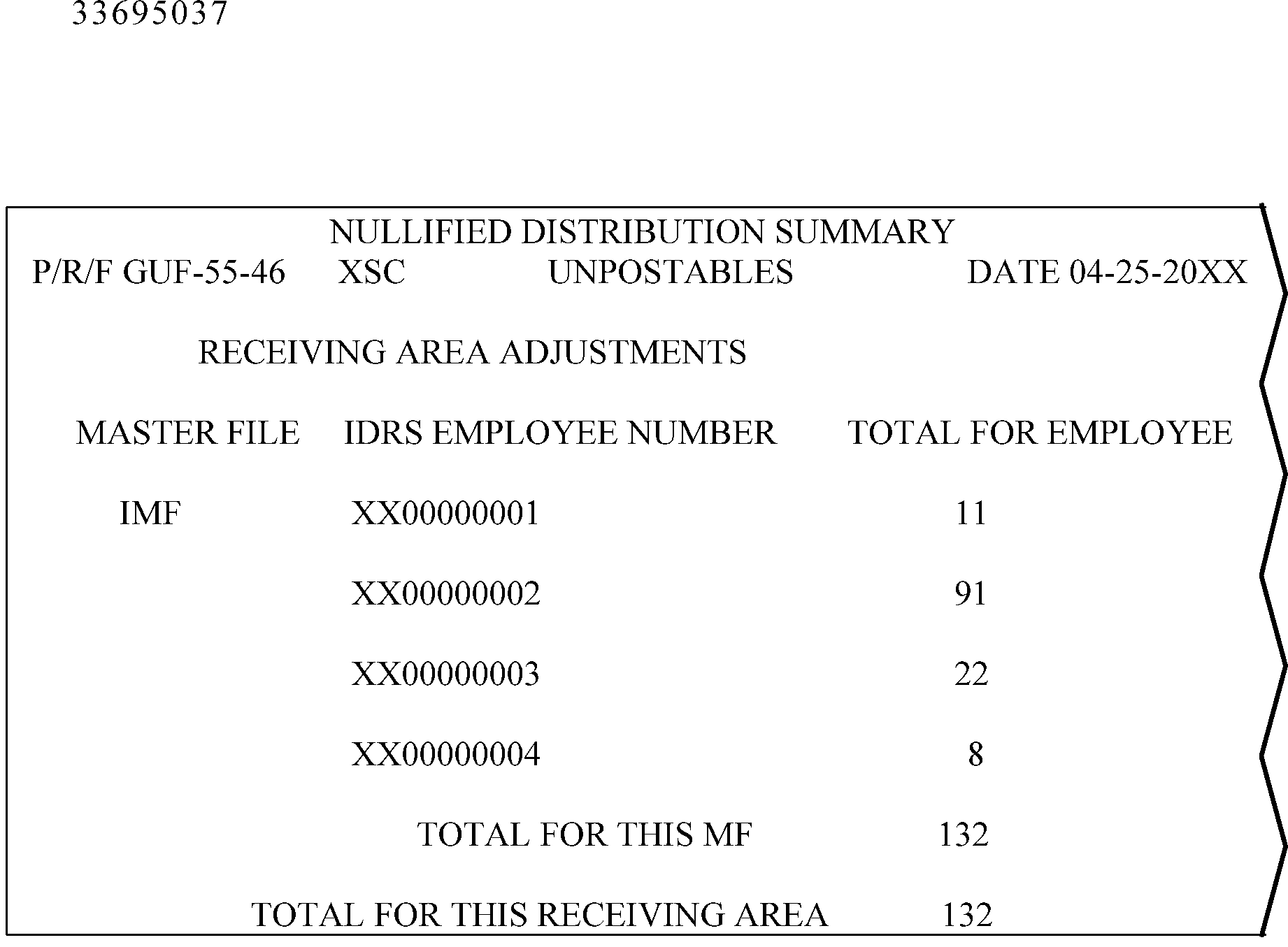
Title: Figure 3.12.32-36, Nullified Distribution Summary Report. Pictured is an example of the report described in the text above.
Please click here for the text description of the image.
-
3.12.32.20.26 (01-01-2021)
GUF 55-48, Weekly CAF Summary Report
-
The GUF 55-48, Weekly CAF Summary Report provides total volumes for the CAF unpostable closures. The report has sections for each Master File and then for each Unpostable Code it lists the following volumes:
-
Total Closures
-
Closures Non-Void
-
Void URC "2"
-
Void URC "D"
-
-
A total is shown for each Master File and a grand total for all Master Files combined.
-
The GUF 55-48, Weekly CAF Summary Report is produced in addition to the GUF 55-45, CAF Unit Weekly Historical UP Report.
-
See Figure 3.12.32-37.
Figure 3.12.32-37
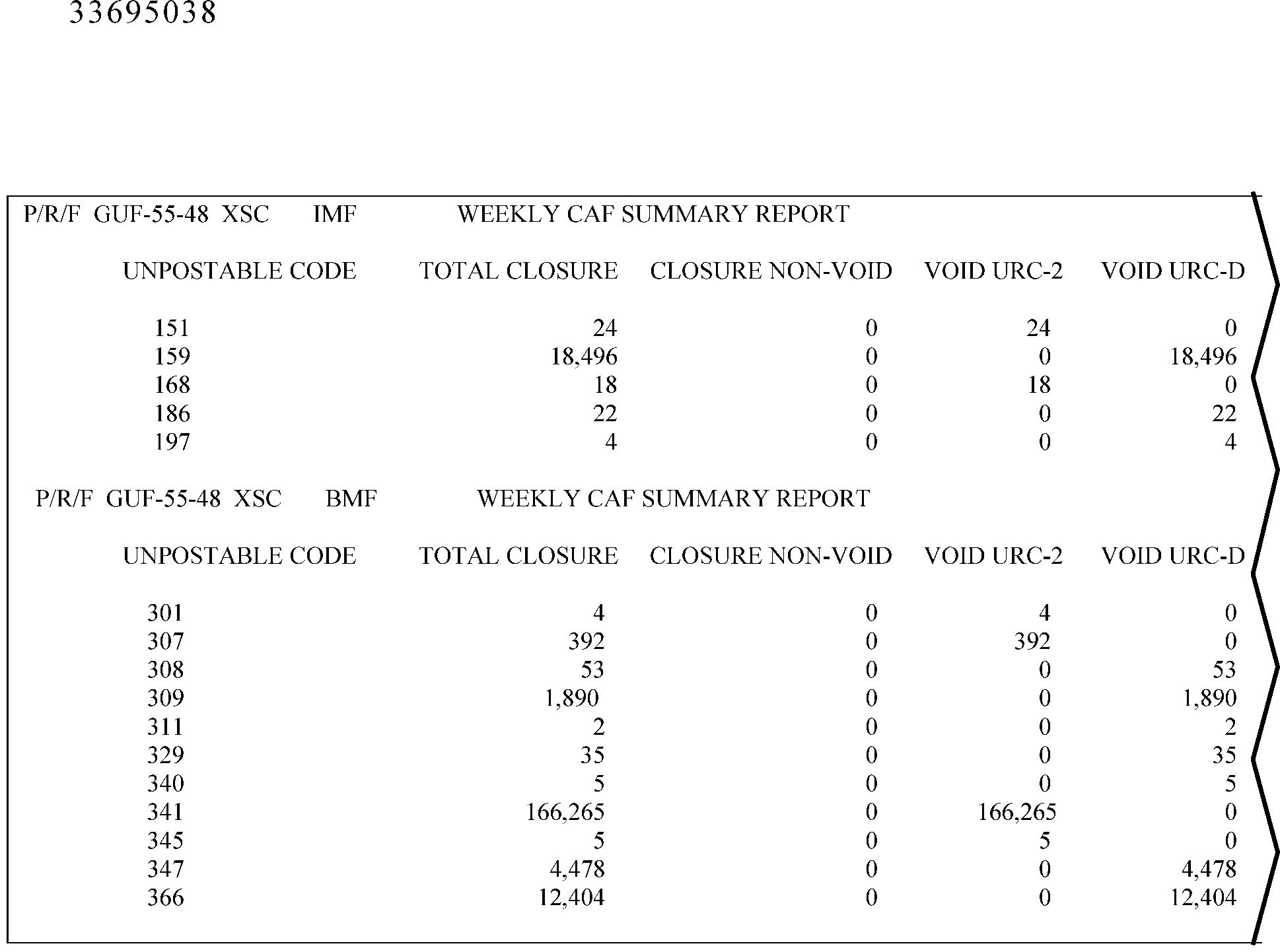
Title: Figure 3.12.32-38, GUF 55-48, Weekly CAF Summary Report. Pictured is an example of the report described in the text above.
Please click here for the text description of the image.
3.12.32.20.27 (01-04-2021)
GUF 57-40, Closed Unpostable Register
-
The GUF 57-40, Closed Unpostable Register report generates a cumulative report of closed unpostables for each Service Center for all master files.
-
The register generates each cycle after the weekly GUF correction. The report displays the closed unpostable records resolved during the quarter. At the end of each quarter, the GUF 57-40 lists records for all cases resolved since the beginning of the year.
-
The GUF 57-40 report generates after the cycle 03 GUF correction run and cumulates the records after the weekly GUF correction run each cycle until the last cycle of the year.
3.12.32.20.28 (01-01-2021)
GUF 60-40, Unpostable PCD Listing and GUF 60-41, PCD Data Control
-
The GUF 60-40, Unpostable PCD Listing report provides a listing of open unpostable cases ready to meet the Program Completion Date (PCD).
-
Request production of this listing as early as 4 weeks prior to the PCD and at the PCD. It is not mandatory to run this listing.
-
Generate the report at other times of the year, as needed by the campus. Campuses Provide CSA notification when to generate the report.
-
The listing contains the following information for the cases assigned to an employee number:
-
Master File
-
Sequence number
-
Repeat Indicator
-
Category Code
-
DLN
-
TYPE/TIN
-
Name Control
-
MFT
-
Tax Period
-
UPC/Reason Code
-
PJ amount
-
Transaction Date
-
Status Code and date
-
History Indicator
-
Total number of cases assigned to the employee
-
-
Use the PCD listing to resolve the cases on an expeditious basis prior to PCD.
-
The following Figure 3.12.32-38 is a sample of the Unpostable PCD Listing.
Figure 3.12.32-38
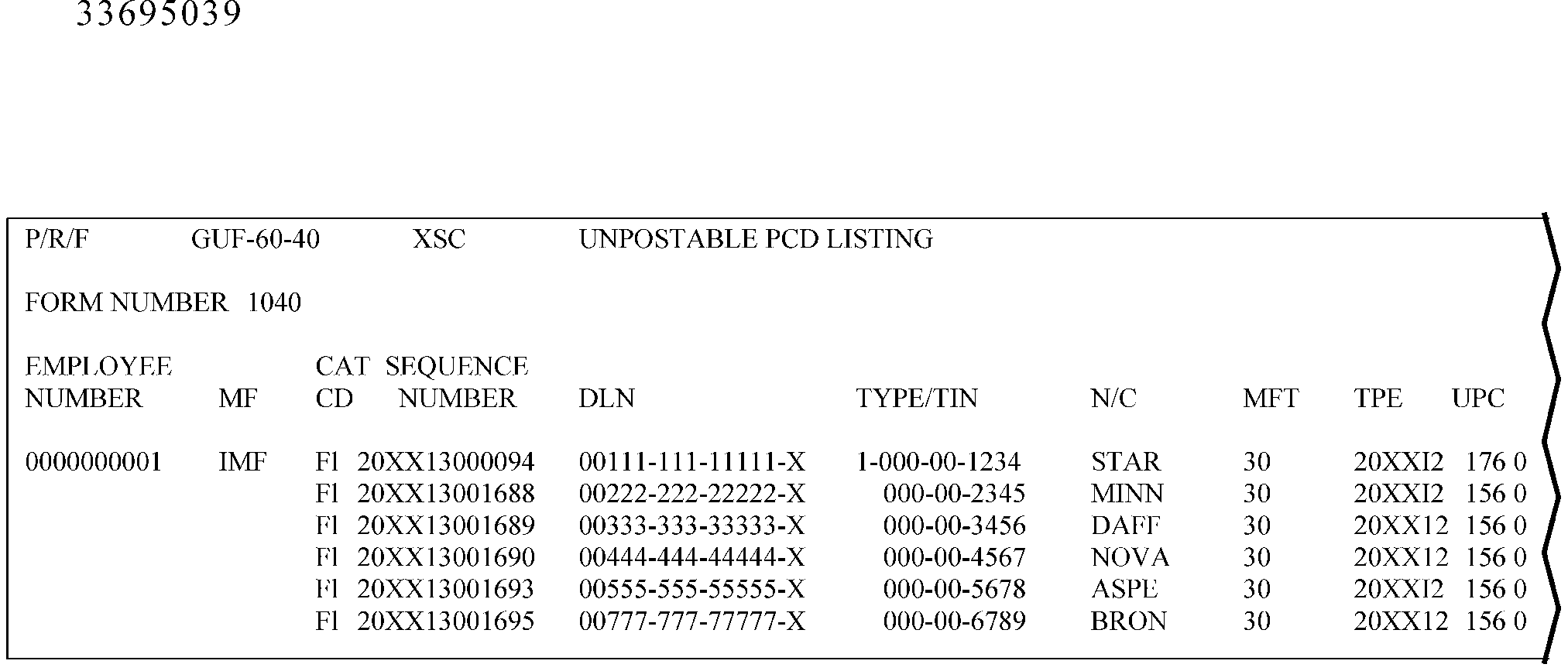
Title: Figure 3.12.32-38, GUF 60-40, Unpostable PCD Listing. Pictured is an example of the report described in the text above.
Please click here for the text description of the image.
-
The GUF 60-41, PCD Data Control report lists each Form type and breaks down the volume of cases by status. The following are a few of the status breakdowns:
-
Cycling
-
Status Date
-
Quality
-
Subsequent Closing Totals
-
Bankruptcy
-
Files Request
-
MRS/Transcript Request
-
Correspondence
-
Suspense - All Other
-
Suspense Total
-
Unworkable Total
-
Service Center Assigned
-
RPS Individual Assigned
-
Unit Assigned
-
Workable Total
-
-
The following Figure 3.12.32-39 is an example of the PCD Data Control Summary Report.
Figure 3.12.32-39
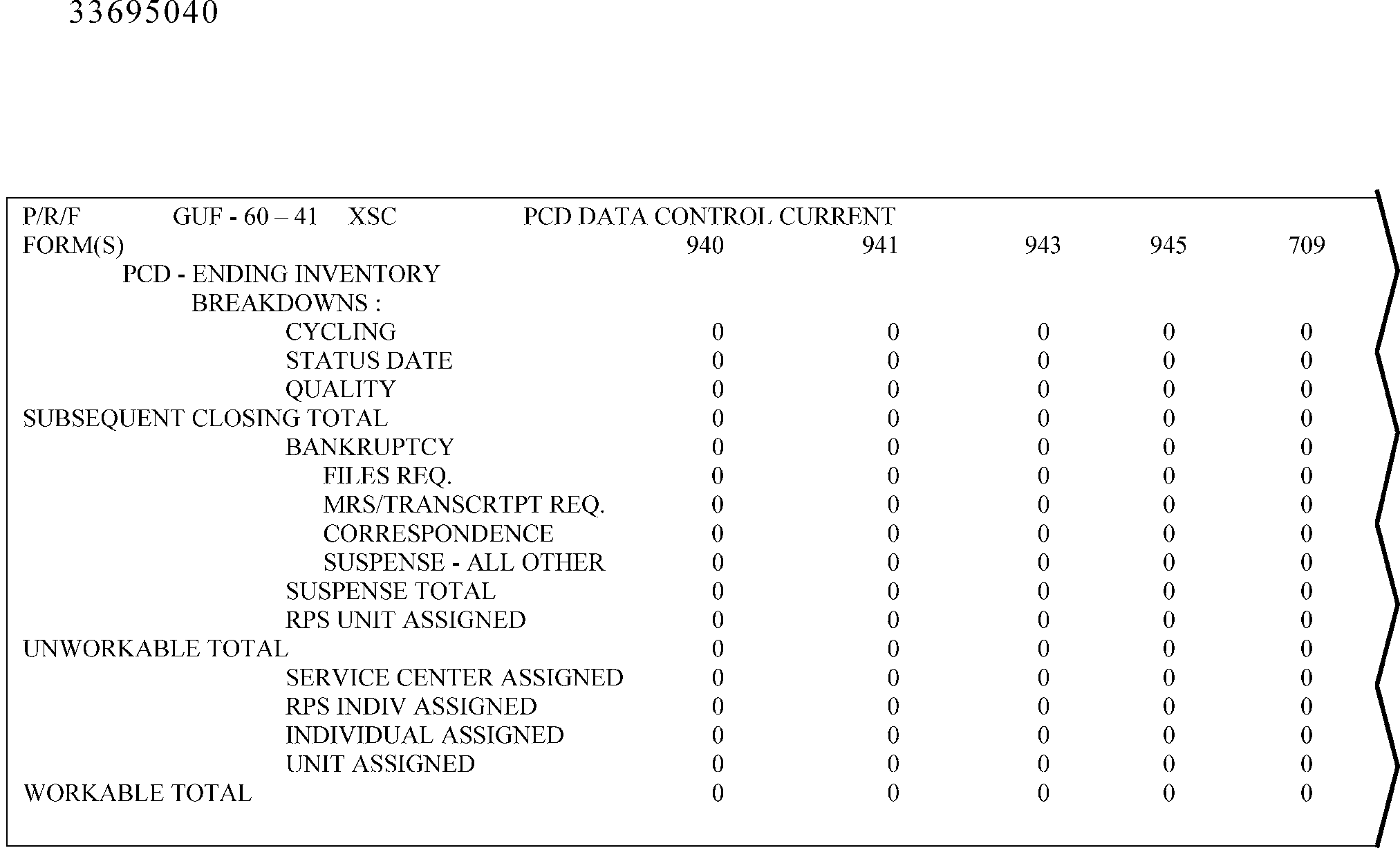
Title: Figure 3.12.32-39, GUF 60-41, PCD Data Control Report. Pictured is an example of the report described in the text above.
Please click here for the text description of the image.
3.12.32.20.29 (01-01-2021)
GUF 87-40, Annual OFP Work Performance and Control Report
-
The GUF 87-40, Annual OFP Work Performance and Control Report contains all unpostable cases remaining in the GUF inventory at the end of the year separated by master file and type of closure for the Organization, Function and Program (OFP).
-
This report is produced one time, at the end of the year.
-
It is produced for all unpostable functions (Exam, Entity, CI, Statutes and Unpostables).
-
Use this report as a management tool to match the volumes against the ending inventory shown on the Work Performance & Control (WP&C) report.
-
Adjust the WP&C when the volumes don't match.
-
Take no action when the volumes match.
Note:
The total volumes on this report should match the ending inventory volumes on the GUF 53-41 "Workload Report." Batch volumes will always be zero (0).
-
-
See Figure 3.12.32-40 for an example of the GUF 87-40 report.
Figure 3.12.32-40
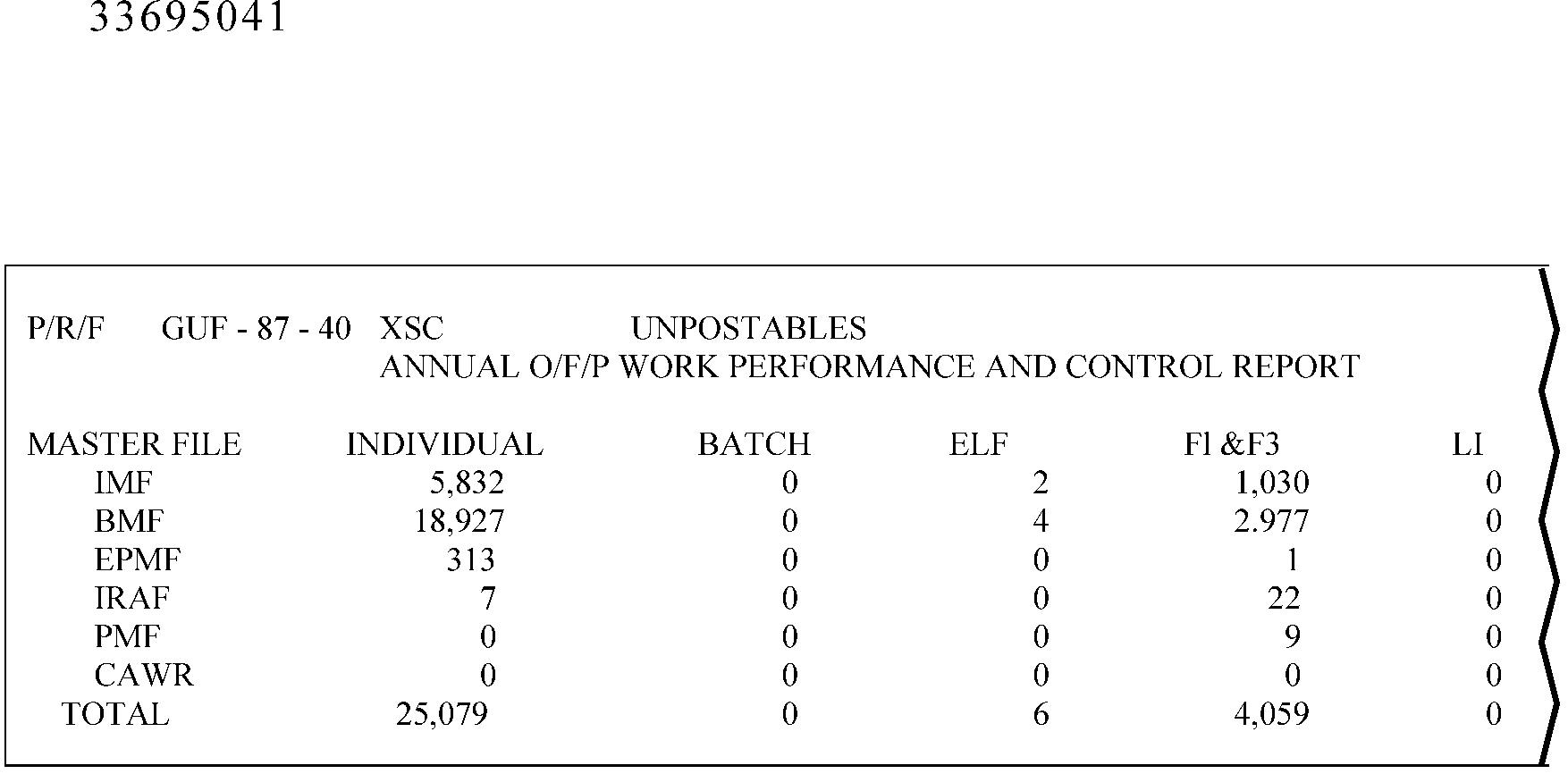
Title: Figure 3.12.32-40, GUF 87-40, Unpostables Annual O/F/P Work Performance and Control Report. Pictured is an example of the report. The report lists each master file and then provides inventory volumes for the following types of unpostable cases:INDIVIDUALBATCHELFF1 and F3L1The total line has the total for all Master Files by case type.
Please click here for the text description of the image.
3.12.32.21 (01-01-2022)
Unpostable Category Aging Criteria Chart
-
The following chart identifies how many unpostable cycles pass before a transaction in the specific category is considered aged.
Category Code Category Name Aged if the Current Cycle minus the Original Cycle is greater than: A1 Criminal Investigation (CI) 10 A6 Appeals 10 B1 Entity Control 10 B3 Exempt Organization (EO) Unpostables 10 B4 Employee Plan Master File (EPMF) Unpostables 10 B5 Entity Control - 1120S, 1065, or 1041 Unpostables 15 B6 Exempt Organization E-Post filings 10 C1 Statute Reject Batch 3 C2 Statute Void Batch 3 C3 Potential Statutes 5 C5 Credit Interest Returns 5 D1 Accounts Management No Change 5 D5 Accounts Management Void Batch 3 E1 Examination Changes 10 E2 Examination Statutes 5 E3 Examination Void Batch 3 F1 Name Control Files 5 UPC 501 (PMF) = 15 F3 Files Unpostables 5 UPC 503 (PMF) = 15 G1 Electronic Federal Tax Payment Transactions 5 I1 Identity Theft 10 I2 IDT - AMTAP 10 I4 IDT - LOCK NA L1 Foreign Operations (International) 15 L3 All Other/No Documents 10 L5 All Other with Documents 10 L7 Credit Transfers and Bad Checks 10 P1 PMF Generated Transactions 3 R1 Reject Batch Transactions 3 TI Identity Theft - TPP 10 V1 Batch Void with Document 3 V3 Batch Void No Document 3 V6 IRDM Generated Transactions 3 V7 Centralized Authorization File (CAF) 10 V8 Combined Annual Wage Reporting (CAWR) 15 W1 Records with Transcripts 10 W3 Documents and Transcripts 10 W5 Retention Register Micro 10 Y1 With-Remittance (ISRP/RPS) Batch TC 150 = 5 TC 610 = 10 Y2 With-Remittance ISRP/LB Prior Year and Repeats 5 Z1 Bankruptcy 3 Z2 Bankruptcy Freeze 3